
Tasas de Éxito de la FIV por Edad: Expectativas Realistas Basadas en Datos Actuales
Tasas de éxito de la FIV por edad explicadas con datos actuales de SART y HFEA: tasas de nacidos vivos por ciclo en cada edad, qué afecta tus probabilidades y cómo tener una conversación honesta con tu clínica.
Probar herramientas relacionadas
Use our informadas por fuentes calculators to get helpful insights.
Índice
(El índice se generará automáticamente aquí mediante el plugin.)
Cuando estás considerando la Fecundación In Vitro (FIV), a pergunta que você mais precisa que seja respondida raramente é respondida com total honestidade: ¿cuáles son las probabilidades reales de que este tratamiento resulte en un bebé que llevarás a casa?
No un test positivo. No un embarazo clínico. Un bebé vivo en tus brazos.
Las clínicas de FIV presentan sus estadísticas de muitas maneiras diferentes — taxas de gravidez, taxas de gravidez clínica, taxas de transferência de embriões, taxas por ciclo, taxas cumulativas — e as diferenças entre esses números são enormes. Uma clínica que relata "50% de sucesso" pode estar relatando gestações clínicas por transferência de embrião em mulheres com menos de 35 anos com bom prognóstico. A taxa de nascidos vivos por ciclo iniciado para todas as idades na mesma clínica pode ser menos da metade desse valor.
Entender como ler as estatísticas da FIV honestamente — quais números pedir, o que os afeta e o que é realista para a sua idade e circunstâncias específicas — é uma preparação essencial para uma das decisões mais importantes (e emocionalmente intensas) que você tomará.
Esta guía acogedora y objetiva, revisada por la Dra. Preeti Agarwal, MBBS, D.G.O., baseia-se em dados atuais da Sociedad de Tecnología de Reproducción Asistida (SART, EE. UU.) y la Autoridad de Fertilización Humana y Embriología (HFEA, Reino Unido) para lhe dar a imagem mais precisa e realista disponível.
Estima tus probabilidades en FIV
Nossa Calculadora de Éxito FIV combina idade, diagnóstico e histórico de ciclos para gerar uma estimativa de probabilidade de sucesso personalizada com base em dados de resultados publicados. Nossa Calculadora de Fecha de Parto FIV pode ajudá-la a planejar tudo assim que você estiver grávida.
El número más importante: tasa de nacidos vivos por ciclo iniciado
Antes de examinar dados específicos por idade, entender em qual estatística se concentrar é fundamental.
Por qué la "tasa de embarazo" es engañosa
La mayoría de las clínicas de FIV históricamente informaban taxas de gravidez clínica — a proporção de ciclos em que um batimento cardíaco fetal foi detectado no ultrassom às 6–7 semanas. Este número é significativamente maior do que a taxa de nascidos vivos porque não leva em conta:
- Perdas precoces da gravidez (abortos espontâneos, que são significativamente mais comuns com a FIV, particularmente em mulheres mais velhas)
- Complicações no final da gravidez
- Ciclos que foram cancelados antes da transferência do embrião (devido à má resposta aos medicamentos, ausência de fertilização ou nenhum embrião sobrevivente)
Uma clínica que relata uma taxa de gravidez clínica de 55% pode ter uma taxa de nascidos vivos de 40% — ou menos.
El número que debes pedir
Taxa de nascidos vivos por ciclo iniciado — também chamada de taxa de parto de nascido vivo por extração de óvulos pretendida nos relatórios atuais da SART.
Esta é a medida mais conservadora e mais honesta: o número de mulheres que iniciaram um ciclo de FIV a fresco (tomaram injeções, tiveram uma tentativa de punção/captação) e, finalmente, levaram um bebê vivo para casa, dividido pelo número total de ciclos iniciados.
Sempre pergunte à sua clínica: "Qual é a sua taxa de nascidos vivos por ciclo iniciado, estratificada pela idade da paciente?"
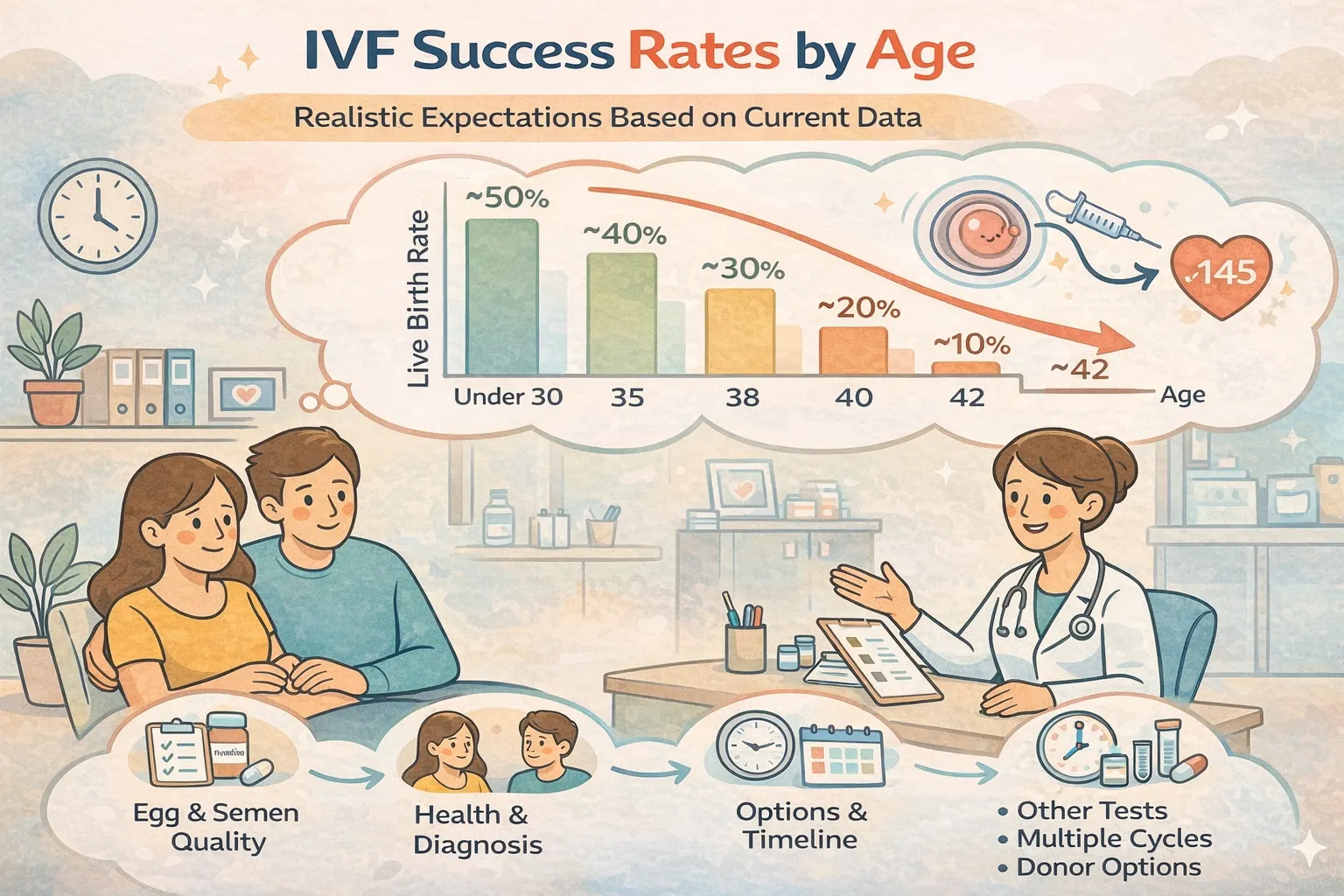
Tasas de nacidos vivos en FIV por edad: datos actuales
Os dados a seguir são extraídos dos relatórios de resultados nacionais publicados mais recentemente pela SART e pela HFEA. Estas são médias nacionais — os resultados individuais da sua clínica podem ser diferentes.
Usando Óvulos Próprios (Ciclos a Fresco)
| Faixa Etária | Taxa de Nascidos Vivos Por Ciclo Iniciado |
|---|---|
| Menos de 35 | 40–48% |
| 35–37 | 31–38% |
| 38–40 | 20–26% |
| 41–42 | 11–15% |
| 43–44 | 5–7% |
| Mais de 44 | 2–4% |
Usando Óvulos Próprios (Transferência de Embrião Congelado — TEC)
Os ciclos de transferência de embriões congelados (TEC ou FET, em inglês) usando embriões de uma captação anterior tornaram-se a abordagem dominante em muitas clínicas, oferecendo:
- A capacidade de biopsiar embriões para testes genéticos pré-implantacionais (PGT-A)
- Um ambiente endometrial mais receptivo (evitando a síndrome de hiperestimulação ovariana do ciclo a fresco)
- Flexibilidade no cronograma
| Idade na Captação dos Óvulos (TEC usando embriões próprios) | Taxa de Nascidos Vivos Por Transferência |
|---|---|
| Menos de 35 | 45–52% |
| 35–37 | 36–43% |
| 38–40 | 26–33% |
| 41–42 | 15–20% |
| 43–44 | 8–12% |
Por que as taxas de TEC são frequentemente mais altas do que as a fresco: O endométrio está mais bem preparado em um ciclo congelado — o ambiente hormonal do ciclo de transferência é controlado com precisão e a hiperestimulação ovariana está ausente. Isso melhora bastante as taxas de implantação.
Usando Óvulos de Doadora (Ovodorecepção)
Quando óvulos de doadora são usados, a taxa de nascidos vivos é determinada principalmente pela idade da doadora (tipicamente menos de 35 anos na maioria dos programas) em vez da idade da receptora. A idade da receptora tem um efeito adicional relativamente modesto.
| Idade da Receptora | Taxa de Nascidos Vivos Por Transferência (Óvulos de Doadora) |
|---|---|
| Menos de 40 | 47–55% |
| 40–44 | 43–52% |
| 45–49 | 38–48% |
| 50+ | 30–42% |
A consistência relativa das taxas de sucesso de óvulos de doadoras em todas as idades das receptoras demonstra claramente que o sucesso decrescente da FIV em mulheres mais velhas usando seus próprios óvulos é principalmente uma função da qualidade do óvulo, não da receptividade uterina.
"Esta é uma das percepções clínicas mais importantes que compartilho com pacientes com mais de 40 anos que consideram opções de tratamento", diz a Dra. Preeti Agarwal. "O útero não envelhece tão rapidamente quanto os óvulos. O útero de uma mulher de 44 anos pode carregar com muito sucesso uma gravidez com um óvulo de doadora — são os óvulos que carregam o risco mais significativo relacionado à idade. Esta não é uma razão para correr apressadamente para a ovodoação, mas é um contexto crucial para discutir opções realistas."
Taxas Cumulativas de Nascidos Vivos: O Quadro Geral
Os números acima representam um único ciclo. A maioria dos pacientes que consegue um nascido vivo através da FIV o faz ao longo de vários ciclos, e as taxas de sucesso cumulativas são significativamente mais encorajadoras do que as taxas por ciclo.
Os dados da HFEA mostram que após até 6 ciclos de FIV usando óvulos próprios:
| Idade | Taxa Cumulativa de Nascidos Vivos (Até 6 Ciclos) |
|---|---|
| Menos de 35 | 79–85% |
| 35–37 | 63–72% |
| 38–39 | 46–55% |
| 40–42 | 27–35% |
| 43–44 | 14–20% |
Esses números cumulativos incluem transferências de embriões a fresco e congelados de todas as captações e representam muito melhor a verdadeira probabilidade de sucesso para pacientes que conseguem (financeira e emocionalmente) continuar o tratamento.
Ressalvas importantes:
- Estes números representam pacientes que completaram vários ciclos — aquelas que interromperam o tratamento devido ao custo, carga emocional ou mau prognóstico não estão incluídas nos dados dos ciclos 4 a 6, o que introduz um viés de seleção.
- Nem todo mundo produz embriões viáveis para vários ciclos, particularmente em idades mais avançadas.
- Algumas pacientes alcançam o sucesso no primeiro ciclo; outras não conseguem mesmo após seis.
Fatores Que Afetam as Taxas de Sucesso da FIV Além da Idade
A idade é o fator preditivo mais importante para o sucesso da FIV, mas não é o único. Esses fatores modificam significativamente o resultado:
Reserva Ovariana
Avaliada pelo Hormônio Antimülleriano (AMH) e pela contagem de folículos antrais (CFA) no ultrassom, a reserva ovariana mede a quantidade de óvulos restantes. A baixa reserva ovariana em qualquer idade está associada a números reduzidos de extração de óvulos, menos embriões viáveis e taxas mais baixas de nascidos vivos.
No entanto, os testes de reserva medem a quantidade, não a qualidade. Algumas mulheres com AMH baixo produzem poucos óvulos, mas de excelente qualidade; outras com AMH mais alto têm óvulos de má qualidade. Os testes de reserva ajudam a prever a resposta à estimulação, mas são preditores imperfeitos do resultado final.
Se você deseja entender o quadro da sua própria reserva ovariana, nosso Previsor de Níveis de AMH interpreta os resultados do AMH no contexto da sua idade.
Causa da Infertilidade
- Fator tubário: A FIV ignora totalmente as trompas de Falópio; os resultados são geralmente muito bons.
- Fator masculino: Com a ICSI (injeção intracitoplasmática de espermatozoides), mesmo o fator masculino severo pode ser superado se houver espermatozoides recuperáveis disponíveis.
- Infertilidade sem causa aparente (ISCA): Os resultados seguem amplamente as normas baseadas na idade.
- Reserva ovariana diminuída: Taxas de sucesso geralmente abaixo das normas médias para a idade.
- Endometriose: Taxas de sucesso leve a moderadamente reduzidas, embora isso varie significativamente de acordo com o estágio e se uma cirurgia já foi realizada.
- Anormalidades uterinas: Miomas (dependendo da posição), pólipos e anomalias estruturais reduzem o sucesso da implantação e devem ser corrigidos antes do tratamento sempre que possível.
Qualidade do Embrião e PGT-A
O teste genético pré-implantacional para aneuploidias (PGT-A) — triagem cromossômica de embriões biopsiados antes da transferência — identifica embriões euploides (cromossomicamente normais) para transferência.
Benefícios:
- Reduz significativamente o risco de aborto espontâneo (particularmente relevante para mulheres com mais de 38 anos, onde as taxas de aneuploidia são altas).
- Aumenta a taxa de nascidos vivos por transferência selecionando apenas embriões viáveis.
- Reduz o tempo até o nascimento de um bebê vivo, evitando transferências fracassadas com embriões aneuploides.
Limitações:
- Adiciona um custo financeiro muito significativo.
- Algumas pacientes não têm embriões euploides para transferir (particularmente comum após os 40 anos).
- Não é universalmente recomendado — o benefício é mais claro em mulheres com mais de 38 anos e naquelas com falha recorrente de implantação.
Experiência da Clínica e Qualidade do Laboratório
Os resultados da FIV são significativamente influenciados pela qualidade da clínica e do laboratório — os padrões do laboratório de embriologia, a experiência da equipe médica nos protocolos de estimulação e os meios de cultura. Dados nacionais mostram variações expressivas entre as clínicas que não podem ser explicadas apenas pela demografia das pacientes. Ao escolher uma clínica, observe as taxas de nascidos vivos estratificadas por idade em vez de taxas genéricas e não ajustadas.
Fatores de Estilo de Vida
- Tabagismo: Reduz a resposta ovariana à estimulação e reduz as taxas de nascidos vivos em 20–30%.
- IMC: A obesidade está associada à resposta ovariana reduzida, maiores taxas de cancelamento de ciclos, menor implantação e maiores taxas de aborto espontâneo. O IMC acima de 30 reduz significativamente o sucesso.
- Álcool: O consumo regular de álcool está associado à redução do sucesso da FIV; abster-se durante o tratamento é fortemente recomendado.
- Estresse: Embora o estresse não "cause" o fracasso da FIV, as evidências sugerem que a redução do estresse baseada em atenção plena (mindfulness) durante o tratamento pode melhorar modestamente os resultados — e melhora significativamente o bem-estar durante o que é, sem dúvida, um processo intensamente estressante.
Perguntas para Fazer à Sua Clínica Antes de Começar
Com esse entendimento, aqui estão as perguntas específicas que toda paciente deve fazer:
- Qual é a sua taxa de nascidos vivos por ciclo iniciado, para a minha faixa etária, usando meus próprios óvulos?
- Qual é a sua taxa de nascidos vivos para transferências de embriões congelados para a minha faixa etária?
- De quantas captações de óvulos eu normalmente preciso para acumular embriões suficientes para transferência na minha situação?
- Qual a proporção de pacientes na minha faixa etária que acabam sem nenhum embrião viável para transferir?
- Vocês recomendam o PGT-A para a minha situação, e o que os dados mostram para o seu laboratório?
- Qual é o custo total estimado, incluindo monitoramento, medicamentos (estimativa) e testes genéticos, se aplicável?
- Qual é a sua taxa de cancelamento na captação de óvulos — a proporção de ciclos cancelados antes da punção?
Uma clínica que responde a essas perguntas de forma clara e honesta — sem redirecioná-la para estatísticas mais favoráveis, mas menos precisas — está demonstrando a transparência que um cuidado de qualidade exige.
A Realidade Emocional da FIV: Gerenciando as Expectativas
Os números são essenciais — mas não capturam a imagem completa do que a FIV envolve.
Cada ciclo carrega um investimento emocional gigantesco. Um ciclo fracassado é genuinamente uma perda e um luto — não no sentido clínico, mas no sentido de que uma esperança foi construída e depois violentamente retirada. Recalibrar as emoções após um ciclo fracassado, particularmente um segundo ou terceiro, é psicologicamente exigente de maneiras difíceis de antecipar.
Apoio baseado em evidências durante a FIV:
- Aconselhamento psicológico com um terapeuta experiente em reprodução assistida é fortemente recomendado antes e durante o tratamento em qualquer clínica respeitável.
- Comunicação com o parceiro(a) — casais que discutem seus limites mútuos (número de ciclos, uso de óvulos de doadora, critérios de parada) antes de iniciar o tratamento relatam significativamente menos conflitos e melhores resultados emocionais, independentemente do resultado da FIV.
- Atenção plena (Mindfulness) e gerenciamento de estresse — não porque o estresse causa o fracasso, mas porque o processo é infinitamente mais fácil de navegar a partir de uma posição de estabilidade psicológica.
- Comunidades de apoio — o apoio de colegas que estão passando pela FIV pode normalizar e validar a experiência emocional de maneiras que o apoio profissional não consegue replicar totalmente. Você não está sozinha.
Preguntas frecuentes (FAQ)
P: Qual é a taxa média de sucesso da FIV? R: Não existe uma "média" única e significativa — as taxas de sucesso variam enormemente por idade. Para mulheres com menos de 35 anos usando seus próprios óvulos, as taxas de nascidos vivos por ciclo iniciado são de aproximadamente 40–48% em clínicas experientes. Para mulheres com mais de 43 anos usando seus próprios óvulos, a taxa cai para 2–7%. Qualquer estatística de FIV citada sem estratificação por idade não é útil.
P: Quantos ciclos de FIV são necessários em média para engravidar? R: A maioria das mulheres que, em última análise, tem sucesso, o faz dentro de 3 ciclos. Os dados cumulativos da HFEA mostram que as taxas de sucesso continuam a aumentar com cada ciclo adicional até o ciclo 6, embora o ganho incremental por ciclo diminua além do ciclo 3. Para mulheres com menos de 38 anos, aproximadamente 50-60% têm sucesso em 3 ciclos. Para mulheres com mais de 40 anos, mais ciclos podem ser necessários, e a discussão sobre óvulos de doadora muitas vezes se torna relevante após 2–3 ciclos fracassados com óvulos próprios.
P: A taxa de sucesso da FIV diminui após um ciclo fracassado? R: Não — um ciclo anterior fracassado não reduz as suas chances estatísticas no próximo ciclo, desde que sua situação médica não tenha mudado e a estimulação tenha sido otimizada. Para a maioria das faixas etárias, a probabilidade por ciclo permanece aproximadamente estável nos primeiros 3–4 ciclos. Algumas evidências até sugerem uma ligeira melhora nos resultados no ciclo 2 ou 3, à medida que os médicos refinam os protocolos para o seu corpo.
P: Com que idade devo considerar mudar para óvulos de doadora? R: Esta é uma decisão profundamente pessoal e dolorosa sem um limite universal. Clinicamente, vale a pena discutir óvulos de doadora quando os ciclos com óvulos próprios produzem consistentemente poucos ou nenhum embrião euploide (saudável), quando o AMH e o CFA são muito baixos, ou quando 2–3 ciclos com óvulos próprios falharam. Para mulheres com mais de 43 anos, a probabilidade de nascido vivo com óvulos próprios está abaixo de 10% por ciclo, e o sucesso cumulativo em vários ciclos permanece modesto. Muitas mulheres têm uma forte preferência por tentar os próprios óvulos primeiro, independentemente das estatísticas — isso é válido e deve ser respeitado na tomada de decisão compartilhada com um especialista em reprodução.
P: A FIV tem menos sucesso para mulheres com SOP? R: Mulheres com SOP (Síndrome dos Ovários Policísticos) geralmente produzem mais óvulos em resposta à estimulação e têm taxas de nascidos vivos por FIV normais a acima da média. A principal preocupação na SOP é a síndrome de hiperestimulação ovariana (SOH) — cujo risco é gerenciado pela escolha cuidadosa do protocolo (doses mais baixas, protocolos de antagonistas de GnRH, estratégias de "congelar tudo" para transferência posterior). No geral, as mulheres com SOP se saem muito bem com a FIV quando os protocolos são escolhidos adequadamente.
P: Qual porcentagem de ciclos de FIV é cancelada antes da captação de óvulos? R: As taxas de cancelamento nacionais antes da punção têm uma média de aproximadamente 12–15% em todas as faixas etárias. Os motivos mais comuns são má resposta ovariana (poucos folículos se desenvolvendo), resposta excessiva com risco de SOH ou falha na maturação do folículo. As taxas de cancelamento são mais altas em mulheres mais velhas e naquelas com baixa reserva ovariana.
P: Mudanças no estilo de vida podem melhorar a minha taxa de sucesso na FIV? R: Sim. Parar de fumar, atingir um IMC saudável, abster-se de álcool, otimizar os níveis de vitamina D e tomar os suplementos apropriados (CoQ10, DHEA em alguns protocolos) estão associados a melhorias modestas, mas reais, nos resultados da FIV. Essas mudanças levam aproximadamente 3 meses para impactar totalmente a qualidade do óvulo (um ciclo completo de espermatogênese e foliculogênese). Iniciar essas mudanças antes do seu primeiro ciclo vale muito a pena.
P: Qual é a diferença entre FIV e ICSI? R: Na FIV padrão, óvulos e espermatozoides são combinados em uma placa de laboratório e a fertilização ocorre de forma "natural". Na ICSI (injeção intracitoplasmática de espermatozoides), um único espermatozoide é injetado diretamente dentro de cada óvulo com uma agulha microscópica — usado quando há infertilidade por fator masculino, quando ciclos anteriores de FIV mostraram má fertilização, ou cada vez mais como uma abordagem padrão em muitas clínicas. A ICSI não melhora significativamente as taxas de nascidos vivos em relação à FIV convencional quando os parâmetros do sêmen são normais.
Referencias y lecturas adicionales
-
HFEA — Fertility Treatment Trends and Figures: https://www.hfea.gov.uk/about-us/publications/research-and-data
-
ACOG — Assisted Reproductive Technology: https://www.acog.org/clinical/clinical-guidance/committee-opinion/articles/2016/09/perinatal-risks-associated-with-assisted-reproductive-technology
-
ASRM — IVF Success Rates: https://www.reproductivefacts.org/news-and-publications/patient-fact-sheets-and-booklets
-
CDC — ART Success Rates: https://www.cdc.gov/art/success-rates/
-
NICE Guideline CG156 — Fertility: Assessment and Treatment: https://www.nice.org.uk/guidance/cg156
Aviso médico
Este artigo é apenas para fins informativos e educacionais. Não constitui aconselhamento, diagnóstico ou tratamento médico. As taxas de sucesso da FIV apresentadas são médias nacionais e os resultados individuais variam significativamente com base no histórico médico pessoal, reserva ovariana, causa da infertilidade e fatores específicos da clínica. Discuta sempre o seu prognóstico individual com um endocrinologista reprodutivo qualificado ou especialista em fertilidade antes de tomar decisões sobre o tratamento. As exigências emocionais e financeiras da FIV são imensas — o apoio psicológico durante todo o processo é fortemente encorajado e recomendado.
Sobre la autora
Abhilasha Mishra é uma escritora de saúde e bem-estar especializada em fertilidade, reprodução assistida e medicina reprodutiva. Ela escreve com o propósito de garantir que todos que navegam no labirinto muitas vezes opressor das decisões de fertilidade tenham acesso a informações clínicas precisas, compreensíveis e comunicadas com total honestidade e empatia.