
Is BMI Accurate? When BMI Fails to Measure Health
BMI is widely used, but often misunderstood. This compassionate, evidence-based guide explains when BMI helps, when it fails, and how to understand your health beyond a single number.
Try Related Tools
Use our source-informed calculators to get helpful insights.
Table of Contents
- What BMI Is Actually Designed to Measure
- Why BMI Often Feels Inaccurate in Real Life
- When BMI Fails to Measure Health Accurately
- BMI and Women’s Health: A Closer Look
- Metabolic Health Matters More Than BMI Alone
- The Emotional Cost of Over-Relying on BMI
- When BMI Is Still Useful
- What to Look At Instead of BMI Alone
- How to Use BMI Without Letting It Harm You
- FAQs
- References and Further Reading
What BMI Is Actually Designed to Measure
BMI, or Body Mass Index, compares weight to height using a mathematical formula. It was originally created to study population health trends, not to assess individual wellbeing.
Doctors still use BMI because it is:
- Easy to calculate
- Consistent across large groups
- Useful for spotting broad risk patterns
Many experts often explain that BMI is best viewed as a screening tool, not a diagnostic test. It raises questions. It does not provide answers on its own.
You can calculate your own number using the BMI Calculator, but understanding the result requires more than the number itself.
Why BMI Often Feels Inaccurate in Real Life
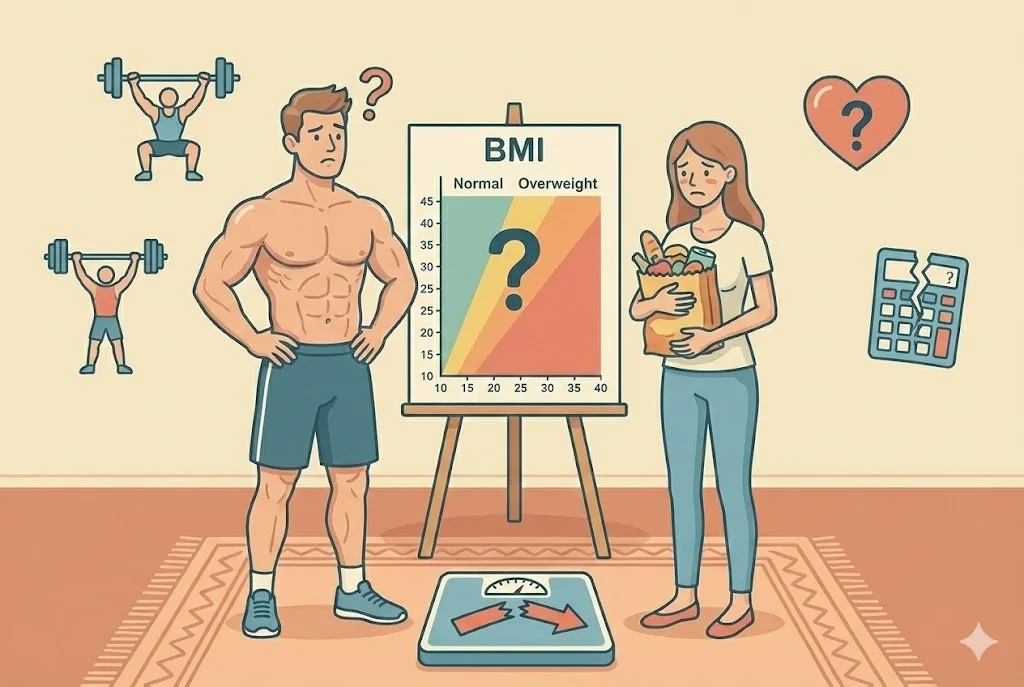
BMI assumes that all weight is equal, but the body does not work that way. Muscle, fat, bone, and water all contribute to weight differently.
Two women with the same BMI may have:
- Very different body fat percentages
- Different activity levels
- Different metabolic health
This is where many people begin to feel disconnected from their BMI label. The number does not reflect how strong, energetic, or healthy they actually feel.
When BMI Fails to Measure Health Accurately
There are several common situations where BMI can be misleading.
Muscle and Athletic Bodies
Muscle weighs more than fat. A physically active woman with higher muscle mass may fall into the overweight category even when her body fat is healthy.
Body Fat Distribution
BMI does not show where fat is stored. Research suggests that fat around the abdomen carries different health risks than fat around the hips or thighs, yet BMI treats them the same.
Hormonal Changes
Life stages such as postpartum recovery, perimenopause, or menopause can change body composition without reflecting poor health.
Ethnic and Genetic Differences
Different populations have different natural body structures. BMI does not adjust for these variations.
In these cases, BMI may create unnecessary worry or miss real concerns.
BMI and Women’s Health: A Closer Look
For women, BMI often intersects with deeply personal experiences. Pregnancy, breastfeeding, hormonal shifts, and caregiving responsibilities all influence weight and body shape.
Many doctors recommend that women consider:
- Energy levels
- Menstrual regularity
- Bone health
- Strength and mobility
rather than focusing solely on BMI. Health is lived daily, not calculated once.
Metabolic Health Matters More Than BMI Alone
Metabolic health refers to how well your body manages energy, blood sugar, and inflammation. A person with a higher BMI can still be metabolically healthy, while someone in the “normal” range may struggle with insulin resistance or fatigue.
This is why many practitioners pair BMI with:
- Blood pressure readings
- Cholesterol levels
- Blood sugar markers
Understanding how much energy your body needs can also provide insight. Tools like the Ideal Weight Calculator and Body Fat Percentage Calculator offer a broader picture.
The Emotional Cost of Over-Relying on BMI
BMI has been used in ways that unintentionally shame or oversimplify health. For many women, it becomes a source of stress rather than guidance.
It is important to say this clearly:
- BMI does not measure self-worth
- BMI does not measure effort
- BMI does not measure care for your body
Health is not a moral achievement. Numbers should support wellbeing, not undermine it.
When BMI Is Still Useful
Despite its limitations, BMI is not useless. It can be helpful when:
- Tracking large population trends
- Identifying potential health risks that need further testing
- Monitoring changes over time rather than single readings
Many doctors recommend using BMI as a doorway to deeper conversations, not a final judgment.
What to Look At Instead of BMI Alone
A more compassionate health assessment considers multiple factors:
- How you feel day to day
- Strength and endurance
- Sleep quality
- Mental wellbeing
- Lab results when appropriate
When these areas are stable, BMI becomes far less central.
How to Use BMI Without Letting It Harm You
If you choose to use BMI, try approaching it with curiosity rather than criticism.
Helpful practices include:
- Looking at trends instead of single numbers
- Pairing BMI with lifestyle habits
- Discussing results with a healthcare provider you trust
BMI should serve you, not define you.
FAQs
1. Is BMI outdated?
BMI is limited, but still used as a basic screening tool in healthcare.
2. Can BMI miss health problems?
Yes. Someone can have a normal BMI and still face metabolic or hormonal issues.
3. Is BMI accurate for women?
It can offer general guidance, but often misses hormonal and body composition factors.
4. Should I ignore BMI completely?
Not necessarily. It works best when combined with other health indicators.
5. Does BMI work for athletes?
BMI often misclassifies athletic bodies due to higher muscle mass.
6. Is body fat percentage better than BMI?
Many experts recommend body fat percentage as a more specific measure of composition.
7. Can BMI affect mental health?
For some women, repeated focus on BMI can increase anxiety or body dissatisfaction.
References and Further Reading
-
Centers for Disease Control and Prevention — BMI Limitations
https://www.cdc.gov/bmi/about/index.html -
World Health Organization — BMI Use and Cautions
https://www.who.int/news-room/fact-sheets/detail/obesity-and-overweight -
National Institutes of Health — Body Composition
https://www.nhlbi.nih.gov/health/body-composition
Medical Disclaimer
This content is for educational purposes only and does not replace personalized medical advice. Always consult a qualified healthcare professional for individual concerns.
About the Author
Abhilasha Mishra writes about early childhood development, women’s health, and parenting. Her work focuses on empathy, clarity, and practical guidance for mothers navigating the toddler years.