
BMR vs TDEE: Which One Should You Use for Weight Loss?
BMR and TDEE are often confused, leading many women to under-eat or feel stuck. This supportive, evidence-based guide explains the real difference between BMR and TDEE, when each matters, and how to use them safely for sustainable weight loss.
Try Related Tools
Use our source-informed calculators to get helpful insights.
Table of Contents
- What Is BMR, Really?
- What Is TDEE and Why It Matters More for Weight Loss
- BMR vs TDEE: The Key Differences
- Which One Should You Use for Weight Loss?
- Why Women Are More Affected by This Confusion
- Signs You May Be Eating Below What Your Body Needs
- Can Eating Too Little Stall Weight Loss?
- Activity Level Changes Everything
- Weight Loss Without Punishment
- When BMR Still Matters
- FAQs
- References and Further Reading
What Is BMR, Really?
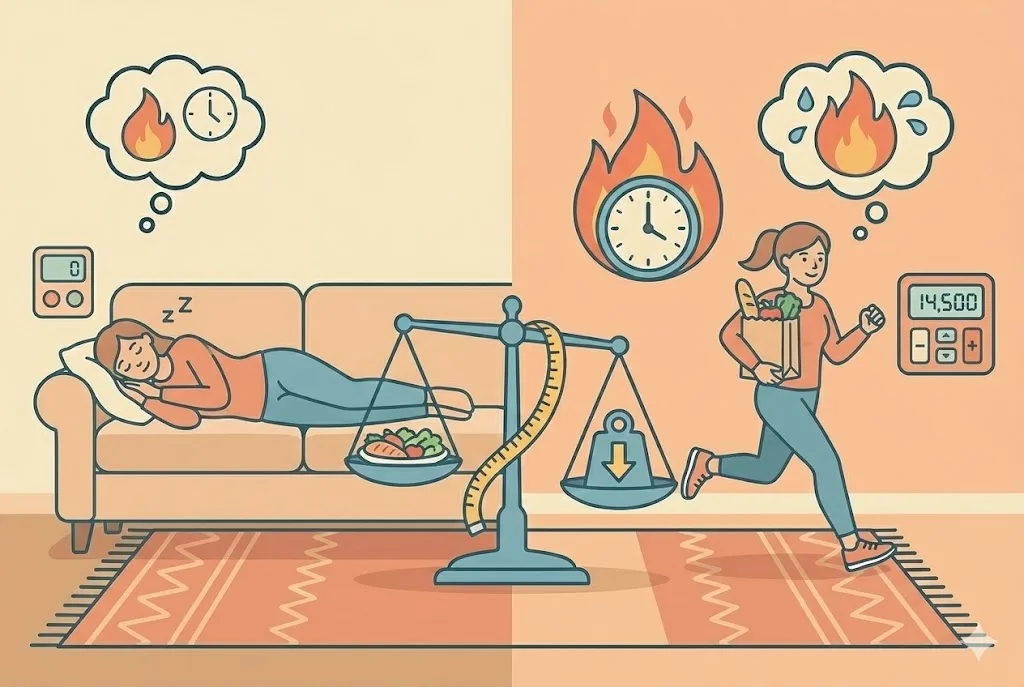
BMR stands for Basal Metabolic Rate. It is the number of calories your body needs just to stay alive while completely at rest. This includes breathing, circulating blood, maintaining body temperature, and supporting your brain and organs.
Even if you did nothing all day, your body would still require this energy. BMR is the minimum fuel requirement for survival, not a weight loss target.
You can estimate this baseline using the BMR Calculator.
Many doctors explain that eating below your BMR for long periods can trigger fatigue, hormonal imbalance, and metabolic slowdown.
What Is TDEE and Why It Matters More for Weight Loss
TDEE stands for Total Daily Energy Expenditure. It represents the total calories your body burns in a day, including:
- Your BMR
- Physical activity
- Daily movement like walking or standing
- The energy used to digest food
In simple terms, TDEE reflects how much energy your body actually uses in real life, not just at rest.
This is why TDEE is usually the more appropriate number to consider for weight loss planning. You can explore your estimate using the TDEE Calculator.
BMR vs TDEE: The Key Differences
The difference between BMR and TDEE is not subtle, and mixing them up often leads to under-eating.
BMR is your body’s survival baseline.
TDEE is your daily operating cost.
Weight loss plans that ignore TDEE often recommend calorie targets that are too low, especially for women. This can cause the body to conserve energy rather than release stored fat.
Which One Should You Use for Weight Loss?
Most health professionals recommend using TDEE, not BMR, when planning weight loss.
A safe, sustainable approach often involves:
- Estimating your TDEE
- Creating a modest calorie deficit from that number
- Ensuring intake stays above your BMR
This approach supports fat loss while protecting hormonal health, energy levels, and mood.
Using a Calorie Calculator alongside TDEE can help identify a range that feels manageable instead of restrictive.
Why Women Are More Affected by This Confusion
Women’s bodies respond differently to calorie restriction due to hormonal sensitivity. Estrogen, progesterone, and cortisol all influence how the body perceives energy availability.
When calorie intake drops too low, the female body often responds by:
- Slowing metabolism
- Disrupting menstrual cycles
- Increasing cravings
- Holding onto fat for perceived survival
This is why many women feel worse, not better, when following very low-calorie plans based on BMR alone.
Signs You May Be Eating Below What Your Body Needs
If your calorie target is too close to or below your BMR, you may notice:
- Constant tiredness
- Cold hands and feet
- Hair thinning
- Irritability or low mood
- Poor sleep
These are not signs of weak willpower. They are biological responses to insufficient fuel.
Can Eating Too Little Stall Weight Loss?
Yes. Research suggests that chronic under-eating can reduce metabolic rate over time. The body becomes efficient at conserving energy, making further weight loss harder.
This is why many doctors now recommend gradual, flexible calorie adjustments rather than aggressive cuts.
Activity Level Changes Everything
Two people with the same BMR may have very different TDEEs depending on lifestyle. A woman caring for children, walking daily, and managing a household may burn far more calories than a desk-bound individual, even without formal exercise.
This is another reason why TDEE provides a more realistic picture than BMR alone.
Weight Loss Without Punishment
Weight loss does not require suffering. When calorie targets respect your TDEE and stay above BMR, many women report:
- Better energy
- Fewer cravings
- Improved consistency
- More sustainable progress
Health improves when the body feels safe, not starved.
When BMR Still Matters
BMR becomes especially important when:
- You feel chronically fatigued
- Menstrual cycles become irregular
- Weight loss feels stalled despite effort
In these cases, BMR serves as a safety check to ensure your intake is not too low.
FAQs
1. Should I ever eat below my BMR?
Most doctors advise against eating below BMR for extended periods.
2. Is TDEE accurate?
TDEE calculators provide estimates. Real-life adjustments are often needed.
3. Why did I lose weight faster when eating very little?
Initial loss often includes water and muscle, not just fat.
4. Can TDEE change over time?
Yes. Activity level, muscle mass, stress, and age all affect TDEE.
5. Is BMR the same as resting metabolic rate?
They are similar but not identical. BMR is measured under stricter conditions.
6. What matters more than the exact number?
Consistency, nourishment, and how your body feels matter more.
References and Further Reading
-
National Institutes of Health — Metabolism and Weight
https://www.niddk.nih.gov/health-information/weight-management -
Harvard Health — Calories and Metabolic Rate
https://www.health.harvard.edu/staying-healthy/the-truth-about-metabolism -
Mayo Clinic — Weight Loss Basics
https://www.mayoclinic.org/healthy-lifestyle/weight-loss
Medical Disclaimer
This article is for educational purposes only and does not replace personalized medical advice. Always consult a qualified healthcare provider before making significant dietary or lifestyle changes.
About the Author
Abhilasha Mishra writes about early childhood development, women’s health, and parenting. Her work focuses on empathy, clarity, and practical guidance for mothers navigating the toddler years.