
Why Your BMI Looks Normal but Your Body Fat Is High
If your BMI falls in the normal range but your body still feels soft, tired, or unhealthy, you are not imagining it. This guide explains why BMI can miss hidden fat, how hormones and muscle mass affect results, and what truly matters for health.
Try Related Tools
Use our source-informed calculators to get helpful insights.
Table of Contents
- What BMI Actually Measures
- When BMI Looks Normal but Health Is Not
- Why This Happens More Often in Women
- The Role of Muscle Mass
- Visceral Fat vs Subcutaneous Fat
- Hormones, Stress, and Cortisol
- Dieting Without Strength Training
- Why You Might Feel Unwell Despite “Normal” Numbers
- What Matters More Than BMI Alone
- Gentle, Sustainable Ways to Improve Body Composition
- When to Seek Medical Guidance
- Learning to Trust Your Body Again
- FAQs
- References and Medical Sources
What BMI Actually Measures
BMI, or Body Mass Index, is a simple ratio of weight to height. It does not distinguish between muscle, fat, bone, or water.
Doctors have used BMI for decades because it is fast, inexpensive, and useful for large population studies. For public health screening, it still has value.
But on an individual level, BMI has blind spots. Experts often explain that BMI was never designed to assess body composition or metabolic health.
When BMI Looks Normal but Health Is Not
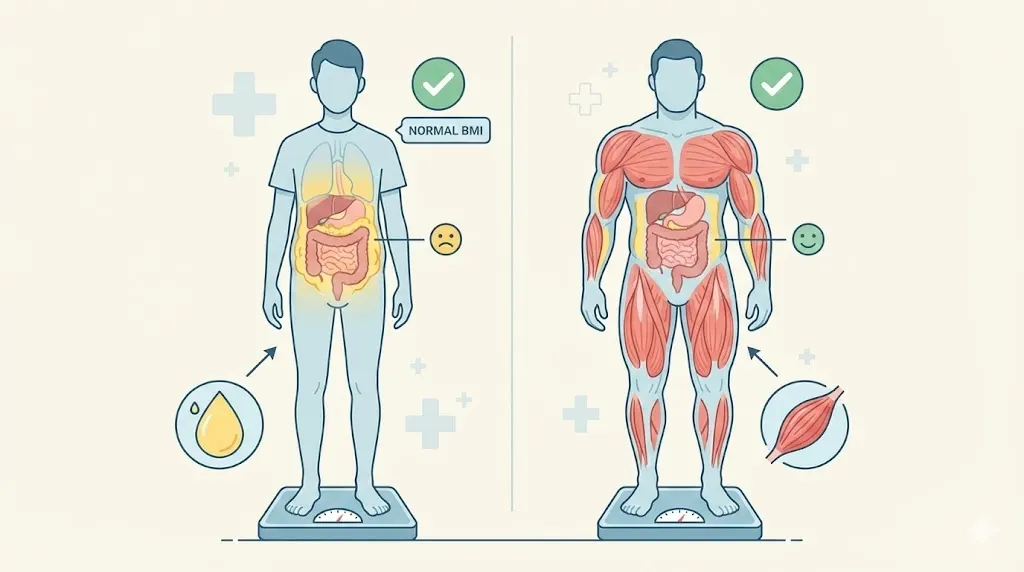
Many women fall into what is often called a “normal BMI, high body fat” category. You may also hear this described as being “skinny fat,” though the term can feel unkind.
This pattern means:
- Body weight is within normal BMI range
- Muscle mass is relatively low
- Fat percentage is higher than expected
Research suggests that this body composition can carry similar metabolic risks as obesity, even when BMI appears healthy.
Why This Happens More Often in Women
Female bodies are hormonally complex and beautifully adaptive. That complexity also means body composition shifts more easily.
Several factors contribute:
- Estrogen changes across life stages
- Pregnancy and postpartum muscle loss
- Long periods of dieting
- Sedentary routines paired with stress
- Poor sleep quality
Many doctors note that women can lose muscle more quickly than fat when calories are restricted. Over time, weight stays stable but muscle shrinks, leaving a higher fat ratio.
The Role of Muscle Mass
Muscle is metabolically active tissue. It supports insulin sensitivity, posture, joint health, and energy levels.
When muscle mass is low:
- Fat storage increases more easily
- Blood sugar regulation becomes less efficient
- Basal metabolism slows
A BMR Calculator can help illustrate how muscle influences how many calories your body burns at rest.
BMI cannot reflect this difference. Two women with the same BMI can have very different health profiles depending on muscle-to-fat ratio.
Visceral Fat vs Subcutaneous Fat
Not all fat behaves the same way.
Subcutaneous fat sits under the skin and often feels soft. Visceral fat surrounds internal organs and is more metabolically active.
Studies show that women with normal BMI but higher visceral fat may face increased risks for:
- Insulin resistance
- Inflammation
- Hormonal imbalance
BMI cannot detect where fat is stored. Body composition tools can.
Hormones, Stress, and Cortisol
Chronic stress affects body fat distribution. Elevated cortisol levels can encourage fat storage around the abdomen, even without weight gain.
Women juggling work, caregiving, sleep disruption, or emotional load often notice this pattern. It is not a discipline problem. It is a biological response.
Many doctors recommend addressing stress and sleep before aggressively targeting weight.
Dieting Without Strength Training
Repeated cycles of calorie restriction without resistance training can quietly reduce muscle mass.
Over time:
- Scale weight stays similar
- BMI remains normal
- Body fat percentage rises
This is one reason why eating less does not always lead to feeling healthier.
Why You Might Feel Unwell Despite “Normal” Numbers
Women in this situation often report:
- Fatigue despite adequate sleep
- Poor exercise tolerance
- Low confidence in body strength
- Digestive discomfort
- Difficulty maintaining weight
These signals matter. Your body is communicating beyond numbers.
What Matters More Than BMI Alone
Many doctors recommend looking at:
- Body fat percentage
- Waist circumference
- Muscle strength
- Blood sugar and lipid markers
- Energy levels and recovery
Health is not a single number. It is a pattern.
Gentle, Sustainable Ways to Improve Body Composition
Improvement does not mean punishment or restriction.
Helpful steps often include:
- Resistance training two to three times weekly
- Protein intake appropriate for body needs
- Adequate sleep and stress support
- Avoiding extreme calorie deficits
Research suggests that building muscle can improve body composition even if weight remains unchanged.
When to Seek Medical Guidance
Consider speaking with a healthcare provider if:
- Fat gain continues despite healthy habits
- Menstrual cycles change
- Fatigue feels persistent
- Blood markers worsen
Medical guidance can rule out thyroid issues, insulin resistance, or hormonal imbalances.
Learning to Trust Your Body Again
A normal BMI can feel reassuring, but it should not silence your intuition. Feeling strong, nourished, and capable matters more than fitting into a chart.
Your body is not asking to be smaller. It may be asking to be supported differently.
FAQs
1. Can I have health risks with a normal BMI?
Yes. High body fat percentage can increase metabolic risk even with normal BMI.
2. Is BMI useless?
No. It is useful for screening but incomplete for individual health.
3. Why do I gain fat without weight gain?
Loss of muscle and hormonal changes can shift body composition.
4. Can strength training change this without weight loss?
Yes. Many women see improved health without scale changes.
5. Should I stop using BMI completely?
Use it as one tool, not the final judgment.
6. How long does body composition change take?
Most changes occur gradually over months, not weeks.
References and Medical Sources
-
American College of Obstetricians and Gynecologists
https://www.acog.org -
National Institutes of Health
https://www.nih.gov -
Harvard Health Publishing
https://www.health.harvard.edu
Medical Disclaimer
This article is for educational purposes only and does not replace professional medical advice. Always consult a qualified healthcare provider for personalized guidance regarding body composition and metabolic health.
About the Author
Abhilasha Mishra writes about early childhood development, women’s health, and parenting. Her work focuses on empathy, clarity, and practical guidance for mothers navigating the toddler years.