
What Is BMR? How Many Calories Your Body Burns at Rest
Basal Metabolic Rate explains how much energy your body needs just to keep you alive. This supportive, medically responsible guide helps you understand BMR, why it matters, how it changes for women, and how to use it without fear or diet pressure.
Try Related Tools
Use our source-informed calculators to get helpful insights.
Table of Contents
- What Is BMR in Simple Terms
- Why BMR Matters More Than You Think
- What Influences Your BMR
- BMR vs TDEE: Understanding the Difference
- BMR and Weight Changes
- Why Women Often Struggle With Low Energy
- Pregnancy, Postpartum, and BMR
- Menopause and Shifting Energy Needs
- Using BMR Without Obsession
- FAQs
- References and Further Reading
What Is BMR in Simple Terms
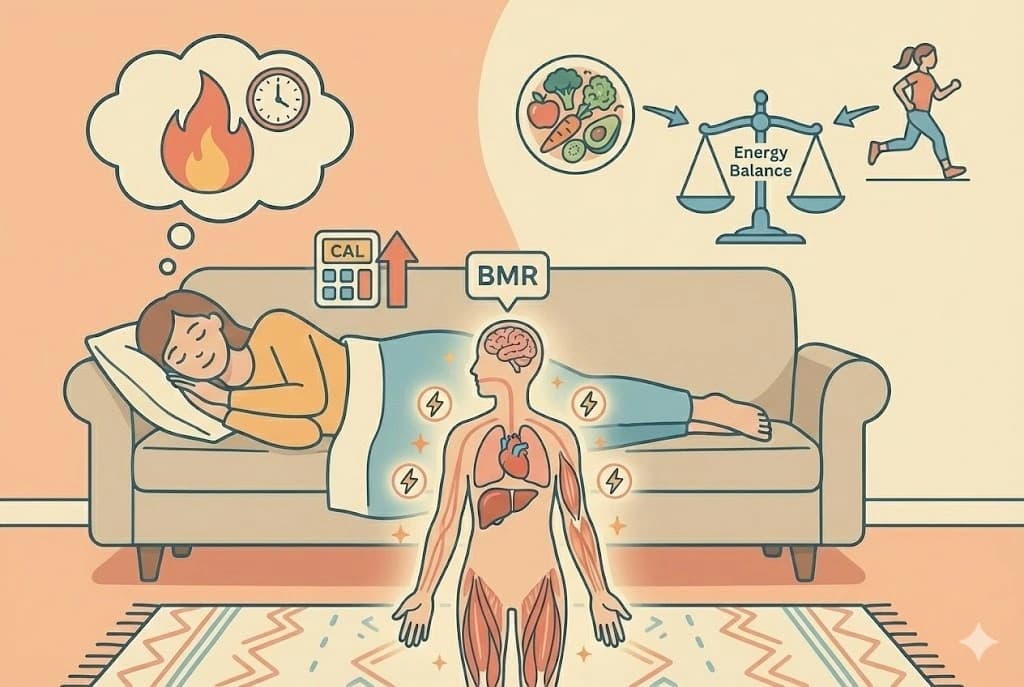
BMR stands for Basal Metabolic Rate. It refers to the number of calories your body burns at complete rest to keep essential systems running. This includes breathing, circulation, temperature regulation, brain activity, and cellular repair.
Even if you stayed in bed all day without moving, your body would still need energy. That baseline energy requirement is your BMR.
Doctors often explain BMR as the foundation of your daily calorie needs. Everything else you do builds on top of it.
Why BMR Matters More Than You Think
Many calorie recommendations fail because they ignore BMR. When intake drops below what the body needs at rest, the body adapts by slowing processes, increasing fatigue, and conserving energy.
Research suggests that consistently eating below BMR can lead to:
- Hormonal disruption
- Menstrual irregularities
- Hair thinning
- Persistent tiredness
Understanding BMR helps you avoid under-fueling, especially during stressful life stages.
You can estimate your baseline needs using the BMR Calculator.
What Influences Your BMR
Body Size and Composition
Larger bodies require more energy to maintain basic functions. Muscle tissue burns more calories at rest than fat tissue, which is why strength training can raise BMR slightly over time.
Age and Metabolic Changes
As we age, muscle mass naturally declines unless actively maintained. This can lower BMR gradually. The change is slow but noticeable, especially after the mid-30s.
Experts often recommend focusing on nourishment and strength rather than aggressive calorie cuts during this phase.
Hormones and Female Metabolism
Hormones play a major role in BMR for women. Estrogen, thyroid hormones, cortisol, and insulin sensitivity all influence how efficiently the body uses energy.
Life events such as pregnancy, postpartum recovery, and menopause can temporarily or permanently alter BMR.
Genetics and Health Conditions
Some people are born with naturally higher or lower metabolic rates. Thyroid disorders, chronic stress, and inflammatory conditions can also affect resting energy needs.
This is why comparing your intake to someone else’s is rarely helpful.
BMR vs TDEE: Understanding the Difference
BMR is not your total calorie need. It is the starting point.
TDEE, or Total Daily Energy Expenditure, includes:
- BMR
- Physical activity
- Digestion
- Daily movement
If BMR is the foundation, TDEE is the full picture. You can explore this with the TDEE Calculator to understand how lifestyle adds to baseline needs.
BMR and Weight Changes
Many people assume that lowering calories automatically leads to weight loss. In reality, dropping intake too far below BMR can slow metabolism and make progress harder.
Doctors often recommend eating above BMR and adjusting activity levels instead of extreme restriction.
Using a Calorie Calculator alongside BMR can help identify a sustainable range.
Why Women Often Struggle With Low Energy
Women are especially vulnerable to under-eating because social expectations often push calorie targets below biological needs.
Signs that intake may be below BMR include:
- Cold sensitivity
- Brain fog
- Sleep disruption
- Low mood
These symptoms are not failures. They are signals.
Pregnancy, Postpartum, and BMR
During pregnancy, BMR increases to support fetal development. After birth, energy needs remain elevated during recovery and breastfeeding.
Many doctors emphasize that postpartum weight loss should never come at the expense of adequate fueling.
Menopause and Shifting Energy Needs
During menopause, hormonal changes can lower BMR slightly while increasing fatigue. This is not a personal shortcoming.
Gentle movement, protein intake, and adequate calories are often more helpful than drastic dietary changes during this stage.
Using BMR Without Obsession
BMR is meant to inform, not control. It works best when used as a guide to:
- Prevent under-eating
- Support hormonal health
- Build sustainable routines
Health is not about hitting the lowest number possible.
FAQs
1. Is BMR the same for everyone?
No. It varies based on body size, age, hormones, and genetics.
2. Should I eat below my BMR to lose weight?
Many doctors advise against eating below BMR for extended periods.
3. Can BMR increase?
Yes. Muscle gain and recovery from stress can raise BMR slightly.
4. Why did my BMR change over time?
Age, hormonal shifts, and lifestyle changes all influence BMR.
5. Is a low BMR bad?
A lower BMR is not bad, but under-fueling can cause problems.
6. Should women track BMR differently?
Women benefit from considering menstrual cycles, pregnancy, and menopause when interpreting BMR.
References and Further Reading
-
National Institutes of Health — Metabolism Basics
https://www.niddk.nih.gov/health-information/weight-management -
Harvard Health — Understanding Metabolism
https://www.health.harvard.edu/staying-healthy/the-truth-about-metabolism -
Mayo Clinic — Calories and Energy Balance
https://www.mayoclinic.org/healthy-lifestyle/weight-loss/in-depth/calories/art-20048065
Medical Disclaimer
This article is for educational purposes only and does not replace personalized medical advice. Always consult a qualified healthcare provider for guidance tailored to your health needs.
About the Author
Abhilasha Mishra writes about early childhood development, women’s health, and parenting. Her work focuses on empathy, clarity, and practical guidance for mothers navigating the toddler years.