
What Is a Healthy BMI? Adult BMI Chart Explained (Men & Women)
A clear, compassionate guide to understanding Body Mass Index in adults. Learn what BMI really measures, how healthy ranges differ for men and women, its limitations, and when BMI matters or does not.
Try Related Tools
Use our source-informed calculators to get helpful insights.
Table of Contents
- What Is BMI and Why Doctors Use It
- The Standard Adult BMI Chart Explained
- What Is Considered a Healthy BMI for Adults
- Does Healthy BMI Differ for Men and Women
- BMI and Muscle: When the Chart Can Mislead
- When a High or Low BMI Deserves Attention
- BMI Across Different Life Stages
- Emotional Impact of BMI and Weight Labels
- How to Use BMI in a Healthy Way
- FAQs
- References and Further Reading
What Is BMI and Why Doctors Use It
BMI is a screening tool that compares your weight to your height to estimate whether your body weight falls within a range associated with lower or higher health risk. It does not diagnose disease. Instead, it helps identify patterns that may warrant further evaluation.
Healthcare providers often use BMI because it is:
- Simple to calculate
- Consistent across populations
- Useful for identifying trends at a public health level
Many doctors explain that BMI is best viewed as a starting point, not a final verdict on health.
You can calculate your own number using the BMI Calculator to follow along with the ranges explained below.
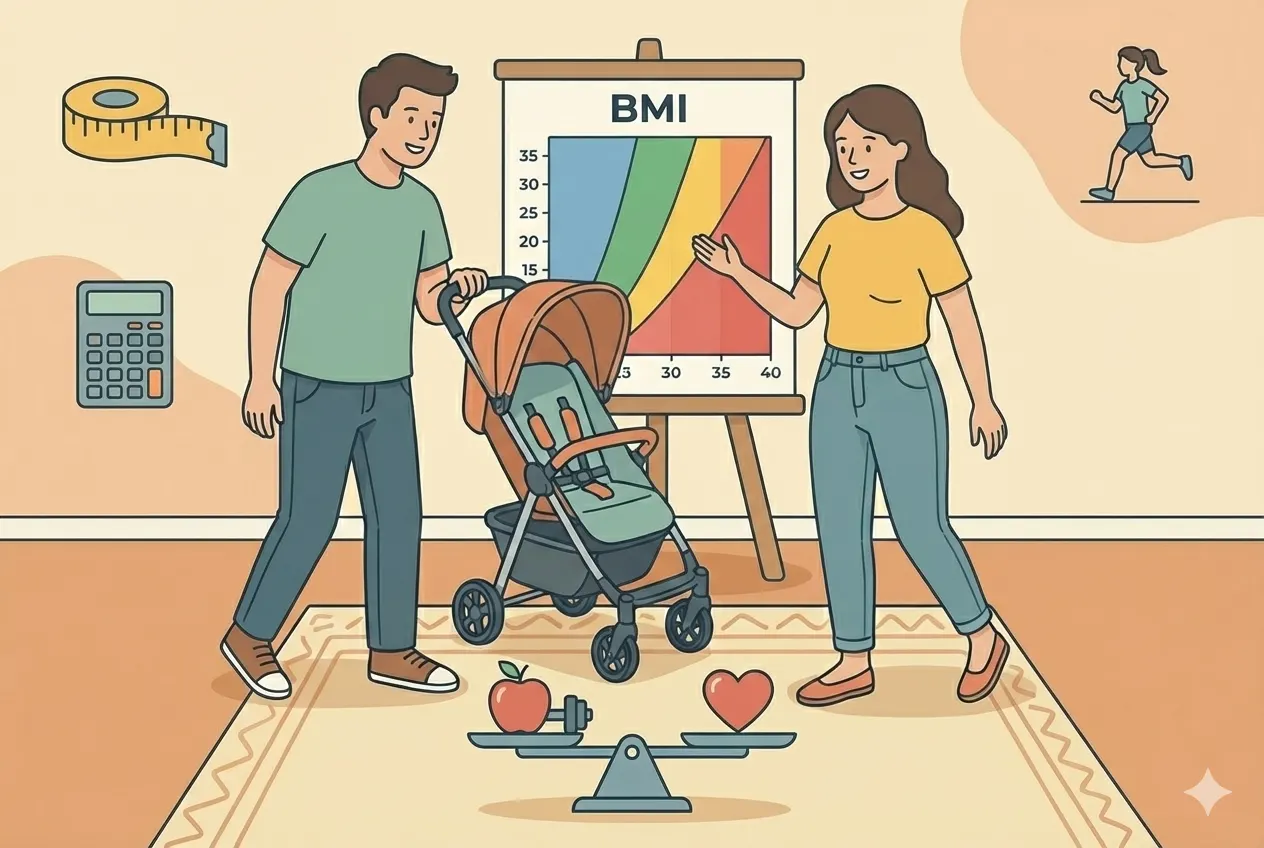
The Standard Adult BMI Chart Explained
BMI is calculated using the same formula for all adults, regardless of gender. However, health interpretation may differ slightly based on sex, age, and body composition.
Adult BMI categories
- Below 18.5: Underweight
- 18.5 to 24.9: Healthy weight
- 25.0 to 29.9: Overweight
- 30.0 and above: Obesity
These categories are based on long-term research linking BMI ranges to population health outcomes such as heart disease, diabetes, and joint stress.
What Is Considered a Healthy BMI for Adults
A BMI between 18.5 and 24.9 is generally considered healthy for most adults. Research suggests that people in this range tend to have lower risks of chronic illness when other health factors are stable.
That said, healthy does not mean identical. Two people with the same BMI can look and feel very different.
Many doctors recommend pairing BMI with other indicators such as:
- Waist circumference
- Blood pressure
- Cholesterol levels
- Energy levels and mobility
For weight goals beyond BMI, tools like the Ideal Weight Calculator can offer a broader perspective.
Does Healthy BMI Differ for Men and Women
While BMI ranges are technically the same for adult men and women, body composition differs naturally.
Typical differences
- Women tend to carry more essential body fat
- Men often have higher lean muscle mass
- Hormonal patterns influence fat distribution
Because BMI does not distinguish fat from muscle, a physically active woman or a muscular man may fall into a higher BMI category without having excess body fat.
Experts often explain that context matters more than the number alone.
BMI and Muscle: When the Chart Can Mislead
One of the most important limitations of BMI is that it does not account for muscle mass. Muscle weighs more than fat, but it carries very different health implications.
You may have a higher BMI if you:
- Lift weights regularly
- Have an athletic build
- Are naturally broad-framed
In these cases, doctors often recommend additional assessment instead of focusing on BMI alone.
Understanding how your body uses energy can help provide context. The BMR Calculator estimates how many calories your body needs at rest, which complements BMI insights.
When a High or Low BMI Deserves Attention
BMI becomes more clinically relevant when it aligns with symptoms or health changes.
A higher BMI may need attention if paired with:
- Shortness of breath
- Joint pain
- Elevated blood sugar or cholesterol
- Reduced stamina
A low BMI may be concerning if accompanied by:
- Fatigue or weakness
- Hair thinning
- Missed periods
- Difficulty maintaining weight
In these situations, BMI acts as a signal rather than a diagnosis.
BMI Across Different Life Stages
Adult BMI interpretation can shift slightly depending on age and life circumstances.
Younger adults
BMI often reflects body composition more directly, especially when paired with activity level.
Midlife
Hormonal changes, especially in women, can alter fat distribution even if BMI stays the same.
Older adults
Some research suggests that a slightly higher BMI may not carry the same risks in later years, particularly if muscle mass and mobility are preserved.
Many doctors recommend focusing on strength, balance, and metabolic health rather than chasing a specific BMI number with age.
Emotional Impact of BMI and Weight Labels
For many women, BMI is not just a number. It can carry emotional weight shaped by years of messaging about bodies, worth, and health.
It is important to remember:
- BMI does not measure self-discipline
- BMI does not define beauty
- BMI does not reflect effort or care
Health exists on a spectrum, not within a single calculation.
How to Use BMI in a Healthy Way
A healthy relationship with BMI involves using it as one data point among many.
Helpful approaches include:
- Tracking trends instead of fixating on one number
- Pairing BMI with lifestyle habits
- Checking how your body feels and functions
BMI works best when it informs, not controls, your health decisions.
FAQs
1. Is BMI accurate for everyone?
BMI is a useful screening tool but does not account for muscle mass, bone density, or fat distribution.
2. Can I be healthy with a BMI over 25?
Yes. Many people with higher BMI are metabolically healthy, especially if they are active and have balanced blood markers.
3. Should women use a different BMI chart than men?
The BMI chart is the same, but interpretation should consider hormonal and body composition differences.
4. Does BMI change with age?
The formula does not change, but how doctors interpret BMI may evolve with age and overall health.
5. Is BMI useful for weight loss goals?
BMI can offer direction, but sustainable goals often work better when based on habits and wellbeing.
6. Can BMI predict disease?
BMI alone cannot diagnose disease, but extreme values may signal increased risk.
7. How often should BMI be checked?
Many doctors recommend reviewing it during routine health visits rather than frequent self-monitoring.
References and Further Reading
-
World Health Organization — BMI Classification:
https://www.who.int/tools/growth-reference-data-for-5to19-years/indicators/bmi-for-age -
Centers for Disease Control and Prevention — BMI:
https://www.cdc.gov/bmi -
National Institutes of Health — Body Weight and Health:
https://www.nhlbi.nih.gov/health/educational/lose_wt/index.htm
Medical Disclaimer
This article is for educational purposes only and does not replace individualized medical advice. Always consult a qualified healthcare professional for personal health concerns.
About the Author
Abhilasha Mishra writes about early childhood development, women’s health, and parenting. Her work focuses on empathy, clarity, and practical guidance for mothers navigating the toddler years.