
Two Week Wait Symptoms Day by Day: What's Real, What's In Your Head
Two week wait symptoms day by day — an OB/GYN-reviewed guide to what implantation actually feels like from 1 DPO to 14 DPO, and which signs genuinely mean something.
Try Related Tools
Use our source-informed calculators to get helpful insights.
Table of Contents
- What Is Actually Happening During the Two Week Wait?
- Two Week Wait Symptoms: Day by Day (1 DPO to 14 DPO)
- Symptoms That Have a Real Physiological Basis During the TWW
- The Symptom Overlap Problem: Why You Cannot Know Until You Test
- When Can You Take a Pregnancy Test?
- Surviving the Two Week Wait: Practical Advice
- Frequently Asked Questions (FAQ)
- References and Further Reading
What Is Actually Happening During the Two Week Wait?
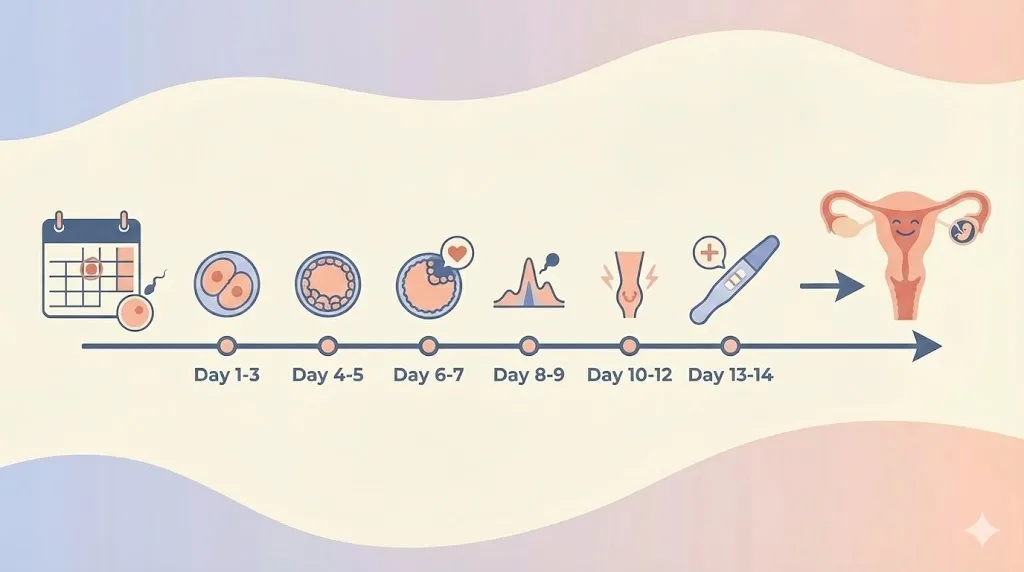
To understand TWW symptoms, it helps to understand the biology. After ovulation, here is what unfolds:
Day of Ovulation (Day 0): A mature egg is released from the follicle. It is viable for fertilisation for approximately 12 to 24 hours.
Days 1–5 post-ovulation: Sperm (which can survive 3–5 days) fertilises the egg in the fallopian tube, creating a zygote. The fertilised egg divides repeatedly as it travels toward the uterus.
Days 6-12 post-ovulation: The blastocyst (now a ball of around 100 cells) reaches the uterus and begins the process of implantation — burrowing into the uterine lining. Implantation most commonly occurs between 6 and 10 DPO, with the statistical peak at 8–10 DPO.
Days 8–14 post-ovulation: The implanted embryo begins producing human chorionic gonadotropin (hCG). hCG tells the corpus luteum (the remnant of the follicle) to keep producing progesterone, which maintains the uterine lining and prevents menstruation.
Day 14: If pregnancy has occurred, hCG levels are rising. A sensitive home pregnancy test may detect it. If pregnancy has not occurred, progesterone drops, the uterine lining sheds, and menstruation begins.
The critical insight: most symptoms before implantation (before ~7 DPO) are caused by progesterone alone, which rises after every ovulation regardless of pregnancy. They are not pregnancy symptoms. They are ovulation aftermath symptoms.
Two Week Wait Symptoms: Day by Day (1 DPO to 14 DPO)
1 DPO — 3 DPO: Ovulation Aftermath
What is happening biologically: The corpus luteum forms and begins producing progesterone. The egg, if fertilised, is dividing in the fallopian tube. Fertilisation itself produces no detectable symptoms.
What you may feel:
- Mild pelvic ache or dull heaviness (residual from ovulation)
- Bloating (progesterone begins slowing digestion)
- Slight breast tenderness beginning
- Mild fatigue
- Possible EWCM (egg white cervical mucus) transitioning to creamy, white discharge
The honest assessment: Nothing you feel at 1–3 DPO is a pregnancy symptom. Progesterone rises after every ovulation cycle. The embryo, if there is one, is a microscopic cluster of cells in your fallopian tube. It is producing no detectable hormones.
4 DPO — 5 DPO: The Blastocyst Arrives in the Uterus
What is happening biologically: The blastocyst (if fertilised) enters the uterus. Implantation has not yet begun. The uterus is producing a nutrient-rich fluid to sustain it.
What you may feel:
- Continued mild bloating
- Breast tenderness, potentially increasing
- Fatigue
- Mild mood changes
- Possibly increased appetite
The honest assessment: Again, these are progesterone-driven symptoms present in every luteal phase. Nothing you feel at 4–5 DPO is specific to pregnancy. Any "symptom" at this stage is the progesterone you always produce after ovulation.
6 DPO — 7 DPO: The Implantation Window Opens
What is happening biologically: Implantation can begin as early as 6 DPO, though it is more commonly 8–10 DPO. If and when implantation occurs, the embryo disrupts small blood vessels in the uterine lining — this is when implantation bleeding or cramping can theoretically occur.
What you may feel:
- Implantation cramping: Mild, brief, one-sided or central pelvic cramping, distinct from menstrual cramps. Not all women experience this, and it is often indistinguishable from normal luteal phase cramping.
- Implantation spotting: A small amount of light pink or brown spotting, lasting a few hours to 1–2 days. Experienced by approximately 25–30% of pregnant women.
- Continued breast tenderness
- Fatigue
- Mild nausea (rare this early, and almost certainly progesterone-related rather than hCG-related)
The honest assessment: At 6–7 DPO, implantation may be beginning in some women. However, the symptoms described above — cramping, spotting — can also occur in a non-pregnant luteal phase. Spotting specifically has a more credible physiological link to implantation, but it is not present in the majority of pregnancies.
8 DPO — 10 DPO: Peak Implantation Window
What is happening biologically: This is the most statistically probable window for implantation. A 1999 study by Wilcox et al. in the New England Journal of Medicine found that 84% of successful implantations occurred between 8 and 10 DPO. Once implantation is complete, hCG production begins. However, hCG levels at this stage are still very low — typically 1–2 mIU/mL, far below what most tests detect.
What you may feel:
- Implantation cramping (if implantation is occurring now): mild, brief, lower abdominal cramping
- Implantation spotting (if applicable): light pink or brown discharge, not red
- Breast changes possibly intensifying: heavier feeling, areola darkening may begin
- Fatigue that feels slightly different — heavier or more persistent than usual
- Heightened sense of smell (hyperosmia) — a genuine early symptom, as estrogen rises
- Increased vaginal discharge: creamy, white, odourless
- Mild bloating and constipation
The honest assessment: By 8–10 DPO, if implantation is occurring, there is a biological basis for some new sensations. However, the hCG levels at this stage are still too low to produce significant symptoms. Most women who are pregnant at 9 DPO feel exactly the same as they did in previous non-pregnant luteal phases.
11 DPO — 12 DPO: hCG Begins to Rise
What is happening biologically: In a successful pregnancy, hCG levels are now doubling approximately every 48–72 hours. At 11–12 DPO, hCG may be in the range of 10–50 mIU/mL. The most sensitive home pregnancy tests (with a 10 mIU/mL threshold) may detect it at this stage, though a negative test here does not rule out pregnancy.
What you may feel:
- More pronounced breast tenderness and heaviness
- Nausea — now with a potential hCG component, especially on an empty stomach
- Heightened sense of smell
- Fatigue that feels qualitatively different (the progesterone-hCG combination)
- Frequent urination beginning
- Mild headaches
- Emotional sensitivity
The honest assessment: By 11–12 DPO, for women who are pregnant, symptoms may genuinely begin to feel different from a typical luteal phase — though this is by no means universal. Many pregnant women feel nothing distinguishable at this stage. Some women who are not pregnant also notice intensified symptoms due to progesterone.
13 DPO — 14 DPO: Test Time
What is happening biologically: If pregnant, hCG is now likely in the range of 50–200+ mIU/mL in many women (though there is significant individual variation). A standard home pregnancy test (25 mIU/mL threshold) should produce a positive result.
If not pregnant, progesterone is dropping, the uterine lining is beginning to shed, and your period will arrive.
What you may feel (if pregnant):
- A positive pregnancy test
- Persistent, possibly intensifying nausea
- Breast tenderness that does not resolve as your period date passes
- Fatigue
- Heightened sense of smell
- Mild, constant lower abdominal fullness
What you may feel (if not pregnant):
- Spotting (premenstrual spotting)
- Cramping
- Mood changes
- Breast tenderness beginning to ease
- Your period arrives
The honest assessment: A home pregnancy test at 14 DPO is reliable. A negative test at 14 DPO, if your period does not arrive, should be repeated in 2–3 days.
Symptoms That Have a Real Physiological Basis During the TWW
Based on biology, these are the symptoms with the most credible connection to early pregnancy (as opposed to normal luteal phase symptoms):
| Symptom | When It May Start | Physiological Basis |
|---|---|---|
| Implantation spotting | 6–10 DPO | Blood vessel disruption during implantation |
| Implantation cramping | 6–10 DPO | Uterine response to implantation |
| Heightened sense of smell | 8–12 DPO | Rising estrogen levels |
| Breast heaviness / areola darkening | 10–14 DPO | Estrogen + progesterone combined effect |
| Nausea on empty stomach | 11–14 DPO | Rising hCG beginning to act |
| Frequent urination | 12–14 DPO | hCG increasing renal blood flow |
| Temperature staying elevated | All TWW | Progesterone (confirms ovulation occurred; not specific to pregnancy) |
The Symptom Overlap Problem: Why You Cannot Know Until You Test
"The honest clinical answer is that we cannot distinguish early pregnancy from PMS by symptoms alone," says medical experts**. "Progesterone causes breast tenderness, bloating, fatigue, mild nausea, and mood changes in every luteal phase — pregnant or not. A urine or blood pregnancy test is the only reliable tool we have."
The only exception is a temperature chart that remains elevated beyond 18 days post-ovulation — this is a reliable indicator of pregnancy, because a non-pregnant luteal phase does not sustain elevated temperatures beyond approximately 14–16 days.
When Can You Take a Pregnancy Test?
| Test Type | Earliest Reliable Result |
|---|---|
| Standard HPT (25 mIU/mL) | 14 DPO (first day of missed period) |
| Sensitive HPT (10 mIU/mL) | 10–12 DPO (may be positive, negative doesn't rule out) |
| Blood test (quantitative hCG) | 8–10 DPO |
Best practice: Test on the first day of your missed period using first-morning urine. If negative but no period, retest in 48–72 hours.
Track Your Implantation Window
Based on your ovulation date, our Implantation Calculator estimates when implantation is most likely to occur and when your earliest test date may be.
Surviving the Two Week Wait: Practical Advice
The two week wait is not just a physical experience — it is a significant psychological one, particularly for those who have been trying for multiple cycles.
What actually helps:
- Continue normal life as much as possible. Dwelling intensifies symptom-scanning.
- Schedule your test date and commit to it. Testing early (and getting false negatives) prolongs the anxiety.
- Gentle exercise. Walking, yoga, and swimming maintain blood flow and reduce stress without risk.
- Limit symptom Googling. Every symptom appears in both pregnant and non-pregnant searches. It will not give you clarity.
- Talk to your partner or a trusted friend. The isolation of the TWW is real.
- Maintain a nutritious diet and continue prenatal vitamins (specifically folic acid) as though you may be pregnant.
What to avoid:
- Alcohol (in case you are pregnant)
- Excessive strenuous exercise
- Hot baths or saunas (elevated core temperature is not recommended in early pregnancy)
- Unnecessary medications (discuss with your provider)
Frequently Asked Questions (FAQ)
Q: Can I feel implantation happening? A: Some women report a brief, mild cramping at around 6–10 DPO that they associate with implantation. However, implantation itself is a microscopic process — the embryo is 0.1–0.2 mm in size. Most women feel nothing specific. Any sensation at this time could equally be luteal phase cramping.
Q: Is nausea at 5 DPO a pregnancy symptom? A: Almost certainly not. At 5 DPO, even if fertilisation has occurred, the embryo is not yet implanted and is producing no hCG. Any nausea at 5 DPO is driven by progesterone — which rises after every ovulation, pregnant or not.
Q: What does implantation spotting look like and how long does it last? A: Implantation spotting is typically very light — a few drops to a small amount of light pink or brown discharge. It lasts hours to 1–2 days, not as long as a period. It is not red and does not involve clots. Only about 25–30% of pregnant women experience it.
Q: My temperature dropped at 7 DPO. Does that mean I am not pregnant? A: A single temperature dip at around 7–8 DPO (sometimes called an "implantation dip") has been discussed online as a positive sign. The evidence for it as a reliable indicator is weak. A single lower reading can result from poor sleep, illness, taking your temperature at a different time, or simply normal variation. Your overall temperature trend matters more than individual readings.
Q: I have had no symptoms at all. Is that bad? A: No. The absence of symptoms during the TWW is not a negative indicator. Many women who are pregnant feel nothing unusual during the two week wait, particularly before 10–12 DPO when hCG is still very low.
Q: When should I test if I have irregular cycles? A: For irregular cycles, calculate 14 days from your ovulation date (not your last period) to estimate your test date. If you are unsure when you ovulated, testing 17–18 days after your last unprotected intercourse is a reasonable approach.
Q: My period came but it was very light. Could I still be pregnant? A: Possibly. Very light, brief spotting that arrives around the expected period date can occasionally be implantation bleeding misidentified as a period. If your "period" was significantly lighter and shorter than usual, take a pregnancy test.
Q: I got a negative test at 12 DPO. Is it over? A: Not necessarily. Late implantation (at 11–12 DPO) can result in hCG that has not yet reached detectable levels by 12 DPO. Retest on the day of your missed period (typically 14 DPO) with first-morning urine.
References and Further Reading
-
Wilcox AJ et al. — Time of Implantation of the Conceptus (NEJM, 1999):
https://www.nejm.org/doi/full/10.1056/NEJM199906103402304 -
American Society for Reproductive Medicine (ASRM):
https://www.reproductivefacts.org -
ACOG — Early Pregnancy Loss:
https://www.acog.org/womens-health/faqs/early-pregnancy-loss -
NHS — Trying to Get Pregnant:
https://www.nhs.uk/pregnancy/trying-for-a-baby/
Medical Disclaimer
This article is for informational and educational purposes only. It does not constitute medical advice, diagnosis, or treatment. Symptom experience varies significantly between individuals and cycles. A laboratory pregnancy test is the only reliable method of confirming pregnancy. Always consult your healthcare provider with any concerns about your reproductive health or fertility.
About the Author
Abhilasha Mishra is a health and wellness writer specializing in women's health, fertility, and pregnancy. She writes with empathy and clinical accuracy to support those navigating the often emotionally complex world of conception and early pregnancy.