
Thyroid & Fertility: Hypothyroidism Impact
Thyroid and fertility: how hypothyroidism affects ovulation, TSH levels for conception, and treatment during pregnancy. OB/GYN guide.
Try Related Tools
Use our source-informed calculators to get helpful insights.
Table of Contents
- The Thyroid-Fertility Connection: How It Works
- Types of Thyroid Disorder and Their Fertility Impact
- TSH Target Levels: What the Numbers Mean for Fertility and Pregnancy
- Thyroid Antibodies and Fertility: The Underrecognised Risk
- Getting Tested: What Your Doctor Should Check
- Treatment: Levothyroxine Before and During Pregnancy
- Practical Steps If You Suspect a Thyroid Issue
- Frequently Asked Questions (FAQ)
- References and Further Reading
The Thyroid-Fertility Connection: How It Works
The thyroid gland produces two primary hormones: thyroxine (T4) and triiodothyronine (T3). T4 is the storage form; T3 is the biologically active form that acts on cells throughout the body. The pituitary gland regulates thyroid output by producing thyroid-stimulating hormone (TSH) — when thyroid hormone levels are low, TSH rises to stimulate more production.
The connection between the thyroid and reproduction runs through multiple overlapping pathways:
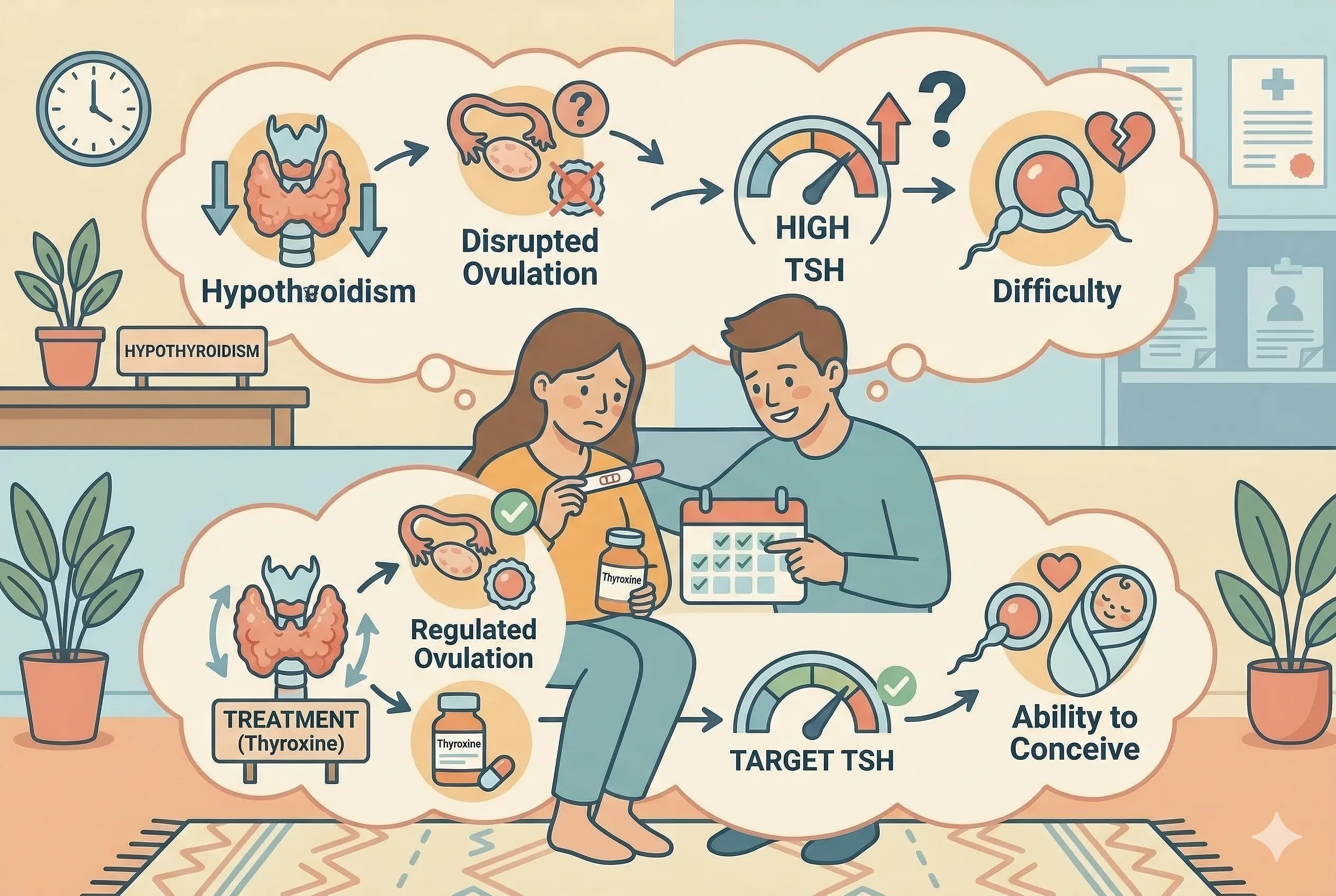
1. The HPT and HPG axes interact directly The hypothalamic-pituitary-thyroid (HPT) axis and the hypothalamic-pituitary-gonadal (HPG) axis share regulatory structures. Thyroid hormone deficiency elevates TRH (thyrotropin-releasing hormone), which in turn stimulates excess prolactin production. Elevated prolactin suppresses GnRH pulsatility, which disrupts FSH and LH secretion — the hormones that drive ovulation.
2. Thyroid hormones regulate sex hormone-binding globulin (SHBG) Hypothyroidism reduces SHBG levels. Lower SHBG means more androgens circulate freely, creating a hormonal environment that disrupts follicular development and the menstrual cycle — in some ways mirroring the hormonal profile of PCOS.
3. Thyroid hormone directly supports implantation and early placentation Thyroid hormone receptors are present in the endometrium. T3 directly stimulates the growth of endometrial cells and the development of the uterine lining. An underactive thyroid produces a thinner, less receptive endometrium — reducing the chances of successful implantation even when ovulation occurs.
4. Thyroid antibodies independently harm fertility Women with Hashimoto's thyroiditis — the autoimmune condition that causes most hypothyroidism — carry anti-thyroid antibodies (anti-TPO and anti-Tg). Research increasingly shows these antibodies are independently associated with reduced fertility, recurrent miscarriage, and poor IVF outcomes, even when TSH is within the standard normal range. The antibodies appear to directly interfere with implantation through immune mechanisms.
"In my clinical experience, thyroid disorders are one of the most rewarding diagnoses to make in a woman with unexplained infertility," says medical experts**. "Once identified and treated correctly, the improvement in reproductive outcomes can be remarkable — often without any other intervention needed."
Types of Thyroid Disorder and Their Fertility Impact
Hypothyroidism (Underactive Thyroid)
The most common thyroid disorder overall and the most impactful on fertility. In hypothyroidism, the thyroid produces insufficient hormone. The body's response is to raise TSH — so a high TSH typically indicates hypothyroidism.
Fertility effects:
- Anovulation (cycles without ovulation) or luteal phase deficiency
- Irregular, heavy, or prolonged periods
- Elevated prolactin (hyperprolactinaemia)
- Reduced endometrial receptivity
- Increased miscarriage risk
- Reduced IVF implantation rates
Common symptoms beyond fertility:
- Fatigue and low energy disproportionate to activity
- Weight gain with no dietary change
- Cold intolerance
- Constipation
- Dry skin, hair, nails
- Brain fog and poor concentration
- Low mood or depression
- Slow heart rate and low blood pressure
Subclinical Hypothyroidism
Subclinical hypothyroidism is defined as a TSH above the normal upper limit with normal T4 levels — meaning the thyroid is beginning to underperform but has not yet produced overt hormone deficiency.
This is a critical distinction for fertility because subclinical hypothyroidism — often dismissed as "not really hypothyroid" — is independently associated with:
- Increased risk of miscarriage (multiple meta-analyses confirm this)
- Reduced IVF success rates
- Adverse pregnancy outcomes even before symptoms appear
The debate in reproductive medicine is where the treatment threshold should sit. This is addressed below.
Hyperthyroidism (Overactive Thyroid)
An overactive thyroid, characterised by low TSH and elevated T3/T4, also disrupts fertility — though less commonly than hypothyroidism.
Fertility effects:
- Menstrual irregularity (often lighter, shorter periods or amenorrhoea)
- Ovulatory dysfunction
- Increased risk of miscarriage and preterm birth
Hyperthyroidism is beyond the scope of this post's depth, but the principle is the same: thyroid hormones outside the optimal range — in either direction — impair reproductive function.
TSH Target Levels: What the Numbers Mean for Fertility and Pregnancy
This is where clinical guidance has evolved significantly in the past decade, and where many women receive outdated advice.
Standard TSH Reference Range vs. Fertility-Specific Targets
| Context | TSH Target |
|---|---|
| Standard laboratory normal range | 0.4–4.0 mIU/L (varies by lab) |
| Trying to conceive (TTC) | < 2.5 mIU/L (recommended by most reproductive endocrinologists) |
| First trimester of pregnancy | < 2.5 mIU/L |
| Second trimester | < 3.0 mIU/L |
| Third trimester | < 3.5 mIU/L |
The critical point: A TSH of 3.8 mIU/L is within the standard "normal" laboratory range and will typically not prompt treatment in a general medicine context. But for a woman trying to conceive, a TSH of 3.8 mIU/L is now considered suboptimal by most reproductive specialists, and treatment or optimisation is often recommended.
This matters because many women are told their thyroid is "fine" based on a TSH of 3.0–4.0 — when in fact their thyroid function is at a level that reproductive medicine considers impaired for conception purposes.
| TSH Level Range | Conception & Fertility Impact | Clinical Action & Guidelines |
|---|---|---|
| < 0.1 mIU/L (Low TSH) | Hyperthyroidism. Associated with anovulation, menstrual cycle irregularities (missed/light periods), and elevated early miscarriage risk. | Requires further testing for Free T3 and Free T4. Adjust dosage if currently on thyroid hormone replacement. |
| 0.1 – 2.5 mIU/L (Optimal) | Ideal fertility zone. Promotes regular ovulation, strong luteal phase timing, and high endometrial receptivity for implantation. | Target range for trying to conceive (TTC) and throughout the first trimester. Maintain current regime. |
| 2.5 – 4.0 mIU/L (Suboptimal) | Subclinical Hypothyroidism. Double the standard risk of early miscarriage and reduced IVF implantation rates, despite normal Free T4. | Low-dose levothyroxine treatment is strongly considered for fertility optimization, especially if positive for anti-TPO antibodies. |
| > 4.0 mIU/L (High TSH) | Overt Hypothyroidism. Frequently causes ovulatory dysfunction (anovulation), luteal phase defect, thinner uterine lining, and high rates of pregnancy loss. | Levothyroxine therapy is standard clinical practice to safely lower TSH below 2.5 mIU/L before conception. |
Why the Pregnancy TSH Targets Are Lower
During the first trimester, the developing fetus has no functioning thyroid of its own. It is entirely dependent on the mother's thyroid hormones for the first 10–12 weeks of pregnancy. This period coincides with the most critical phase of fetal brain and nervous system development. Adequate maternal thyroid hormone in early pregnancy is essential for:
- Normal fetal neurological development
- Prevention of intellectual impairment and developmental delays
- Normal placental function and fetal growth
The hCG surge of early pregnancy naturally stimulates the thyroid and slightly lowers TSH — the pregnant thyroid is working harder. A thyroid that is already borderline underactive may not be able to meet this increased demand, resulting in inadequate hormone supply to the developing fetus even when pre-pregnancy TSH was "acceptable."
Thyroid Antibodies and Fertility: The Underrecognised Risk
Women with positive anti-TPO antibodies — indicating Hashimoto's autoimmune thyroiditis — face elevated fertility and pregnancy risks even when TSH is normal:
- Miscarriage risk is approximately 2–3× higher in women with positive anti-TPO antibodies, even with normal TSH, compared to antibody-negative women
- IVF outcomes are significantly worse in antibody-positive women
- The mechanism appears to involve local immune dysregulation at the level of the endometrium and placenta, not just systemic thyroid hormone deficiency
What this means practically: If you are struggling with recurrent miscarriage or infertility and your TSH is normal, testing for anti-TPO and anti-Tg antibodies is warranted. A normal TSH does not rule out clinically relevant thyroid autoimmunity.
The therapeutic question of whether levothyroxine treatment in euthyroid (normal TSH) antibody-positive women improves outcomes is actively debated. Several trials show benefit for miscarriage reduction; others are less conclusive. This is an evolving area — discuss the current evidence with your specialist.
Getting Tested: What Your Doctor Should Check
A comprehensive thyroid evaluation for a woman trying to conceive should include:
| Test | What It Measures | Why It Matters |
|---|---|---|
| TSH | Pituitary signal to the thyroid | Primary screening test; elevated = underactive thyroid |
| Free T4 (FT4) | Active thyroid hormone level | Confirms whether TSH elevation reflects true hormone deficiency |
| Free T3 (FT3) | Most active thyroid hormone | Some women have normal T4 but poor T4-to-T3 conversion |
| Anti-TPO antibodies | Immune attack on thyroid | Predicts risk even when TSH is normal |
| Anti-Tg antibodies | Second autoimmune marker | Detected in some women who are anti-TPO negative |
When to test: Ideally before you start trying to conceive, or within the first few months of trying. Certainly before any fertility treatment. All women undergoing IVF should have thyroid function assessed.
Treatment: Levothyroxine Before and During Pregnancy
Pre-Conception Treatment
For women with hypothyroidism (TSH above the treatment threshold) who are trying to conceive, levothyroxine (synthetic T4) is the standard treatment. It is safe, well-tolerated, and when dosed correctly, it effectively normalises thyroid function and reverses the fertility-impairing effects.
Key points:
- Dose is adjusted by weight and TSH response — starting doses are typically 25–50 mcg daily
- TSH should be rechecked 6–8 weeks after starting or changing dose
- The goal before conception is TSH < 2.5 mIU/L
- Levothyroxine should be taken on an empty stomach, 30-60 minutes before food and at least 4 hours away from calcium, iron, or antacid supplements (all reduce absorption significantly)
During Pregnancy
Thyroid hormone requirements increase by approximately 30–50% during pregnancy, beginning in the first trimester. Women already on levothyroxine before pregnancy should increase their dose immediately upon a positive pregnancy test — most reproductive endocrinologists recommend increasing by approximately 30% (2 extra doses per week) as a first step, then adjusting based on TSH levels.
This is not optional — the consequence of inadequate thyroid hormone in early pregnancy is fetal neurological impairment. Do not wait for your next scheduled appointment if you get a positive test.
Thyroid function should be checked every 4 weeks for the first 20 weeks of pregnancy, then every 6–8 weeks thereafter.
Postpartum
Postpartum thyroiditis — a transient thyroid inflammation occurring in 5–10% of women after delivery — can cause a hyperthyroid phase (weeks 1–4 postpartum) followed by a hypothyroid phase (months 2–6 postpartum). It is frequently misdiagnosed as postnatal depression or postpartum anxiety. Symptoms include fatigue, low mood, anxiety, weight changes, and palpitations. Women with pre-existing Hashimoto's are at particularly elevated risk.
A TSH check at 6-12 weeks postpartum is appropriate for any woman with a history of thyroid disorder, previous postpartum thyroiditis, or symptoms suggestive of thyroid dysfunction postpartum.
Practical Steps If You Suspect a Thyroid Issue
- Request a full thyroid panel from your GP or gynaecologist: TSH, free T4, anti-TPO, anti-Tg
- Know your numbers — get a copy of your results. A TSH of 3.5 with positive antibodies is not the same as a TSH of 1.2 with negative antibodies, even if both are "within normal limits"
- If TSH is above 2.5 and you are trying to conceive, discuss treatment with a doctor familiar with current reproductive medicine guidelines — not all general practitioners are aware of the lower fertility-specific thresholds
- If your TSH is "normal" but you are struggling to conceive, ensure antibodies have been checked
- If pregnant, notify your doctor immediately so thyroid function can be assessed in the first trimester and dose adjusted if needed
Frequently Asked Questions (FAQ)
Q: Can hypothyroidism cause infertility even with regular periods? A: Yes. Regular periods do not guarantee ovulation — cycles can appear regular while being anovulatory, or ovulation may occur but the luteal phase may be too short to support implantation. Hypothyroidism can impair fertility through endometrial receptivity and immune mechanisms even when cycles appear normal. A TSH test and, ideally, ovulation confirmation are both necessary parts of a fertility workup.
Q: What TSH level should I aim for when trying to get pregnant? A: Most reproductive endocrinologists and fertility specialists recommend a TSH below 2.5 mIU/L when actively trying to conceive. This is lower than the standard laboratory upper limit of 4.0 mIU/L. If your TSH is between 2.5 and 4.0 and you have been trying to conceive for several months without success, discuss whether treatment is appropriate for your specific situation.
Q: My TSH is normal but I have positive anti-TPO antibodies. Does this affect my fertility? A: Yes, potentially. Anti-TPO antibody positivity is independently associated with increased miscarriage risk and reduced IVF success rates, even with normal TSH. The antibodies appear to exert local immune effects at the endometrium and early placenta. Testing antibodies as part of a comprehensive fertility workup — not just TSH — is important for women struggling to conceive or experiencing recurrent loss.
Q: I am already on levothyroxine. Do I need to change anything when I get pregnant? A: Yes, immediately. Thyroid hormone requirements increase by 30–50% in early pregnancy. Do not wait for a scheduled appointment — increase your dose as discussed with your doctor in advance, and have your TSH checked within 4 weeks of the positive test. Most specialists recommend adding 2 extra doses per week (your current daily dose taken 7 days a week instead of 5) as an immediate bridge adjustment.
Q: Can thyroid problems cause recurrent miscarriage? A: Yes. Both overt and subclinical hypothyroidism are associated with increased miscarriage risk. Anti-thyroid antibodies — even with normal TSH — are associated with a 2–3× higher rate of miscarriage. Thyroid function should be part of any recurrent miscarriage investigation. Treatment with levothyroxine in women with TSH above 2.5 and in antibody-positive women with TSH above 2.5 appears to reduce miscarriage risk based on available evidence.
Q: How long after starting levothyroxine will my fertility improve? A: TSH normalisation with levothyroxine typically takes 6–8 weeks to stabilise after each dose adjustment. The fertility benefits — restoration of regular ovulation, improved endometrial receptivity, correction of elevated prolactin — generally follow TSH normalisation. Most specialists recommend allowing 2–3 months of optimal TSH levels before concluding that thyroid treatment alone has not resolved fertility issues.
Q: Does the thyroid affect male fertility too? A: Yes, though less commonly discussed. Thyroid hormones play a role in sperm production, motility, and function. Hypothyroidism in men can reduce sperm count, impair motility, and increase DNA fragmentation. If a male partner has symptoms of thyroid dysfunction, testing is warranted as part of a comprehensive fertility evaluation.
Q: Is levothyroxine safe to take during pregnancy? A: Yes. Levothyroxine is synthetic T4 — chemically identical to the T4 your own thyroid produces. It crosses the placenta minimally, does not cause fetal abnormalities, and is the standard of care for treating hypothyroidism in pregnancy worldwide. Untreated or undertreated hypothyroidism in pregnancy carries far greater risks to fetal development than levothyroxine treatment.
References and Further Reading
-
American Thyroid Association — Thyroid and Fertility:
https://www.thyroid.org/thyroid-highlighted-article-june-2025/ -
American Thyroid Association — Guidelines for Thyroid Disease in Pregnancy (2017):
https://www.thyroid.org/professionals/ata-professional-guidelines -
British Thyroid Foundation — Pregnancy and thyroid disorders:
https://www.btf-thyroid.org/pregnancy-and-thyroid-disorders -
NHS — Underactive Thyroid (Hypothyroidism):
https://www.nhs.uk/conditions/underactive-thyroid-hypothyroidism -
ACOG — Thyroid Disease in Pregnancy:
https://www.acog.org/clinical/clinical-guidance/practice-bulletin/articles/2020/06/thyroid-disease-in-pregnancy -
NIH — National Institute of Diabetes and Digestive and Kidney Diseases — Thyroid Disease:
https://www.niddk.nih.gov/health-information/endocrine-diseases/pregnancy-thyroid-disease
Medical Disclaimer
This article is for informational and educational purposes only. It does not constitute medical advice, diagnosis, or treatment. Thyroid conditions require individual medical evaluation, appropriate blood testing, and treatment decisions made in partnership with a qualified healthcare provider. Do not adjust thyroid medication without medical guidance. If you are pregnant and have a thyroid condition, contact your healthcare provider immediately.
About the Author
Abhilasha Mishra is a health and wellness writer specializing in women's reproductive health, fertility, and endocrinology. She writes to ensure that complex clinical topics are communicated clearly and accessibly, helping women advocate effectively for their own care.