
Secondary Infertility: Why Can't I Get Pregnant Again?
Secondary infertility explained by an OB/GYN — why getting pregnant again can be harder than the first time, the most common causes by age, what testing involves, and when to stop waiting and seek help.
Try Related Tools
Use our source-informed calculators to get helpful insights.
Table of Contents
- What Is Secondary Infertility — and What Qualifies?
- Why Secondary Infertility Happens: The Most Common Causes
- When to Seek Help: The Right Timeframe
- The Investigation: What to Expect
- Treatment Options
- The Emotional Dimension: Ambiguous Grief
- Frequently Asked Questions (FAQ)
- References and Further Reading
What Is Secondary Infertility — and What Qualifies?
Secondary infertility is defined as the failure to conceive or carry a pregnancy to term after 12 months of regular, unprotected intercourse (or 6 months if the woman is 35 or older), in a couple who has previously achieved a successful pregnancy.
The key qualifying criteria:
- A previous successful pregnancy (live birth, or sometimes also prior pregnancies that ended in miscarriage — definitions vary by source)
- Current inability to conceive despite trying for the standard qualifying period
- No change in partner (new-partner infertility is its own category)
Secondary infertility is distinct from recurrent pregnancy loss (repeated miscarriages) — though the two can co-exist, and some causes overlap.
Why Secondary Infertility Happens: The Most Common Causes
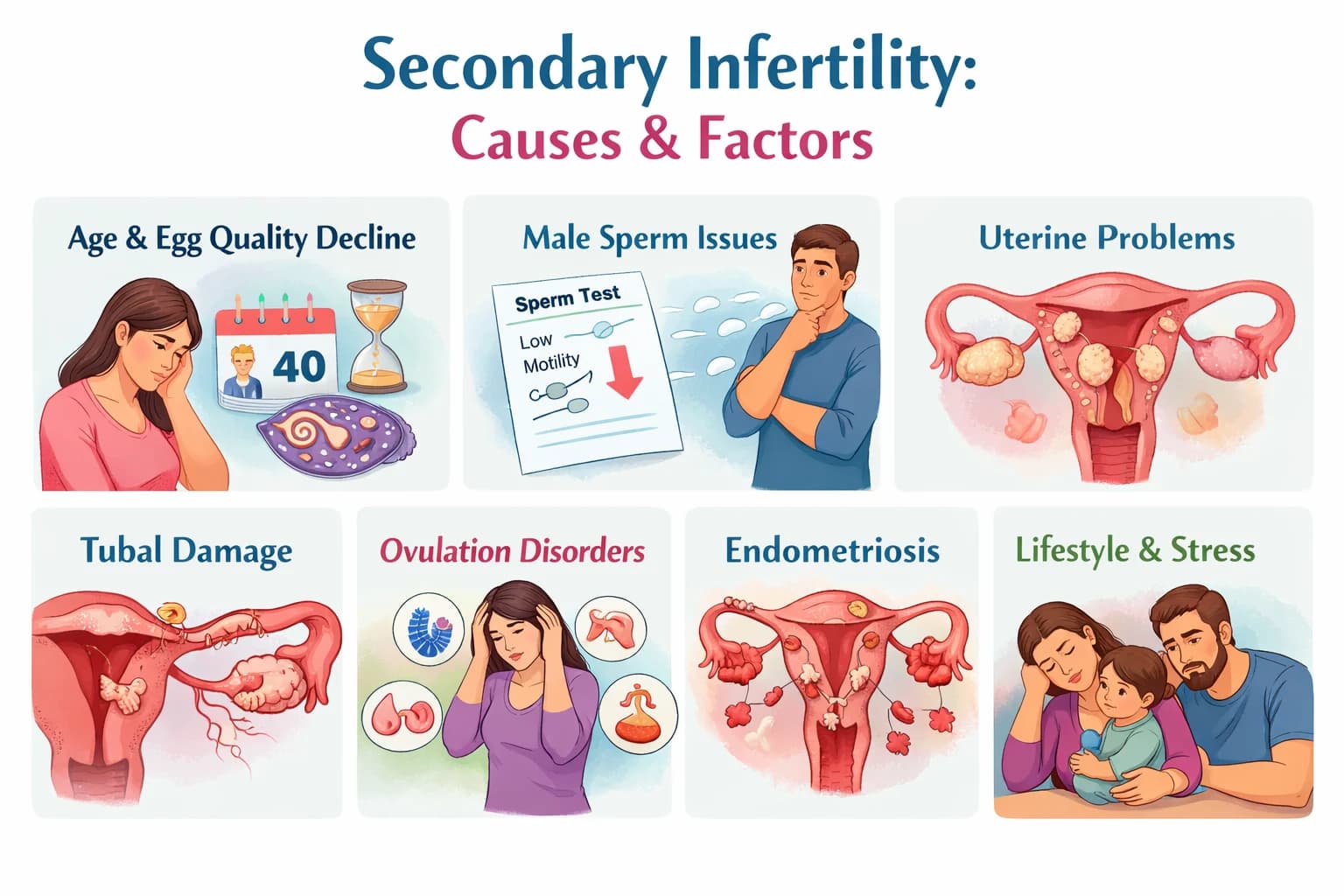
The causes of secondary infertility are largely the same as those of primary infertility — but the likelihood of specific causes shifts based on what has changed since the previous pregnancy.
1. Age-Related Decline in Ovarian Reserve and Egg Quality
The most common and most significant factor in secondary infertility when there is a meaningful gap between pregnancies. Female fertility declines with age, with the decline accelerating from approximately 35 and significantly more steeply from 38 onward.
A woman who conceived easily at 28 may find that conception at 35 or 37 is genuinely more difficult — not because anything is "wrong" in a pathological sense, but because the quantity and quality of available eggs has declined as a natural consequence of ageing.
The numbers matter: A 30-year-old has approximately a 20% chance of conceiving in any given cycle. By 40, this has fallen to approximately 5% per cycle. This is why time since the first pregnancy, and current age, are the most critical pieces of context in evaluating secondary infertility.
2. Changes in Sperm Quality
Male factor infertility accounts for 40–50% of all infertility — and sperm quality also declines with age, though less dramatically than female fertility. More significantly, sperm quality can be affected by:
- New lifestyle factors since the previous conception: increased alcohol, smoking, heat exposure, weight gain
- New medications (including testosterone therapy, which suppresses sperm production)
- New health conditions: diabetes, hypertension, varicocele (varicose veins of the scrotum — can develop or worsen over time)
- A new STI (chlamydia or gonorrhoea can cause epididymal damage without symptoms)
A semen analysis should be part of the secondary infertility evaluation — the partner who contributed sperm previously may not have equivalent sperm quality now.
3. Uterine Structural Changes Since the Previous Pregnancy
The uterus can change significantly in the time since the last pregnancy:
Fibroids (uterine leiomyomata): Benign muscle tumours that grow in or on the uterus. They are common (affecting up to 70% of women by age 50) and often asymptomatic, but submucosal fibroids (growing inside the uterine cavity) and intramural fibroids that distort the cavity impair implantation and increase miscarriage risk.
Intrauterine adhesions (Asherman's Syndrome): Scar tissue within the uterine cavity, typically resulting from a previous dilatation and curettage (D&C) — whether for a previous miscarriage, termination, or retained placenta after delivery. Asherman's syndrome reduces the surface area available for implantation and can cause absent or very light periods.
Uterine polyps: Small outgrowths of the uterine lining that can interfere with implantation, particularly when located near the tubal openings.
Retained products of conception: Rarely, a small amount of placental tissue retained from the previous delivery can impair subsequent conception.
4. New Tubal Disease
The fallopian tubes can become damaged between pregnancies through:
- Pelvic inflammatory disease (PID): From untreated chlamydia, gonorrhoea, or other pelvic infections — often subclinical and unrecognised
- Endometriosis: Progressive in many women; mild endometriosis at the time of the first pregnancy may have advanced to affect tubal function
- A previous ectopic pregnancy: Which may have resulted in tubal surgery
5. Ovulatory Dysfunction
New or worsening conditions that disrupt ovulation since the previous pregnancy:
- PCOS becoming more symptomatic with weight changes or age
- Thyroid dysfunction (particularly hypothyroidism — one of the most commonly missed causes of secondary infertility)
- Elevated prolactin (hyperprolactinaemia) — from a pituitary adenoma or from medications (antipsychotics, metoclopramide, some antihypertensives)
- Primary ovarian insufficiency — accelerated decline in ovarian function
- Hypothalamic amenorrhoea from low body weight, excessive exercise, or chronic stress
6. Endometriosis — New or Progressive
Endometriosis is a progressive condition for many women. A woman who had mild endometriosis (or undiagnosed endometriosis) at the time of her first pregnancy may now have more advanced disease that affects tubal function, creates an inflammatory pelvic environment hostile to fertilisation, and reduces ovarian reserve.
7. Changes in the Couple's Lifestyle and Circumstances
Less biological but equally real contributors:
- Reduced frequency of intercourse — a reality for many couples with young children, whose time, energy, and spontaneity are constrained
- Increased psychological stress — which affects the HPG axis and ovulation
- Postpartum weight changes that have not resolved — significant weight gain increases insulin resistance, affects androgen levels, and impairs ovulation
- Breastfeeding: Lactational amenorrhoea (the hormonal suppression of ovulation during breastfeeding) prevents conception and can persist well beyond exclusive breastfeeding if breastfeeding continues. This is a genuinely common and frequently unrecognised factor in couples trying to conceive while the previous child is still being breastfed.
When to Seek Help: The Right Timeframe
The standard guidance:
- Under 35: Seek evaluation after 12 months of regular unprotected intercourse without conception
- 35–39: Seek evaluation after 6 months
- 40 and above: Seek evaluation after 3 months, or immediately if preferred
Seek evaluation sooner regardless of how long you have been trying if:
- You have irregular or absent periods
- You have a known condition affecting fertility (PCOS, endometriosis, previous pelvic surgery, thyroid disorder)
- You have had recurrent miscarriages (two or more)
- Your partner has a known sperm issue
- You or your partner are in a higher age bracket for fertility
"Secondary infertility is often investigated too late because patients — and sometimes clinicians — assume that a previous successful pregnancy means fertility is intact," says medical experts**. "It is not always. The biology has changed. Evaluating early — particularly for women over 35 — is far better than waiting a year and then discovering that ovarian reserve has dropped significantly in the interim."
The Investigation: What to Expect
A secondary infertility evaluation follows the same framework as primary infertility:
Female Assessment
Ovarian reserve:
- AMH (Anti-Müllerian Hormone): Blood test measuring the hormone produced by developing follicles — an indicator of remaining egg quantity
- Antral Follicle Count (AFC): Ultrasound count of resting follicles visible in both ovaries — the most direct measure of ovarian reserve
Ovulatory function:
- Cycle history and menstrual pattern assessment
- Progesterone on day 21 (or 7 days post-confirmed ovulation) to confirm ovulation occurred
- TSH, prolactin, androgens if indicated
Uterine anatomy:
- Transvaginal ultrasound: First-line assessment for fibroids, polyps, and ovarian cysts
- Hysterosalpingogram (HSG): X-ray with contrast dye injected through the cervix to assess the uterine cavity shape and confirm tubal patency (open tubes)
- Saline infusion sonohysterography (SIS/SHG): Ultrasound with saline used to assess the uterine cavity in more detail — better than standard ultrasound for detecting small polyps and submucosal fibroids
- Hysteroscopy: Direct visualisation inside the uterine cavity — the gold standard for diagnosing and treating Asherman's syndrome, polyps, and uterine septa
Tubal patency:
- HSG as above, or laparoscopy with dye test if laparoscopy is being performed for another indication
Male Assessment
- Semen analysis (WHO 2021 reference criteria): volume, concentration, total motility, progressive motility, morphology
- Repeat analysis if first result is abnormal (significant variability between samples)
Treatment Options
Treatment depends entirely on the identified cause. Secondary infertility that has an identifiable, treatable cause often has excellent outcomes.
Ovulation Induction
For women with ovulatory dysfunction — PCOS, mild hormonal imbalance, hypothyroidism (treat the thyroid first):
- Clomiphene citrate (Clomid): Oral medication that stimulates follicular development
- Letrozole: Now preferred over Clomid for women with PCOS; better live birth rates with fewer multiple pregnancy risks
- Gonadotropin injections: For more aggressive stimulation when oral medications are insufficient
Uterine Surgery
- Hysteroscopic removal of polyps or submucosal fibroids (generally very effective for improving implantation)
- Hysteroscopic lysis of intrauterine adhesions (Asherman's syndrome) — outcomes depend on severity; mild-moderate Asherman's responds well to surgery
- Myomectomy (surgical removal of fibroids) for intramural fibroids significantly distorting the cavity
Tubal Surgery or IVF Bypass
- Mild adhesions or partial blockage may be treatable surgically or via HSG disruption
- Severe tubal disease: IVF bypasses the tubes entirely and is the most effective option
Intrauterine Insemination (IUI)
Appropriate for mild male factor, unexplained secondary infertility in younger women, or cervical factor. Less effective after 35–38. Often tried for 3–6 cycles before moving to IVF.
IVF
Appropriate for:
- Tubal factor
- Significant male factor
- Diminished ovarian reserve (banking embryos before further decline)
- Failed IUI cycles
- Age over 38 with unexplained secondary infertility
For understanding IVF success rates by age, our IVF Success Estimator provides age-stratified probability estimates.
The Emotional Dimension: Ambiguous Grief
Secondary infertility involves a form of grief that is socially ambiguous and often invalidated. Well-meaning comments — "at least you have one," "you should be grateful," "you could always adopt," "it will happen when you relax" — cause genuine harm, not because they are malicious, but because they minimise a real loss.
The desire for another child is not diminished by already having one. The experience of watching your existing child grow and not being able to give them a sibling they may have asked for is its own specific grief. Repeated failed cycles — the monthly cycle of hope and loss — has a cumulative emotional cost that is often dismissed because the couple already has a child.
This grief is real. It deserves acknowledgement. Psychological support — either through a counsellor experienced in infertility or a peer support community (the organisation RESOLVE in the US, or Fertility Network UK, are good starting points) — is as important as the medical investigation.
Frequently Asked Questions (FAQ)
Q: We got pregnant easily the first time. Why is it taking so long now? A: The most common reason is time — and specifically, age. Female fertility declines meaningfully from the mid-30s and significantly from 38. If there has been a gap of several years between pregnancies, ovarian reserve and egg quality may have changed substantially, even if nothing has gone "wrong." Other factors include new health conditions, changes in the male partner's sperm quality, uterine changes (fibroids, polyps), or new tubal damage. A structured evaluation identifies which factors are relevant.
Q: I am still breastfeeding. Could that be why I am not getting pregnant? A: Yes, very possibly. Lactational amenorrhoea — the hormonal suppression of ovulation caused by breastfeeding — can persist well beyond the point of exclusive breastfeeding. Elevated prolactin from breastfeeding suppresses GnRH and LH, preventing ovulation. If your periods have not returned, you are almost certainly not ovulating. If your periods have returned but you are still breastfeeding several times daily, ovulation may be occurring but luteal phase function may be impaired. For many women, weaning (partially or fully) is the first step in restoring fertility.
Q: Should my partner be tested too? A: Yes, always. Male factor contributes to infertility in 40–50% of cases, and sperm quality can change significantly in the years since the previous conception. A semen analysis is non-invasive, inexpensive, and provides critical information. Do not proceed with female-only investigations without a concurrent semen analysis.
Q: I had a D&C after my first pregnancy for a miscarriage. Could this have caused infertility? A: Possibly. D&C (dilatation and curettage) can occasionally cause intrauterine adhesions — known as Asherman's syndrome — which impair the uterine lining and reduce implantation success. Symptoms include significantly lighter periods, absent periods, or recurrent early pregnancy loss. A hysteroscopy is the definitive investigation for suspected Asherman's, and surgical treatment is effective in most cases.
Q: How many cycles of IUI should we try before moving to IVF? A: Most fertility specialists recommend a maximum of 3–6 IUI cycles in women under 38 with good ovarian reserve and no severe male factor before recommending IVF. For women 38 and above, or those with diminished ovarian reserve, the evidence supports moving to IVF sooner — typically after 2–3 IUI cycles or even directly to IVF — because the cumulative success rate of multiple IUI cycles is lower than a single IVF cycle in this group, and time is a critical factor.
Q: At what point should we consider using donor eggs? A: Donor eggs become a realistic consideration when ovarian reserve is significantly diminished (very low AMH), when multiple IVF cycles using own eggs have failed, or when the woman is in a stage of perimenopause or early menopause. The age at which this becomes clinically relevant varies, but for most women it is in the 42–45 range for own-egg IVF, earlier if reserve testing shows premature decline. This is a deeply personal decision that should be made with full information about your individual prognosis.
Q: We have unexplained secondary infertility — all tests are normal. What now? A: Unexplained infertility — where investigation reveals no identifiable cause — is diagnosed in approximately 20–30% of infertile couples. Options include: continued expectant management with optimised timing (timed intercourse), ovulation induction with IUI (which modestly improves per-cycle probability by increasing egg number and optimising timing), or IVF (which bypasses many potential subtle barriers to fertilisation). The right choice depends on age, duration of trying, and the couple's preferences. A fertility specialist can model the probability of spontaneous conception versus treatment options for your specific situation.
Q: How do I deal with the emotional impact of secondary infertility when everyone tells me to be grateful for my first child? A: The grief of secondary infertility is real and legitimate, regardless of whether you already have children. "At least you have one" is not a comfort — it is an invalidation. Consider connecting with others who have experienced secondary infertility (RESOLVE, Fertility Network UK, and online communities are good starting points), working with a counsellor experienced in fertility grief, and being honest with close friends and family about what you need from them in terms of support versus unsolicited advice.
References and Further Reading
-
ASRM — Secondary Infertility:
https://www.reproductivefacts.org/news-and-publications/patient-fact-sheets-and-booklets -
ACOG — Evaluating Infertility for the Women's Health Specialist:
https://www.acog.org/womens-health/faqs/evaluating-infertility -
NHS — Infertility:
https://www.nhs.uk/conditions/infertility -
NICE Guideline CG156 — Fertility: Assessment and Treatment:
https://www.nice.org.uk/guidance/cg156 -
Fertility Network UK:
https://fertilitynetworkuk.org
Medical Disclaimer
This article is for informational and educational purposes only. It does not constitute medical advice, diagnosis, or treatment. Secondary infertility has many possible causes, most of which require specific medical investigation and individualised treatment. If you are experiencing difficulty conceiving after a previous pregnancy, please consult your gynaecologist, obstetrician, or a reproductive medicine specialist for a personalised evaluation. Do not delay seeking help based on the assumption that a previous successful pregnancy guarantees future fertility.
About the Author
Abhilasha Mishra is a health and wellness writer specializing in fertility, reproductive medicine, and the emotional dimensions of the conception journey. She writes with compassion for those navigating infertility in all its forms — including the complex, often invisible experience of secondary infertility.