
Postpartum Rage: Is It Normal?
Postpartum rage explained by an OB/GYN: why anger after baby is a symptom of mood disorders, causes, and how to get help.
Try Related Tools
Use our source-informed calculators to get helpful insights.
Table of Contents
- What Is Postpartum Rage?
- What Does Postpartum Rage Feel Like?
- Why Does Postpartum Rage Happen?
- Postpartum Rage vs. Baby Blues vs. PPD: How to Tell Them Apart
- The Impact on Relationships and Parenting
- What Actually Helps
- A Note to Partners
- Frequently Asked Questions (FAQ)
- References and Further Reading
What Is Postpartum Rage?
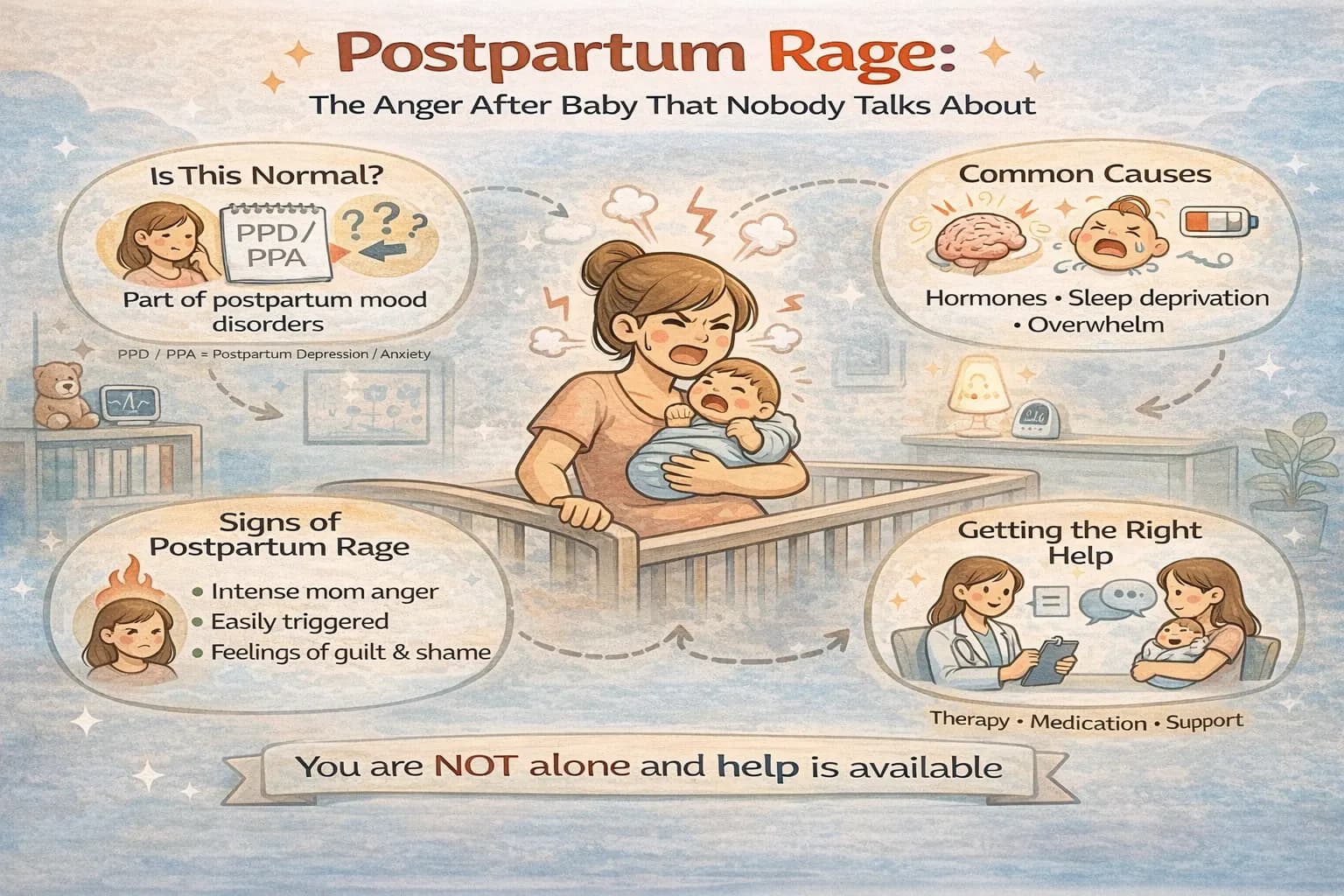
Postpartum rage describes episodes of intense, disproportionate anger experienced in the weeks and months after childbirth. It is not a standalone diagnosis in the DSM-5 — rather, it is a recognised symptom cluster within the broader spectrum of perinatal mood and anxiety disorders (PMADs), most commonly associated with:
- Postpartum anxiety (PPA) — often the primary driver; the anger is frequently anxiety expressing itself through irritability rather than fear
- Postpartum depression (PPD) — where irritability and anger are often more prominent than sadness, particularly in some women and almost universally in men with postpartum depression
- Postpartum OCD — intrusive thoughts paired with extreme emotional reactivity
- Postpartum PTSD — following a traumatic birth experience
Irritability is formally listed as a diagnostic criterion for both major depressive episodes and generalised anxiety disorder. Yet when clinicians screen for postpartum depression using standard tools like the Edinburgh Postnatal Depression Scale (EPDS), the question about irritability is present but weighted less heavily than questions about sadness — meaning women whose primary symptom is rage rather than tearfulness are systematically more likely to be missed.
"Postpartum rage is one of the symptoms I find most important to ask about directly," says medical experts**. "Many women will answer 'no' to questions about feeling sad or hopeless but will describe rage they find terrifying if I ask specifically about anger. It is the same underlying disorder presenting through a different emotional channel — and it needs the same attention."
What Does Postpartum Rage Feel Like?
Postpartum rage is distinct from the ordinary frustration any parent feels. The distinguishing features are:
Intensity disproportionate to the trigger. The baby's cry, a thoughtless comment, a partner who forgot to do something — these are normal life events. In postpartum rage, the response is not normal-magnitude irritation; it is an almost uncontrollable explosion of feeling that seems completely out of proportion.
Rapidity of onset. The anger arrives in an instant — zero to overwhelming in a moment. There is no gradual build, no time to notice it coming and apply a brake.
Physical manifestations. Clenched jaw, racing heart, trembling hands, a sensation of heat rising through the body. The rage has a physical quality that ordinary frustration does not.
Loss of control or fear of losing it. Many mothers describe a terrifying sense of being on the edge of doing something — screaming, throwing something, shaking the baby — and the fear this creates is often more distressing than the anger itself. (If you have ever had the intrusive thought of harming your baby and been horrified by it — these are ego-dystonic intrusive thoughts, meaning thoughts that are completely contrary to your desires and values. They are a feature of postpartum anxiety and OCD, not a sign that you are dangerous.)
Followed by intense guilt and shame. After the wave passes, the mother is often left with profound guilt about the anger, ruminating about what it means, convinced it makes her a bad mother.
Recurring and escalating. Unlike an isolated bad day, postpartum rage returns repeatedly, often becoming more frequent or more intense over time without intervention.
Why Does Postpartum Rage Happen?
The Hormonal Crash
In the 24–72 hours after birth, oestrogen and progesterone levels fall by approximately 100-fold — one of the fastest hormonal drops in human biology. Both hormones have significant effects on neurotransmitter systems:
- Oestrogen modulates serotonin, dopamine, and norepinephrine. Its sudden withdrawal destabilises the emotional regulation systems that depend on these neurotransmitters.
- Progesterone has GABA-A receptor modulating effects — it functions similarly to a natural anxiolytic. Its withdrawal removes this calming influence abruptly.
The result is a nervous system that has lost its buffering capacity — more reactive, less able to return to baseline after stress, more prone to the rapid emotional escalation that characterises rage.
Sleep Deprivation
Chronic sleep deprivation produces measurable neurological changes that are directly relevant to emotional regulation. The prefrontal cortex — the brain region responsible for impulse control, emotional regulation, and the ability to pause before reacting — is exquisitely sensitive to sleep loss. After even one night of significantly disrupted sleep, prefrontal cortex activity is reduced, amygdala reactivity increases, and emotional responses become more intense and more difficult to inhibit.
New parents are subjected to weeks and months of this — accumulating a sleep debt that progressively erodes the neurological systems that allow measured, proportionate emotional responses.
The Invisible Load
Postpartum rage is not purely hormonal or neurological. It is also a response to a genuine situational reality that is frequently not acknowledged:
- The relentlessness of infant care — the absence of autonomy, the constant demand on the body
- The asymmetry in how the postpartum period is often distributed between partners
- The loss of professional identity, social connection, and the self that existed before
- The gap between the imagined experience of motherhood and its reality
- The isolation — particularly in the early weeks when visitors have stopped coming but the hardest part is still ongoing
- The pressure to be grateful, to love every moment, to present a version of motherhood that does not include rage
Anger is often a signal that a genuine need is not being met — for rest, for recognition, for help, for autonomy. In this context, postpartum rage is not only a hormonal or neurological event. It is also the body's response to an untenable situation.
Postpartum Rage vs. Baby Blues vs. PPD: How to Tell Them Apart
Understanding where on the spectrum you are helps determine what kind of support is needed.
Baby Blues (Days 1–14 Postpartum)
The baby blues affect up to 80% of women in the first two weeks after birth. They are characterised by tearfulness, emotional lability (crying one moment, laughing the next), irritability, and feeling overwhelmed. They are caused directly by the hormonal crash and are expected and self-limiting — they resolve within the first two weeks as hormone levels stabilise.
Baby blues that include irritability and irritability that resolves within two weeks are not postpartum rage.
Postpartum Rage (As Part of PPD or PPA)
Distinguishing features:
- Onset can be any time in the first year — not necessarily the first days
- Does not resolve spontaneously over two weeks
- Escalates or persists without treatment
- Impairs daily functioning — affecting relationships, parenting capacity, ability to care for the baby
- Often accompanied by anxiety symptoms (racing thoughts, hypervigilance, physical tension), low mood, inability to rest even when given the opportunity
What Requires Urgent Assessment
Seek same-day medical assessment if:
- You are having thoughts of harming yourself or your baby that feel compelling (not the distressing intrusive thoughts described above, but genuine urges)
- You feel disconnected from reality, are seeing or hearing things that are not there
- You cannot care for yourself or your baby due to the severity of your emotional state
- You are in a postpartum psychosis — an acute psychiatric emergency characterised by confusion, paranoia, hallucinations, and severe disorganisation
The Impact on Relationships and Parenting
Postpartum rage rarely stays contained. It finds targets — most commonly the partner, who receives the full force of the anger because they are present, because they represent the closest relationship, and because the underlying anger often is at least partly directed at the changed relationship dynamic.
This can severely damage the partnership at a time when the relationship is already under maximum stress. Partners who do not understand what is happening may respond defensively, withdraw, or retaliate — escalating conflict rather than providing support.
Mothers are also frequently distressed about the anger they feel toward their baby — particularly when sleep deprivation, constant physical demand, and lack of identity have eroded the emotional reserves that normally buffer against frustration. This is one of the most taboo experiences in new motherhood — admitting anger toward your infant — and yet it is extremely common and does not reflect on the quality of your love or parenting.
What Actually Helps
Professional Treatment
Therapy: Cognitive Behavioural Therapy (CBT) and Acceptance and Commitment Therapy (ACT) have the strongest evidence base for postpartum mood disorders. A therapist experienced in perinatal mental health can help identify triggers, develop regulation strategies, and address the underlying anxiety or depression driving the rage.
Medication: SSRIs and SNRIs are the primary pharmacological treatment for postpartum depression and anxiety. Several are compatible with breastfeeding — sertraline and paroxetine have the most data in breastfeeding women. The decision about medication should involve a frank conversation with your doctor about the risk of untreated postpartum mood disorder (which is real, including effects on infant attachment and development) versus the risk of medication.
Seek referral promptly. There is no benefit to waiting to see if it gets better on its own. Postpartum mood disorders treated early respond better and resolve faster. If your GP, midwife, or obstetrician does not take your symptom report seriously, ask explicitly for a referral to a perinatal mental health service.
Nervous System Regulation Strategies
In the immediate moment of rage onset:
- Physiological sigh: A double inhale through the nose followed by a long, slow exhale. This is the fastest-acting method of activating the parasympathetic nervous system and reducing physiological arousal.
- Cold water on the wrists or face: Triggers the diving reflex, slowing heart rate and reducing acute arousal.
- Physical removal from the situation if possible: Put the baby safely in their cot and step outside for 60 seconds. A brief gap breaks the escalation cycle.
- Name the feeling: "I am feeling very angry right now." This engages the prefrontal cortex and modestly reduces amygdala reactivity — the neurological basis of what is sometimes called "name it to tame it."
These are moment-to-moment strategies, not treatment. They help you stay safe in the immediate moment; they do not address the underlying disorder.
Address the Underlying Needs
If the rage is partly situational — driven by genuine exhaustion, isolation, an unequal distribution of domestic and infant labour — these need to be addressed directly. This requires honest communication with your partner, practical problem-solving, and possibly renegotiating expectations.
Questions worth asking openly:
- Am I getting any uninterrupted sleep, even a few hours?
- Am I getting any time that is genuinely mine — not baby time, not task time?
- Do I have a person (not just my partner) who asks how I am and actually listens?
- Am I being honest about how difficult this is, or am I performing wellness?
Community and Peer Support
Isolation amplifies postpartum rage. Knowing that other mothers are experiencing the same thing — normalising the experience without minimising it — has significant therapeutic value. Peer support groups (in person or online) for postpartum mood disorders provide this. Postpartum Support International (PSI) maintains a helpline and a provider directory.
A Note to Partners
If your partner is experiencing postpartum rage, the most important thing to understand is that the anger is the symptom, not the message. She is not telling you that she hates you, that you are a bad partner, or that the relationship is over. She is telling you, through the only channel currently available to her overwhelmed nervous system, that she is drowning.
What helps most:
- Listen without defending yourself — right now, the priority is that she feels heard
- Reduce her cognitive and physical load actively and without being asked
- Encourage her to seek professional support and offer to arrange it if needed
- Take over at least one full night per week so she can sleep continuously
- Do not ask "what can I do?" — look around and do what needs doing
What does not help:
- Telling her she is overreacting
- Withdrawing to protect yourself
- Competing by cataloguing your own exhaustion
- Treating her as the problem rather than her disorder as the problem
Frequently Asked Questions (FAQ)
Q: Is postpartum rage normal? A: Experiencing some irritability and emotional reactivity in the postpartum period is very common and related to hormonal changes, sleep deprivation, and the adjustment to new parenthood. However, rage that is intense, recurring, difficult to control, and persisting beyond the first two weeks is a symptom of a postpartum mood disorder — specifically postpartum anxiety or depression. It is common, but it is not something to simply endure. It is treatable.
Q: Can postpartum rage happen to fathers or non-birthing parents? A: Yes. Postpartum depression and anxiety affect approximately 10% of fathers and non-birthing parents. The presentation in men more commonly features irritability, anger, and withdrawal rather than sadness and tearfulness — meaning postpartum rage may actually be more characteristic of how PPMD presents in men than in women. Paternal postpartum depression is significantly underdiagnosed.
Q: I had a thought about hurting my baby and I am terrified. What does this mean? A: Intrusive thoughts about harming your baby — thoughts that come unbidden, feel horrifying, and are completely contrary to what you want — are a recognised feature of postpartum anxiety and postpartum OCD. They are ego-dystonic, meaning they are opposed to your values and desires. Having an intrusive thought does not mean you are dangerous or that you will act on it. These thoughts are extremely common (studies suggest up to 90% of new parents have some version of them) and they require compassionate clinical support, not shame. Please tell your healthcare provider.
Q: How long does postpartum rage last without treatment? A: Untreated postpartum mood disorders can persist for 12 months or more and in some cases become chronic. With appropriate treatment — therapy, medication where indicated, and addressing situational stressors — most women show significant improvement within 6-12 weeks. Early treatment consistently produces better and faster outcomes.
Q: Will medication affect my breastmilk and my baby? A: Sertraline and paroxetine are the SSRIs with the most data in breastfeeding women, with very low levels detected in breast milk and no demonstrated adverse effects in breastfed infants. The risk of untreated severe postpartum anxiety or depression — including impaired mother-infant attachment, reduced feeding responsiveness, and effects on the infant's own stress regulation system — is real and should be weighed against the very low risk of appropriate medication. Discuss this honestly with your doctor; the goal is a decision that is informed, not one driven by stigma.
Q: How do I bring this up with my midwife or doctor? A: Being specific and direct is more effective than general expressions of struggling. Say something like: "I have been experiencing episodes of intense anger that feel out of control — more than just ordinary frustration. It is happening regularly and it is frightening me. I think I might have postpartum anxiety or depression and I want to be assessed." If your concern is not taken seriously or you are told to "wait and see," ask specifically for a referral to a perinatal mental health service.
Q: Is postpartum rage linked to a traumatic birth? A: Yes. Postpartum PTSD, which can follow a traumatic birth experience, often features heightened irritability, emotional reactivity, and rage as part of the hyperarousal symptom cluster. If your birth involved an emergency, loss of control, feeling unheard or unsafe, or a significant physical injury, and you are now experiencing anger and reactivity alongside other PTSD symptoms (flashbacks, avoidance, sleep disturbance), PTSD-specific treatment (EMDR, trauma-focused CBT) may be the most appropriate intervention.
Q: I feel rage toward my baby sometimes. Does this make me a bad mother? A: No. It makes you a depleted, overwhelmed human being in an extraordinarily demanding situation with an under-supported nervous system. The fact that you are asking this question — the distress you feel about it — is evidence that you care deeply about your child. Feeling anger toward your infant is not the same as harming them or not loving them. It is, however, a signal that you need more support than you are currently receiving.
References and Further Reading
-
Postpartum Support International (PSI):
https://www.postpartum.net -
ACOG — Postpartum Depression:
https://www.acog.org/womens-health/faqs/postpartum-depression -
NHS — Postnatal Depression:
https://www.nhs.uk/mental-health/conditions/post-natal-depression -
NICE Guideline CG192 — Antenatal and Postnatal Mental Health:
https://www.nice.org.uk/guidance/cg192 -
Wisner KL et al. — Onset Timing, Thoughts of Self-Harm, and Diagnoses in Postpartum Women (JAMA Psychiatry, 2013):
https://pubmed.ncbi.nlm.nih.gov/23487258/ -
MGH Center for Women's Mental Health — Postpartum Psychiatric Disorders:
https://womensmentalhealth.org/specialty-clinics/postpartum-psychiatric-disorders
Medical Disclaimer
This article is for informational and educational purposes only. It does not constitute medical advice, diagnosis, or treatment. Postpartum mood disorders are serious medical conditions that require professional assessment and treatment. If you are experiencing symptoms consistent with postpartum depression, anxiety, or rage, please contact your healthcare provider, midwife, or a perinatal mental health specialist. If you are having thoughts of harming yourself or your baby, contact emergency services or a crisis line immediately.
About the Author
Abhilasha Mishra is a health and wellness writer specializing in maternal mental health, postpartum recovery, and women's emotional wellbeing. She writes to give voice to the experiences that new mothers are most afraid to name, and to ensure they know they are not alone and that help is available.