
Speech Delay in Toddlers: Red Flags & Milestones
Speech delay in toddlers explained by an OB/GYN: exact language milestones by age, warning signs requiring evaluation, and early intervention.
Try Related Tools
Use our source-informed calculators to get helpful insights.
Table of Contents
- Understanding Speech vs. Language Delay
- Speech and Language Milestones by Age
- Absolute Red Flags: Seek Evaluation Immediately
- What Causes Speech Delay?
- The Assessment Process: What to Expect
- Early Intervention: What It Involves and Why It Works
- Frequently Asked Questions (FAQ)
- References and Further Reading
Understanding Speech vs. Language Delay
Before examining milestones, an important distinction:
Speech refers to the physical production of sounds — articulation, fluency, and voice. A speech delay or speech disorder specifically involves difficulties producing clear speech sounds.
Language refers to the broader system of communication — understanding (receptive language) and expressing (expressive language) meaning through words, sentences, and context. A language delay involves falling behind in the acquisition of vocabulary, grammar, or the ability to understand what others say.
These often overlap, but the distinction matters:
- A child with a pure expressive language delay understands everything said to them but speaks less than expected — often a better prognosis, more likely to resolve spontaneously
- A child with receptive and expressive delay — who neither understands nor speaks at the expected level — has a more significant delay that almost always requires intervention
- A child who is not communicating at all — no words, no gestures, no pointing, no eye contact — requires urgent evaluation, as this pattern is associated with autism spectrum disorder
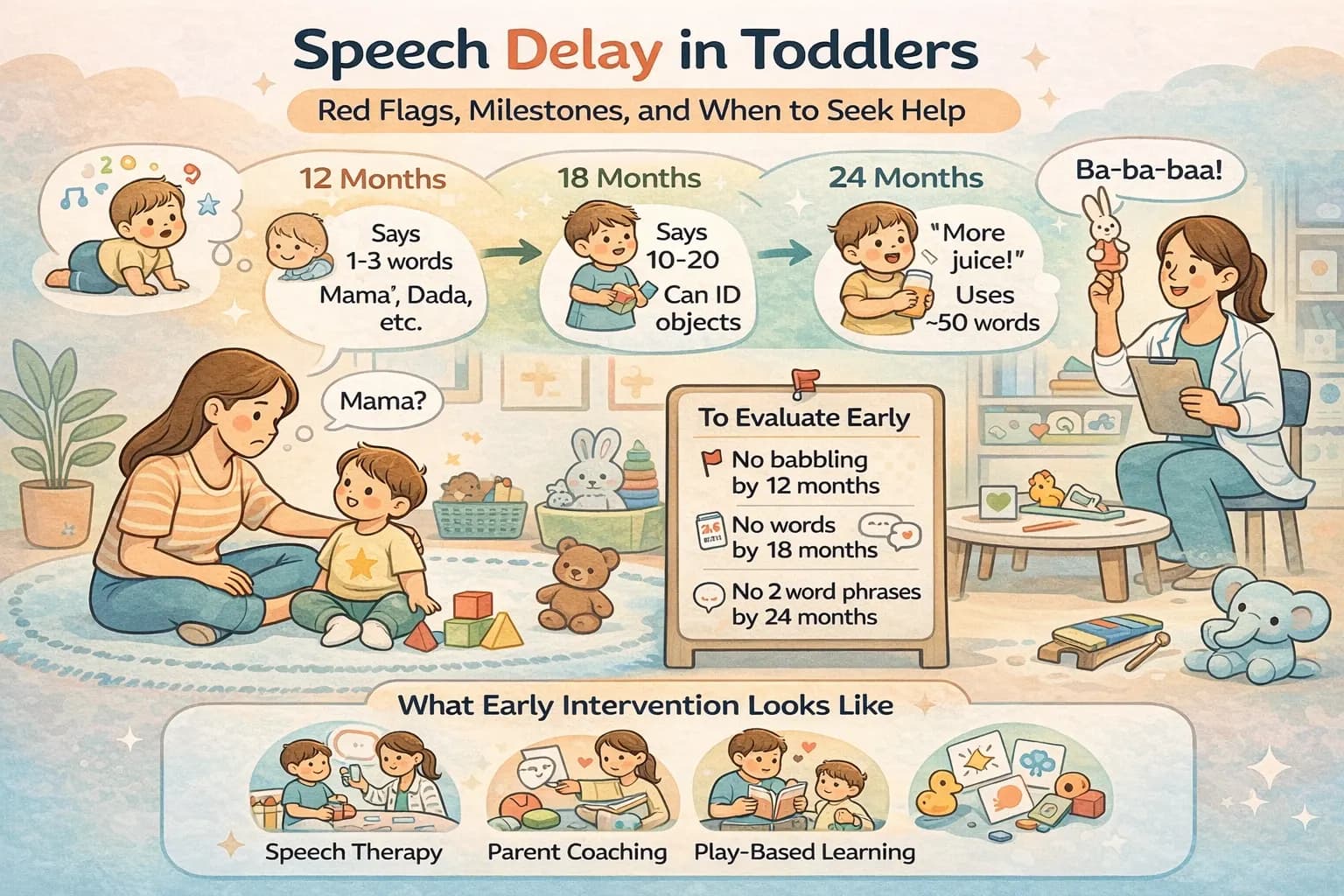
Speech and Language Milestones by Age
These milestones reflect the developmental range seen in typically developing children. The right end of each range is where concern should begin — children who have not reached these milestones by the age indicated warrant professional evaluation.
6–9 Months
| Milestone | Expected By |
|---|---|
| Babbling with consonants (ba-ba, da-da, ma-ma) | 6 months |
| Responding to their own name | 7–8 months |
| Recognising familiar voices and turning toward them | 6–9 months |
| Vocalising to get attention | 9 months |
Red flag: No babbling at all by 9 months, or no response to name being called.
12 Months
| Milestone | Expected By |
|---|---|
| First meaningful word (mama, dada, bye-bye, no) | 10–12 months |
| Understanding simple requests ("give me that") | 12 months |
| Using gestures: pointing, waving, showing | 12 months |
| Imitating sounds and words | 12 months |
Red flags at 12 months:
- No single words with meaning
- No pointing or waving
- No back-and-forth interaction (social referencing)
- Loss of previously acquired words or skills — always requires urgent evaluation
18 Months
| Milestone | Expected By |
|---|---|
| 10–20 meaningful words | 18 months |
| Understanding and following simple 2-word instructions ("get your shoes") | 18 months |
| Using words more than gestures to communicate | 18 months |
| Correctly identifying body parts when asked | 18 months |
Red flags at 18 months:
- Fewer than 6–8 words with consistent, meaningful use
- Not responding to simple verbal instructions (without visual cues)
- No spontaneous pointing to share interest ("look, a dog!")
- Limited variety of consonant sounds
24 Months (The Most-Watched Milestone)
The 24-month milestone is considered the most clinically significant checkpoint for early language development.
| Milestone | Expected By |
|---|---|
| Vocabulary of 50+ words | 24 months |
| Combining 2 words spontaneously ("more milk," "daddy go," "my shoe") | 24 months |
| Understanding 2-step instructions ("get the book and put it on the table") | 24 months |
| Strangers able to understand approximately 50% of speech | 24 months |
| Using words more than crying or gestures to communicate needs | 24 months |
Red flags at 24 months:
- Fewer than 50 words
- No word combinations (no two-word phrases)
- Difficulty being understood even by parents
- Regression — loss of words or communication skills previously acquired
36 Months
| Milestone | Expected By |
|---|---|
| Vocabulary of 200–1000+ words | 36 months |
| 3-word sentences and simple questions | 36 months |
| Strangers able to understand 75–80% of speech | 36 months |
| Understanding concept words (in, on, under, same, different) | 36 months |
| Telling simple stories or recounting recent events | 36 months |
Red flags at 36 months:
- Strangers unable to understand most of what the child says
- Vocabulary below 200 words
- No spontaneous 3-word sentences
- Not asking "what" and "where" questions
Absolute Red Flags: Seek Evaluation Immediately
The following signs should trigger an immediate referral regardless of age. Do not wait for the next routine check-up:
- Loss of previously acquired speech or language skills at any age — regression is always significant and may indicate a medical condition, including Landau-Kleffner syndrome or autism
- No babbling by 12 months
- No single words by 16 months
- No two-word combinations by 24 months
- No response to name by 12 months — repeatedly, not occasionally
- Absent or severely limited eye contact in social situations
- No pointing to share interest by 14 months (this is distinct from pointing to request something)
- Repetitive language — echoing words or phrases back without apparent comprehension (echolalia), or repetitive scripting
- Seeming to hear normally in some situations but not others — may indicate auditory processing differences or selective hearing related to hearing loss
What Causes Speech Delay?
Speech and language delay has many causes. Identifying the cause guides the most effective intervention.
Hearing Loss
The single most important cause to rule out first. Even mild hearing loss — a loss that does not seem to impair the child's ability to hear loud sounds — can significantly impair speech and language acquisition, because children learn language from the fine acoustic details of speech that mild loss eliminates.
Any child with speech or language delay should have a formal hearing assessment (audiological evaluation, not just a parental impression) before any other explanation is accepted.
"Late Bloomer" (Idiopathic Expressive Language Delay)
Some children — particularly boys with positive family history of late talking — are simply late in the expressive domain while comprehension, social skills, and other development are completely typical. These children often catch up spontaneously between 2 and 3 years.
However, even in children who appear to be simple late bloomers, speech therapy accelerates progress and reduces the risk of persisting language difficulty. Watchful waiting is not neutral — early intervention is more effective than later intervention.
Autism Spectrum Disorder (ASD)
Speech and language delay — particularly the combination of delayed expressive language, limited pointing and shared attention (joint attention), and unusual language patterns (echolalia, scripted speech) — is the most common early indicator of autism spectrum disorder.
Other early ASD signs that may accompany language delay:
- Limited or unusual eye contact in social situations
- Reduced response to their name
- Preference for solitary play; limited interest in other children
- Rigid insistence on routines; distress at changes
- Unusual repetitive behaviours (hand flapping, lining up objects, spinning)
- Hypersensitivity or hyposensitivity to sensory input
ASD is diagnosed through specialist developmental assessment — not a checklist. Early diagnosis enables early access to ABA, speech therapy, and developmental support that produces significantly better long-term outcomes.
Developmental Language Disorder (DLD)
DLD (previously called "specific language impairment") describes a persistent language disorder that cannot be explained by hearing loss, neurological conditions, intellectual disability, or ASD. It is the most common childhood developmental disorder, affecting approximately 7–8% of children, and is frequently unrecognised.
Children with DLD may have adequate receptive vocabulary but struggle with sentence structure, grammar, narrative, and the social use of language. They often struggle academically when literacy demands increase and may be mislabelled as inattentive.
Intellectual Disability
Global developmental delay — affecting motor, cognitive, and language domains — may first present as speech delay. Language development broadly reflects cognitive development; a child whose cognitive development is delayed will typically have corresponding language delay.
Bilingual Development
Children learning two languages simultaneously may appear to have a smaller vocabulary in each language individually, while having a combined vocabulary that is age-appropriate. This is normal — assessment should include vocabulary in both languages combined, not each separately.
Bilingual acquisition may produce slightly delayed but normal milestones. It does not cause language disorder. A bilingual child who has no words in either language at 24 months has a language delay.
Structural Issues
Conditions affecting the physical structures of speech production — cleft palate, tongue tie, or structural abnormalities of the mouth and larynx — can cause speech difficulties. These are usually identified early in the neonatal period or at the routine examination.
The Assessment Process: What to Expect
When you seek evaluation, the process typically involves:
1. Hearing test (audiological assessment): A formal assessment by an audiologist, not a parental report or a bedside screen. Should include assessment of hearing thresholds across frequencies.
2. Developmental paediatrician assessment: Review of developmental history, observation of the child, developmental questionnaires, and assessment of other developmental domains (motor, social, adaptive) alongside language.
3. Speech and Language Therapy (SaLT / SLP) assessment: A formal evaluation by a speech-language pathologist assessing receptive and expressive language, phonology, pragmatics (social use of language), and speech sound production.
4. Additional investigations if indicated:
- If global developmental delay is present: genetic testing, metabolic screen
- If regression is present: EEG (to exclude Landau-Kleffner syndrome)
- If ASD is suspected: specialist developmental assessment using standardised tools (ADOS-2, ADI-R)
Early Intervention: What It Involves and Why It Works
The first three years of life represent the period of maximum brain plasticity for language acquisition. Neural pathways for language are actively forming and can be shaped most effectively during this window. Earlier is not just better — it is substantially better.
Speech and Language Therapy (SaLT / SLP)
The primary intervention. A speech-language pathologist (SLP) assesses the specific nature of the delay and designs an intervention targeting the child's individual needs.
Common approaches:
- Parent-mediated therapy: Parents are trained in specific strategies to use throughout the day — during play, meals, and routines. This is the most evidence-based approach for toddlers because it embeds learning in the natural environment and dramatically increases the number of learning opportunities.
- Indirect facilitation: Creating the environment that prompts communication — following the child's lead, reducing unnecessary prompting, building expectant pauses into interaction.
- Hanen More Than Words: A structured parent training programme specifically designed for toddlers with language delay and autistic children.
- Direct therapy sessions: For older toddlers (2.5+), direct work on specific goals with the therapist.
What Parents Can Do Right Now
While waiting for or alongside formal assessment:
- Narrate everything: A running commentary of your day ("I'm putting on your shoes — left shoe, right shoe") provides rich language input without requiring the child to respond
- Follow your child's lead: Comment on what they are already looking at and interested in — this is the most powerful context for language learning
- Reduce questions, increase comments: "What's that?" is a question; "Oh, it's a dog! A big dog!" is a comment. Comments are less pressuring and more effective for language learning
- Read together daily: Shared book reading, particularly where you follow the child's gaze and point-and-label, is one of the most robustly evidence-supported activities for language development
- Reduce screen time for solo viewing — and ensure any screen time is co-viewed with conversation around it
- Reduce your own speech rate and use shorter, simpler sentences that are just one step above the child's current level ("ball" for a pre-verbal child; "red ball" for a child using single words)
Frequently Asked Questions (FAQ)
Q: My toddler is 2 and only says 10 words. Should I be worried? A: Yes, this warrants professional evaluation. The typical milestone at 24 months is 50+ words and beginning to combine two words. Ten words at 24 months is below the threshold for concern, and a referral to a speech-language pathologist for assessment is appropriate. Early intervention at this stage produces better outcomes than waiting another 6 months.
Q: My son's paediatrician said to "wait and see" until age 3. Is that correct? A: This advice is now considered outdated by most speech-language pathology and developmental paediatric organisations. The evidence clearly supports early assessment and intervention. If your paediatrician recommends waiting and you have genuine concerns, you are entitled to request a referral to a speech-language pathologist directly, or to seek a private assessment. Waiting until age 3 to begin intervention is a missed opportunity given the first three years are the period of maximum neural plasticity.
Q: What is the difference between a speech delay and a language delay? A: Speech delay refers specifically to difficulties with the physical production of speech sounds — unclear articulation, stuttering, or voice difficulties. Language delay refers to delays in the broader system of communication — vocabulary, grammar, understanding, and the social use of language. Many children have both. A speech-language pathologist assessment distinguishes between them and guides appropriate intervention.
Q: Could my child's speech delay be caused by being bilingual? A: Bilingual children may develop each language slightly more slowly than monolingual peers in that language, but their combined vocabulary across both languages is typically age-appropriate. True language delay in bilingual children is not caused by bilingualism — it is an underlying developmental issue that would be present regardless of language environment. Assessment should include vocabulary in both languages combined. A specialist experienced in bilingual development is ideal for assessment.
Q: My child understands everything I say but barely speaks. Is this still a delay? A: Expressive-only language delay — where understanding is age-appropriate but spoken output is limited — is the most common and generally most favourable pattern. Many of these children do catch up spontaneously. However, the combination of age under 24 months and fewer than 50 words still warrants a speech-language pathology assessment. Even "late bloomers" benefit from early intervention, and assessment also rules out conditions that may not be obvious on parental observation alone.
Q: How do I know if my child's speech delay might be autism? A: Language delay associated with autism is typically accompanied by other social communication differences: limited eye contact in social situations (though not with familiar people in familiar settings), limited joint attention (not pointing to share interest rather than just to request), reduced response to name, preference for solitary play, and sometimes rigid or repetitive behaviours. A child with expressive language delay who has normal eye contact, does point to share interest, responds to their name, and engages in social play is less likely to have autism — though formal developmental assessment is the only way to evaluate this properly.
Q: At what age is it too late to benefit from speech therapy? A: It is never too late to benefit from speech and language therapy, but earlier intervention consistently produces better outcomes. The first 3 years represent the period of maximum language-related neural plasticity. Intervention at 18–24 months is more effective than intervention at 3–4 years, which is more effective than intervention at 6–7 years. This is not to discourage older children from receiving therapy — it is to underscore why early identification and referral matters.
Q: My child's speech has suddenly regressed — they are using fewer words than last month. What should I do? A: Language regression — a child losing words or skills they previously had — is always significant and requires prompt evaluation. It should not be attributed to a new sibling, illness, or stress without professional assessment. While situational regression can occur temporarily, persistent loss of language skills may indicate conditions including Landau-Kleffner syndrome (acquired epileptic aphasia) or autism spectrum disorder. Seek a same-week paediatric review.
References and Further Reading
-
American Speech-Language-Hearing Association (ASHA) — Late Blooming or Language Problem?
https://www.asha.org/public/speech/disorders/late-blooming-or-language-problem/ -
NHS — Help your baby learn to talk:
https://www.nhs.uk/baby/babys-development/play-and-learning/help-your-baby-learn-to-talk/ -
CDC — Important Milestones: Your Child By Two Years:
https://www.cdc.gov/act-early/milestones/2-years.html -
American Academy of Pediatrics — Language Delays in Toddlers:
https://www.healthychildren.org/English/ages-stages/toddler/Pages/Language-Delay.aspx -
RCPCH — Development — Speech and Language:
https://www.rcpch.ac.uk/resources/rcpch-submission-kingdon-review-childrens-hearing-services -
Law J et al. — Speech and Language Therapy Interventions for Children with Primary Speech and Language Delay or Disorder (Cochrane Review):
https://pubmed.ncbi.nlm.nih.gov/14583990/
Medical Disclaimer
This article is for informational and educational purposes only. It does not constitute medical advice, diagnosis, or treatment. Speech and language development milestones represent typical ranges — individual children vary. If you have concerns about your child's speech, language, or overall development, seek evaluation from a qualified speech-language pathologist and your paediatrician. Early assessment and intervention produce the best outcomes and are always preferable to waiting.
About the Author
Abhilasha Mishra is a health and wellness writer specializing in early childhood development, paediatric health, and evidence-based parenting. She writes to help parents recognise developmental concerns early and navigate the path to assessment and support with clarity and confidence.