
8-Month Sleep Regression: Signs & Survival Tips
8-month sleep regression: signs, causes, duration, and survival tips. Learn why it happens and how to help your baby sleep better.
Try Related Tools
Use our source-informed calculators to get helpful insights.
Table of Contents
- What Is the 8-Month Sleep Regression?
- Why It Happens: The Developmental Drivers
- Signs of the 8-Month Sleep Regression
- How Long Does the 8-Month Regression Last?
- Strategies That Help: Navigating the Regression
- The Night Feeds Question
- Frequently Asked Questions (FAQ)
- References and Further Reading
What Is the 8-Month Sleep Regression?
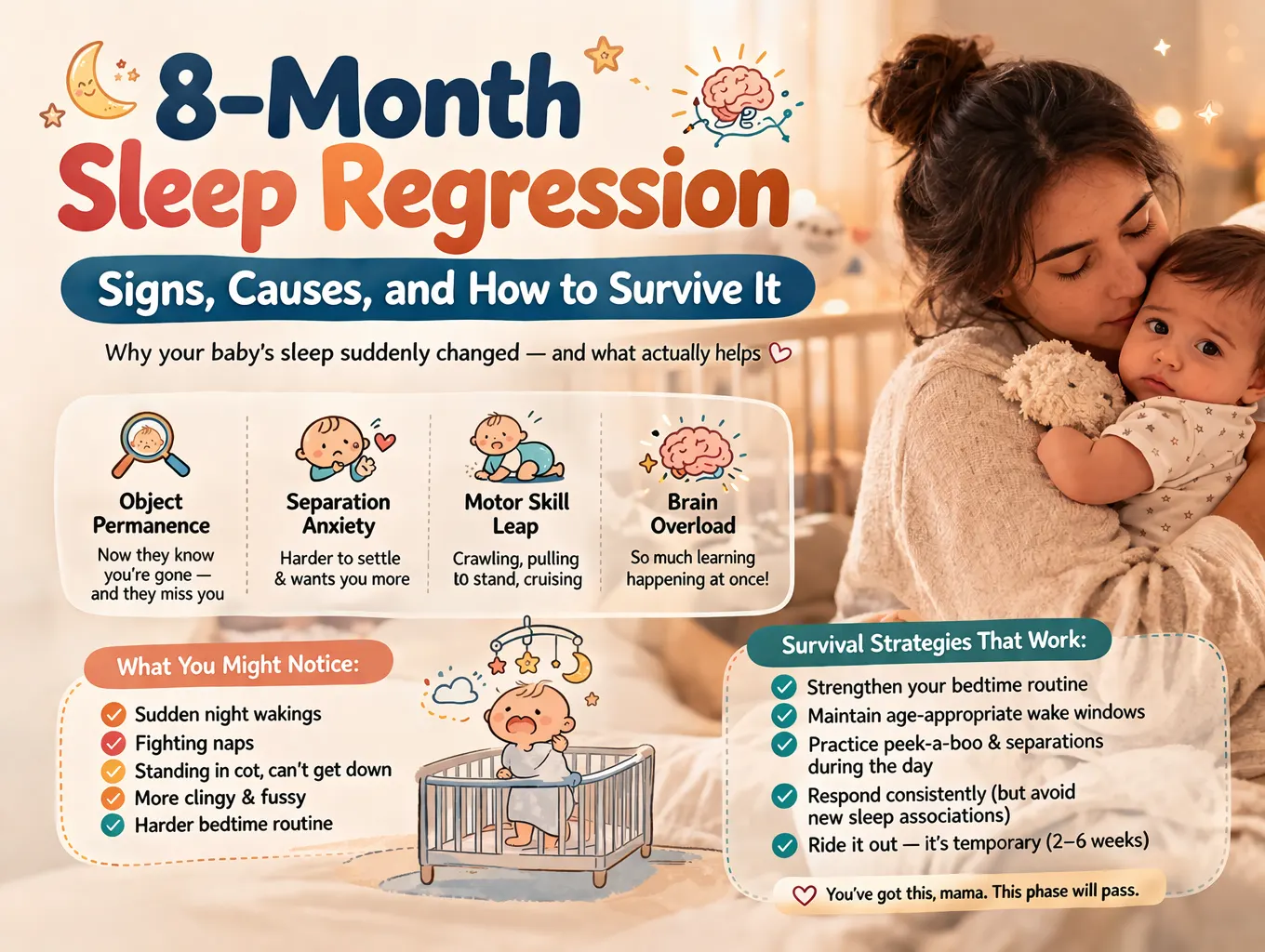
A sleep regression refers to a period in which a baby who was sleeping reasonably well suddenly begins waking more frequently, resisting sleep, napping poorly, or generally reverting to sleep patterns associated with a younger age. The word "regression" is slightly misleading — the disruption is not caused by going backward developmentally, but by going forward so rapidly that the brain is temporarily overwhelmed.
The 8-month regression is sometimes also called the 8–10 month regression, because it can occur anytime from approximately 7 to 10 months depending on individual developmental pace. Many babies experience it at 8–9 months; some hit it closer to 10 months.
It is part of a broader cluster of regressions in the first two years that correspond to major developmental leaps: 4 months, 8–10 months, 12 months, 18 months, and 24 months are the most recognised.
Why It Happens: The Developmental Drivers
Unlike the 4-month regression — which is caused by a permanent, irreversible maturation of sleep architecture — the 8-month regression is driven by an explosion of cognitive, motor, and social development that temporarily hijacks the brain's capacity for settled sleep.
Object Permanence
The most significant cognitive development occurring at this age is the consolidation of object permanence — the understanding that things continue to exist even when they cannot be seen.
Before this developmental stage, when you leave the room, your baby does not experience your absence as loss — you simply cease to exist from their perspective. This sounds distressing, but it is actually protective: out of sight is genuinely out of mind.
As object permanence consolidates — typically from around 6–8 months — your baby begins to understand something profound and initially terrifying: you still exist when you leave, but you are gone. And they do not yet have the cognitive maturity to understand that gone is temporary, or that you will return.
This is why night wakings become so charged at this age. When your baby surfaces between sleep cycles (as all babies do, multiple times per night), they now understand that they are alone and that you are somewhere — somewhere else — and this awareness triggers the attachment alarm system.
"Object permanence is a milestone we celebrate, but we rarely discuss the sleep disruption it predictably causes," says medical experts**. "It is genuinely a sign of cognitive advancement — your baby is smarter than they were last month. The separation distress is a healthy, expected response to this new understanding. It is not manipulation. It is developmental."
Separation Anxiety
Object permanence is the foundation for separation anxiety — and the 8–10 month period is when separation anxiety typically peaks for the first time (it will recur at 18 months with a second, often more intense peak).
Your baby now has a sophisticated enough understanding of relationships to know:
- You are a specific, irreplaceable person (not just a generic caregiver)
- You can be absent
- Your absence is distressing
This is why sleep became suddenly harder: falling asleep requires tolerating separation, and separation has just become genuinely meaningful in a way it was not before.
Motor Development
The 8-month period typically coincides with rapid motor acquisitions:
- Crawling (beginning or consolidating)
- Pulling to stand
- Cruising along furniture
- Possibly early steps
The brain is actively practicing and consolidating these motor programmes during sleep — particularly during REM sleep. This increased neural activity during sleep makes settling harder and night waking more frequent.
Babies at this stage frequently practice their new motor skills during night wakings, standing in the cot and then discovering they do not know how to get back down — crying for help, not out of hunger or distress but because they are literally stuck standing up.
Cognitive Processing Load
The sheer volume of new learning happening at 8–10 months — new words being understood, cause-and-effect relationships, object permanence, spatial awareness, social cues — represents an enormous cognitive load. The brain is working intensively during sleep to consolidate and integrate all of this learning. This increased overnight processing disrupts the steady sleep cycles that parents had begun to rely on.
Signs of the 8-Month Sleep Regression
Recognising the regression for what it is — rather than assuming something is medically wrong or that your previous sleep work has been undone — is the first step to navigating it well.
Typical signs:
- Sudden, unexplained increase in night wakings — a baby who was waking once or twice is now waking four, six, or more times
- Increased difficulty settling at bedtime — a baby who previously settled independently now cries when placed in the cot
- Waking and calling for you between sleep cycles — often not distressed, just awake and wanting connection
- Nap refusal or shortened naps — particularly the afternoon nap may become difficult
- Standing in the cot during wakings and being unable to get back down
- Increased clinginess and separation distress during the day, not only at night
- Overtiredness from disrupted sleep creating a cycle of harder settling and more wakings
- Increased nursing or bottle feeding at night as a comfort response (this can establish new feeding associations if prolonged)
How Long Does the 8-Month Regression Last?
This is the question every parent asks immediately, and the honest answer: typically 2–6 weeks for most babies.
Unlike the 4-month regression (which represents a permanent change in sleep architecture and requires active sleep work to resolve), the 8-month regression does have a natural endpoint. The developmental leap that triggered it completes, the cognitive processing settles, and the baby's brain returns to a state that is more conducive to consolidated sleep.
However, there is a critical caveat: habits formed during the regression can outlast it. If you spend the regression introducing significant new sleep associations — feeding to sleep through every night waking, bringing the baby into the adult bed every night, rocking for extended periods at 2 a.m. — these associations become expectations. Once the developmental leap is complete, the baby's brain is ready to sleep well again, but the newly established expectation for parental intervention at every sleep-cycle boundary persists.
This is the most common reason parents report that their baby "never came out" of the regression — the regression itself ended, but the habits formed during it continued.
Strategies That Help: Navigating the Regression
1. Confirm the Regression — Rule Out Medical Causes First
Before attributing all sleep disruption to regression, consider:
- Teething — which occurs actively in this period (lower incisors typically emerge at 6–10 months)
- Ear infections — which cause waking, particularly when the baby lies flat
- Illness — a cold, gastro, or other acute illness disrupts sleep and should be treated on its own terms
If your baby has fever, is pulling at their ears, seems unwell, or has other symptoms alongside the sleep disruption, a paediatric assessment is appropriate before applying regression management strategies.
2. Maintain — and Strengthen — the Bedtime Routine
A consistent, predictable 20–30 minute bedtime routine is more important during a regression than at any other time. The routine signals the transition from day to night, activates the relaxation response, and provides the predictable, reassuring sequence that a baby in a heightened state of separation anxiety needs.
If your routine has drifted, now is the time to tighten it:
- Same sequence, same timing, same room
- Feed earlier in the routine (not immediately before going into the cot) to prevent feeding becoming a new sleep association
- End with brief, calm goodnight and placement in the cot
3. Optimise the Sleep Schedule
Many parents inadvertently extend the regression by allowing overtiredness to accumulate. An overtired baby has elevated cortisol, finds it harder to settle, and wakes more frequently — creating a cycle.
Approximate schedule for 8–10 months:
- Two naps per day (morning and early afternoon) totalling 2.5–3.5 hours
- Awake window before bedtime: 2.5–3.5 hours after the last nap
- Bedtime: Typically 6:30–7:30 pm for most babies this age — slightly earlier during the regression if overtiredness is accumulating
Capping the morning nap at 1.5 hours and the afternoon nap at 1–1.5 hours prevents late naps from pushing bedtime too late.
4. Respond to Separation Anxiety During the Day
The night-time separation distress cannot be addressed only at night. If the underlying separation anxiety is high, reducing it during the day reduces its intensity at night.
Effective day strategies:
- Peek-a-boo and hide-and-seek games — these literally teach object permanence in a safe, playful context. The parent disappears (behind hands, behind a sofa) and reappears — demonstrating over and over that disappearance is temporary
- Practice brief separations during the day — leave the room, come back. The baby learns through repetition that you return
- Narrate departures and returns in a calm, matter-of-fact way: "I am going to the kitchen. I'll be right back." — even though they do not understand the words, the tone and the consistent pattern eventually become meaningful
- Avoid prolonged, dramatic goodbyes — these increase rather than decrease separation distress
5. Decide on Your Response Strategy at Night
The regression is temporary, but your response shapes what habits persist after it ends. Consider your approach carefully:
Option A: Ride it through with maximum support, then sleep train after Respond quickly to all night wakings, offer maximum comfort, accept the disruption as temporary, and then do structured sleep work (Ferber or your method of choice) once the developmental leap has passed. The advantage: full responsiveness during the regression. The risk: if the regression lasts 6 weeks and new associations are strong, sleep training afterward may be more intensive.
Option B: Maintain independent settling through the regression Continue to place the baby in the cot awake and apply your previous settling method. Respond to genuine distress but aim to avoid introducing new sleep associations. This is harder during the regression but means no reset is needed afterward. Best suited to babies who already had good independent settling skills before the regression.
Option C: A middle path Respond promptly when the baby is genuinely distressed, but use graduated checking-in (brief check-ins, no prolonged holding or feeding back to sleep) for wakings that appear to be habit rather than acute distress. This requires being able to distinguish between distress-based and habit-based crying — a skill that develops with observation over time.
There is no universally correct option. The right approach depends on your baby's temperament, your family's circumstances, and what you can sustain.
6. Split Night Duties
If you have a partner, alternating night duty is one of the most effective survival strategies during any regression. Designating nights so each adult gets at least one full stretch of uninterrupted sleep per two-night cycle reduces the cumulative sleep debt that makes the regression feel unsurvivable.
The Night Feeds Question
A specific challenge at 8–10 months: are the night wakings representing genuine hunger, or habit-based comfort feeding?
By 8 months, most healthy, well-fed, full-term babies do not have a physiological requirement for night feeds. However, during a regression, feeding becomes a powerful comfort measure — and if a baby is offered breast or bottle at every waking, they quickly learn to expect it and to cry for it even without hunger.
Signs a night feed may be habitual rather than hunger:
- The baby feeds for only 2–3 minutes before returning to sleep
- The baby is not increasing in eagerness or intensity of feeding over multiple wakings
- Offering comfort other than feeding (patting, a brief cuddle) settles them as effectively
Gently reducing the duration and frequency of night feeds during the regression, rather than increasing them, prevents a post-regression feeding habit that extends the disruption long after the developmental leap is complete.
Frequently Asked Questions (FAQ)
Q: How do I know if my baby is in the 8-month sleep regression or just unwell? A: Illness typically produces other signs — temperature, reduced appetite, change in nappy output, pulling at ears, nasal congestion, or generally appearing unwell. The 8-month regression, by contrast, presents as a baby who is bright and well during the day but suddenly resistant to sleep and waking more at night. If your baby has fever or other symptoms, have them assessed by a paediatrician before applying regression-management strategies.
Q: My baby was never a great sleeper. Will the 8-month regression be worse for us? A: Babies who have not yet developed independent sleep skills may experience the regression more intensely, since the regression amplifies whatever pre-existing sleep challenges were already present. For these babies, the regression period can paradoxically be a motivation to address independent settling, since the contrast between "not great sleep" and "regression sleep" makes the need for change clearer. Structured sleep work is generally more effective after the acute developmental leap has passed.
Q: Can I start sleep training during the 8-month regression? A: Starting sleep training during the acute regression period is generally not recommended. The heightened separation anxiety and cognitive disruption of the regression make it significantly harder for babies to learn new settling skills at this time — progress is slower, crying is more intense, and the process is more distressing for everyone. Most sleep specialists recommend waiting until the regression has passed (typically 2–6 weeks) and then introducing or reinstating independent settling.
Q: My baby has started standing in the cot at night and can't get down. What do I do? A: This is one of the most common specific challenges of the 8-month regression. The solution is to practice getting down from standing during the day — repeatedly and playfully lower your baby's bottom to the sitting or lying position throughout the day. Once they have the motor skill (which typically develops within a week or two of pulling to stand), the standing-and-stuck problem resolves. At night, go in and lower them down without turning on lights or providing extended interaction, then leave.
Q: Will the 8-month regression undo all the sleep training we did before? A: It can temporarily disrupt previously learned sleep skills, but it does not erase them. Babies who had good independent settling skills before the regression typically recover them faster once the regression passes. The key is to avoid cementing new opposing habits during the regression — try to maintain as much of the previous routine and settling approach as possible, with appropriate adjustments for the heightened need during the leap.
Q: My baby is 10 months and still not sleeping well after what I thought was the 8-month regression. What now? A: If sleep disruption has persisted beyond 6 weeks and your baby is otherwise developmentally well, the regression itself has likely passed and you may now be dealing with entrenched sleep habits formed during it. A structured review of the sleep schedule, bedtime routine, and settling method — and possibly a period of formal sleep training if the habits are firmly established — is appropriate. Consulting a certified infant sleep specialist or your paediatrician for personalised guidance is a reasonable next step.
Q: How many more sleep regressions will we face after 8 months? A: The most recognised subsequent regressions are at approximately 12 months, 18 months, and 24 months. The 18-month regression is often considered the most intense, coinciding with a major developmental leap in language, autonomy, and emotional awareness. However, children who have well-established independent settling skills before each regression consistently recover faster, because the skill is retained even if temporarily disrupted.
Q: Should I bring my baby into bed with us during the regression? A: Bed-sharing is a personal and cultural decision. If you choose to bed-share during the regression, be aware of safe sleep guidelines — firm surface, no alcohol or sedating medications, no soft bedding near the baby. The main consideration for sleep purposes is that bed-sharing during the regression may create a strong new expectation of co-sleeping that is difficult to reverse once the regression passes. If your goal is for your baby to sleep independently in their cot, maintaining that environment as consistently as possible during the regression — with increased responsiveness within it — is more likely to produce that outcome.
References and Further Reading
-
American Academy of Pediatrics — Infant Sleep:
https://www.healthychildren.org/English/healthy-living/sleep -
NHS — Baby and Toddler Sleep:
https://www.nhs.uk/baby/caring-for-a-newborn/helping-your-baby-to-sleep/ -
Mindell JA & Williamson AA — Benefits of a Bedtime Routine (Sleep Medicine Reviews, 2018):
https://pubmed.ncbi.nlm.nih.gov/28606699/ -
Piaget J — Object Permanence and Cognitive Development (foundational developmental psychology):
https://www.simplypsychology.org/piaget.html -
Hiscock H et al. — Behavioural Sleep Techniques — 5-Year Follow-up (Pediatrics, 2016):
https://pubmed.ncbi.nlm.nih.gov/27354460/
Medical Disclaimer
This article is for informational and educational purposes only. It does not constitute medical advice, diagnosis, or treatment. Sleep development varies significantly between individual babies, and the strategies described may need to be adapted to your baby's specific temperament, health status, and family circumstances. If you have concerns about your baby's sleep, health, or development, consult your paediatrician.
About the Author
Abhilasha Mishra is a health and wellness writer specializing in infant sleep, early childhood development, and evidence-based parenting. She writes to help exhausted parents understand what is happening developmentally and navigate each stage with more clarity and less panic.