
SIDS Prevention: Risk Factors & Guidelines
SIDS prevention explained by an OB/GYN: AAP safe sleep guidelines, key risk factors, evidence-based tips, and safe sleep setup.
Try Related Tools
Use our source-informed calculators to get helpful insights.
Table of Contents
- What Is SIDS — and What It Is Not
- The Triple Risk Model: Why SIDS Happens
- SIDS Risk Factors: The Evidence
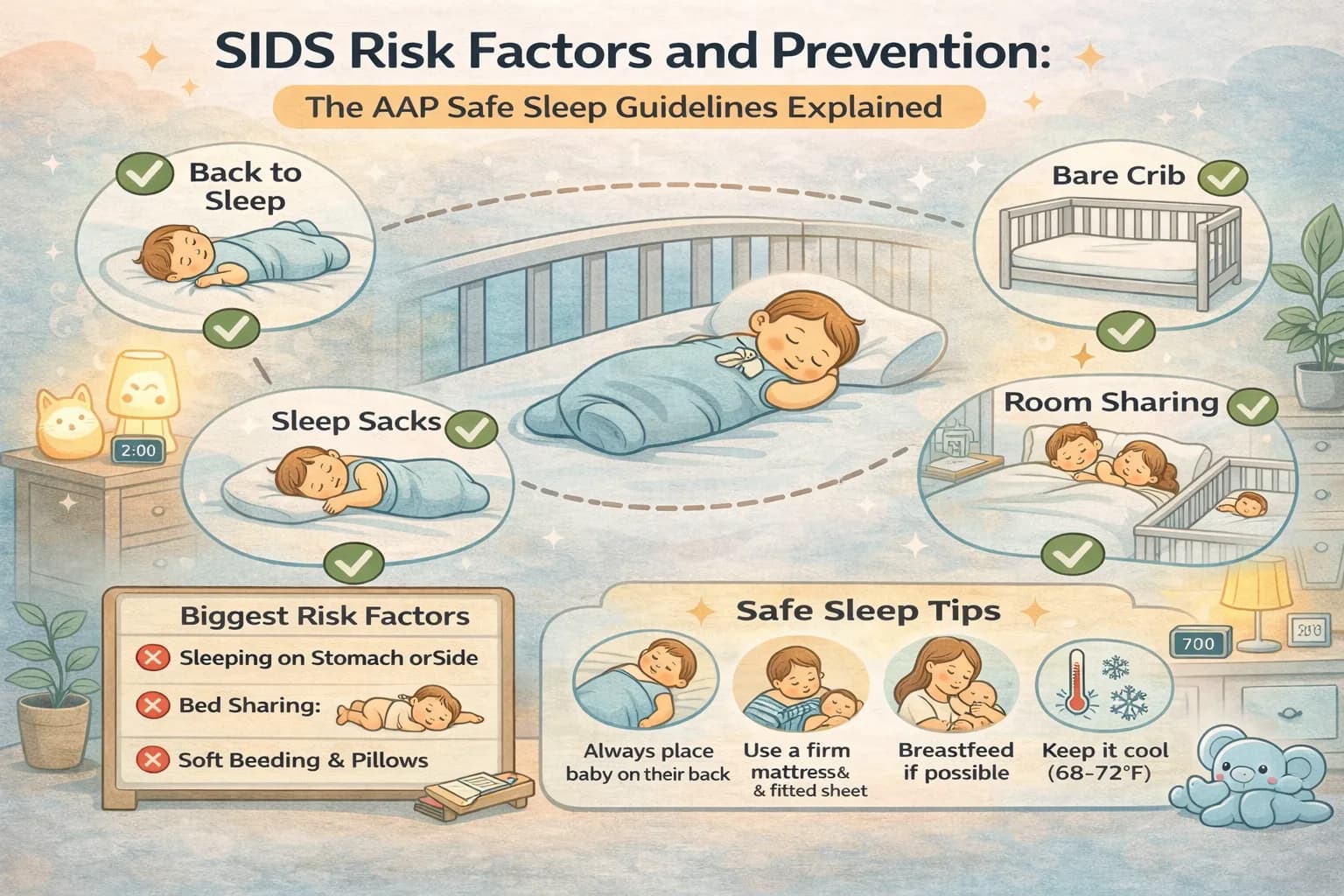
- The AAP Safe Sleep Guidelines: Complete Recommendations
- Creating a Safe Sleep Environment: Practical Checklist
- When Babies Can Sleep in Other Positions
- Frequently Asked Questions (FAQ)
- References and Further Reading
What Is SIDS — and What It Is Not
SIDS (Sudden Infant Death Syndrome) is defined as the sudden, unexpected death of an apparently healthy infant under one year of age that remains unexplained after a thorough post-mortem investigation, including a complete autopsy, examination of the death scene, and review of the clinical history.
The key word is unexplained. SIDS is a diagnosis of exclusion — it is what remains when every identifiable cause (infection, metabolic disorder, cardiac arrhythmia, accidental suffocation, non-accidental injury) has been ruled out.
Closely related terms:
- SUID (Sudden Unexpected Infant Death): The broader category encompassing all unexpected infant deaths — including SIDS, accidental suffocation, and deaths from unknown causes
- Accidental suffocation and strangulation in bed (ASSB): Deaths caused by the sleep environment — soft bedding, overlaying (adult sleeping on the infant), wedging — these are preventable and distinct from true SIDS, though they share risk factors and prevention strategies
In practice, the distinction between SIDS, accidental suffocation, and deaths from unknown causes is often difficult to make definitively. The AAP now addresses the whole category of sleep-related infant death under the framework of safe sleep.
The Triple Risk Model: Why SIDS Happens
No single cause of SIDS has been identified, but the most widely accepted scientific framework is the triple risk model, which holds that SIDS occurs when three factors converge simultaneously:
1. Underlying vulnerability: The infant has an undetected biological vulnerability — most commonly in the development of the brainstem regions that regulate arousal, breathing, and cardiovascular function during sleep. Research led by Dr. Hannah Kinney at Boston Children's Hospital has identified deficiencies in serotonin signalling in the medulla oblongata (the brainstem region controlling arousal and autonomic function) in a significant proportion of SIDS cases.
2. A critical developmental period: The infant is in the first 6 months of life — the period of maximum SIDS risk, when autonomic regulation is immature and the sleep-wake cycle is unstable.
3. An environmental stressor: A trigger in the sleep environment — prone positioning, soft bedding, overheating, exposure to smoke — that the vulnerable infant's arousal system cannot overcome.
"This model is important because it explains why the same sleep environment is safe for the vast majority of infants but fatal for a small number with undetected vulnerabilities," says medical experts**. "We cannot yet identify which babies have this biological vulnerability in advance. So our job — as parents and as clinicians — is to remove every modifiable environmental risk factor. That is where the evidence is clearest and where lives are saved."
SIDS Risk Factors: The Evidence
Highest-Risk Factors
Prone sleep position (sleeping on the stomach) The single most significant modifiable risk factor. Infants placed prone to sleep have a 1.7–12.9× higher risk of SIDS compared to those placed supine (on their back). The mechanism involves rebreathing exhaled carbon dioxide, impaired arousal from sleep, and possible cardiovascular effects of the prone position on a developing autonomic system.
Side sleeping Side sleeping carries intermediate risk — less than prone, but significantly more than supine. The side position is inherently unstable; infants frequently roll to the prone position from their side. The AAP does not recommend side sleeping as a safe alternative to supine.
Soft sleep surface or soft bedding Sleeping on a soft mattress, with pillows, loose blankets, bumper pads, positioning wedges, or stuffed animals in the sleep area significantly increases risk of accidental suffocation and is associated with SIDS. The safest sleep surface is a firm, flat mattress with a fitted sheet and nothing else.
Bed-sharing (adult bed co-sleeping) Sharing an adult bed with a parent or caregiver is associated with a significantly elevated SIDS risk, particularly in the first 4 months. The risk is highest when:
- The parent has consumed alcohol, cannabis, or sedating medications
- The parent smokes
- The infant is under 4 months
- The sleep surface is a sofa, recliner, or armchair
Exposure to tobacco smoke Both prenatal tobacco exposure and postnatal secondhand smoke exposure significantly increase SIDS risk. Prenatal smoking is associated with a 2–3× increased risk; postnatal exposure with a 2× increased risk. The mechanism involves effects on fetal and infant brainstem development, lung function, and arousal.
Overheating Excessive thermal environment — too many layers, too warm a room — impairs the infant's ability to arouse from sleep and is consistently identified as a risk factor. The optimal room temperature for infant sleep is 16–20°C (61–68°F).
Moderate Risk Factors
Prematurity and low birth weight Premature infants have a significantly elevated SIDS risk, proportional to degree of prematurity. The immature brainstem arousal systems of preterm infants are particularly vulnerable. Even late-preterm infants (34–36 weeks) have higher risk than full-term babies.
Young maternal age Mothers under 20 years are associated with higher infant SIDS risk — likely reflecting a cluster of socioeconomic, behavioural, and educational factors rather than biological age per se.
Short inter-pregnancy interval Closely spaced pregnancies are associated with increased SIDS risk for the subsequent infant, possibly through nutritional depletion and reduced prenatal care quality.
Male sex Male infants have a consistently higher SIDS rate than female infants — approximately 60% of SIDS cases occur in boys. The mechanism is unclear but may relate to sex differences in autonomic regulation and arousal.
Not breastfeeding Breastfeeding is independently associated with reduced SIDS risk. Even partial breastfeeding confers some protection. The mechanism may involve immunological factors, differences in sleep architecture in breastfed vs formula-fed infants, or the effect of feeding frequency on arousal.
Factors That Do NOT Increase SIDS Risk (Common Misconceptions)
- Vaccinations: Multiple large studies have confirmed that vaccination does not increase SIDS risk. In fact, vaccinated infants have a lower SIDS rate than unvaccinated infants. The temporal association some parents notice (a death occurring shortly after a vaccination) reflects the coincidence of peak SIDS age with the standard vaccination schedule — not causation.
- Spitting up or choking in the supine position: Healthy infants have protective airway reflexes that prevent aspiration when lying on their back. The AAP has reviewed this concern extensively and maintains that back sleeping is safe even for infants who spit up frequently, unless a specific medical condition (such as severe GERD with airway compromise) is documented by a physician.
The AAP Safe Sleep Guidelines: Complete Recommendations
The following represent the current evidence-based recommendations from the American Academy of Pediatrics (2022 update):
Sleep Position
- Always place your baby on their back for every sleep — naps and night sleep — until their first birthday
- Once a baby can roll from back to front and front to back independently (typically 4–6 months), you do not need to reposition them during sleep if they roll on their own. Continue to place them on their back at the start of sleep
Sleep Surface
- Use a firm, flat, non-inclined sleep surface — a crib, bassinet, portable play yard, or bedside sleeper that meets current safety standards
- The surface should be designed for infant sleep and should not incline more than 10 degrees
- Do not use infant sleep products (inclined rockers, bouncers, swings, car seats) for routine unsupervised sleep — these have been associated with sleep-related deaths when used without adult supervision
- Use only a tightly fitted sheet — nothing else in the sleep area
Room Sharing vs. Bed Sharing
- The AAP recommends that infants sleep in the parents' room (room sharing) on a separate, safe sleep surface for at least the first 6 months — ideally for the full first year
- Room sharing without bed sharing reduces SIDS risk by up to 50%
- Bed sharing is not recommended by the AAP under any circumstances for infants under 4 months, and carries elevated risk throughout the first year
- If you fall asleep feeding your baby and are concerned you might drop them, a firm sofa is safer than an armchair or recliner, but the safest choice is to move the baby to their own sleep surface as soon as possible
Avoiding Smoke, Alcohol, and Drug Exposure
- Keep all sleep environments completely smoke-free — this includes the home, car, and any other spaces where the infant sleeps
- Do not share a sleep surface with your baby if you have consumed alcohol, cannabis, opioids, benzodiazepines, or any sedating substance
Temperature and Clothing
- Keep the room between 16–20°C (61–68°F)
- Dress the baby in one more layer than you would wear to be comfortable in the same room
- Avoid hats indoors after leaving the hospital — infants regulate temperature partly through the head, and indoor hats can cause overheating
- Use sleep sacks (wearable blankets) instead of loose blankets — these maintain warmth without suffocation risk
Avoiding Commercial Devices
- Do not use commercial devices marketed to reduce SIDS risk — heart rate monitors, wedges, positioning devices, specialised mattresses — none have been proven effective and some have been associated with harm
- Do not use home cardiorespiratory monitors as a substitute for safe sleep practices
Breastfeeding
- Breastfeed if able — exclusive breastfeeding for 6 months is associated with the greatest SIDS risk reduction
- If breastfeeding, a dummy/pacifier can be introduced after breastfeeding is established (usually by 3–4 weeks)
Pacifier (Dummy) Use
- Consider offering a pacifier at nap and bedtime — pacifier use is associated with a significant reduction in SIDS risk (possibly by maintaining arousal, keeping the airway open, or affecting sleep architecture)
- Do not force a pacifier if the baby refuses
- Do not reinsert the pacifier if it falls out during sleep
- Do not attach the pacifier to clothing, strings, or stuffed animals in the cot
Tummy Time (Awake and Supervised)
- Provide daily supervised tummy time when the baby is awake and you are watching — this prevents positional plagiocephaly (flat head from back sleeping) and develops neck, shoulder, and core strength
- Start with short periods from birth and gradually increase as your baby tolerates it
Creating a Safe Sleep Environment: Practical Checklist
| Item | Safe | Unsafe |
|---|---|---|
| Sleep position | Back, every time | Side, stomach |
| Sleep surface | Firm, flat, level | Soft, inclined, bouncer, swing |
| Bedding | Fitted sheet only | Pillows, loose blankets, bumpers |
| Sleep space | Crib/bassinet meeting standards | Adult bed, sofa, recliner, armchair |
| Room | Same room as parents | Separate room (first 6 months) |
| Temperature | 16–20°C | Overheated room, indoor hat |
| Smoke exposure | None, zero tolerance | Any secondhand smoke |
| Adult state | Sober, not sedated | Alcohol, drugs, sleeping pills |
| Clothing | Sleep sack, one layer more than adult | Loose blankets, heavy swaddle over 8 weeks |
When Babies Can Sleep in Other Positions
A common parental question: what about when my baby can roll?
Once your baby can roll in both directions independently (back to front and front to back), the risk of the prone sleep position changes significantly because they now have the motor control to reposition themselves if they experience airway compromise. At this stage (typically 4–6 months):
- Continue placing your baby on their back at the start of every sleep
- If they roll to their stomach during sleep, you do not need to keep repositioning them — let them find their own comfortable position
- Continue using a firm, clear sleep surface — the other safe sleep recommendations remain in effect throughout the first year
Frequently Asked Questions (FAQ)
Q: What is the peak age for SIDS? A: SIDS risk is highest between 1 and 4 months of age, with the peak at approximately 2–3 months. More than 90% of SIDS deaths occur in the first 6 months of life. Risk then falls progressively and becomes uncommon after 6 months, though the safe sleep recommendations apply through the first birthday.
Q: Does sleeping on their back cause flat head (plagiocephaly)? A: Back sleeping can contribute to positional plagiocephaly — a flat spot on the back of the head — if a baby spends all their time on their back. The prevention is daily supervised tummy time when the baby is awake, alternating which end of the cot the baby's head is placed toward, and avoiding prolonged time in bouncers, car seats, and swings during the day. Positional plagiocephaly is largely cosmetic and resolves with repositioning in most cases. It is not a reason to abandon back sleeping.
Q: My mother says I slept on my stomach and was fine. Why is this advice different now? A: The research showing the link between prone sleeping and SIDS was not conducted until the 1980s and 1990s. Before the Back to Sleep campaign launched in 1994, prone sleeping was routinely recommended as it was believed to reduce the risk of choking. The dramatic decline in SIDS deaths since 1994 — more than 50% — is direct evidence that the guidelines changed outcomes. Medical guidance evolves with evidence.
Q: Is it safe to use a Snoo or similar smart bassinet? A: The Snoo and similar responsive bassinets that use gentle motion and sound to respond to infant crying are generally compatible with safe sleep guidelines — they maintain the supine position and have a firm, flat sleep surface. The AAP has not specifically endorsed these devices but notes that the Snoo's design keeps the baby on their back. These products are not proven to reduce SIDS risk, but they do not appear to increase it when used correctly.
Q: We bedshare and I have read evidence supporting it. Is the AAP wrong? A: The evidence on bed sharing is genuinely contested, particularly within the context of breastfeeding and when other risk factors are absent. Some researchers argue that the AAP's position does not adequately distinguish between high-risk and lower-risk bed sharing scenarios. However, the AAP's position reflects the overall population evidence, in which bed sharing is consistently associated with elevated infant sleep-related death risk — particularly in the first 4 months and when risk factors like alcohol use, smoking, or soft mattresses are present. If you choose to bed share, understanding and minimising all co-occurring risk factors is essential.
Q: Do pacifiers really reduce SIDS risk? A: Yes — this is one of the more surprising and robust findings in SIDS research. Meta-analyses consistently show that pacifier use at sleep onset is associated with a 50–70% reduction in SIDS risk. The mechanism is not fully understood but may involve maintenance of a more aroused sleep state, prevention of airway obstruction, or a serotonergic effect. Pacifiers should not be forced on a baby who rejects them, and should not be reinserted during sleep. The association appears strongest for pacifier use specifically at sleep onset.
Q: My baby only settles in a swing. Is this safe for overnight sleep? A: No. Inclined sleep surfaces — including swings, bouncers, and rockers — are not safe for unsupervised infant sleep. Multiple SIDS and ASSB deaths have been associated with infant sleep products that place the baby in a semi-reclined or inclined position. While these products may be used for brief, supervised soothing, a baby who falls asleep in a swing should be moved to a firm, flat, supine sleep surface as soon as safely possible.
Q: What should I do if my baby absolutely won't sleep on their back? A: This is a common concern in the first weeks. Strategies that help: firm swaddling (with the baby still placed on their back — swaddling does not change the recommended position), a white noise machine, a feeding immediately before sleep, ensuring the baby is fully drowsy before placement. Some babies resist back sleeping initially but adapt within a few weeks. If your baby has a medical condition that affects their ability to sleep safely on their back, discuss this specifically with your paediatrician — positioning recommendations can be modified for documented medical indications.
References and Further Reading
-
American Academy of Pediatrics — Safe Sleep Recommendations:
https://www.healthychildren.org/English/ages-stages/baby/sleep/Pages/a-parents-guide-to-safe-sleep.aspx -
AAP Technical Report — SIDS and Other Sleep-Related Infant Deaths:
https://publications.aap.org/pediatrics/resources/24358/Safe-Infant-Sleep-Landmark-Articles-That -
CDC — Sudden Unexpected Infant Death:
https://www.cdc.gov/sudden-infant-death/ -
NHS — Reducing the Risk of Sudden Infant Death Syndrome:
https://www.nhs.uk/conditions/sudden-infant-death-syndrome-sids -
The Lullaby Trust — Safer Sleep for Babies:
https://www.lullabytrust.org.uk/safer-sleep-advice -
Kinney HC & Thach BT — The Sudden Infant Death Syndrome (NEJM, 2009):
https://pubmed.ncbi.nlm.nih.gov/19516032/
Medical Disclaimer
This article is for informational and educational purposes only. It does not constitute medical advice, diagnosis, or treatment. Safe sleep guidelines are population-level evidence-based recommendations. If your baby has a specific medical condition that affects breathing, sleep, or positioning, discuss individualised safe sleep guidance with your paediatrician. SIDS is a complex phenomenon and no safe sleep strategy can guarantee complete elimination of risk, but adherence to evidence-based guidelines substantially reduces it.
About the Author
Abhilasha Mishra is a health and wellness writer specializing in newborn care, infant safety, and evidence-based paediatric health guidance. She writes to help new parents protect their babies with the most current, clearly communicated clinical evidence available.