
Screen Time for Toddlers: Age-by-Age Guidelines and What the Research Really Shows
Screen time for toddlers explained with the latest AAP guidelines, what research says about effects on development, language, and sleep — and a realistic framework for modern families.
Try Related Tools
Use our source-informed calculators to get helpful insights.
Table of Contents
- The Current Guidelines: What Major Health Authorities Say
- What the Research Actually Shows
- The "What It Replaces" Framework
- What Counts as "High-Quality" Content?
- Practical Strategies for Managing Screens in Real Life
- When Screen Time May Be an Appropriate Tool
- Frequently Asked Questions (FAQ)
- References and Further Reading
The Current Guidelines: What Major Health Authorities Say
American Academy of Pediatrics (AAP) — 2016 Guidelines (Updated Framework 2023)
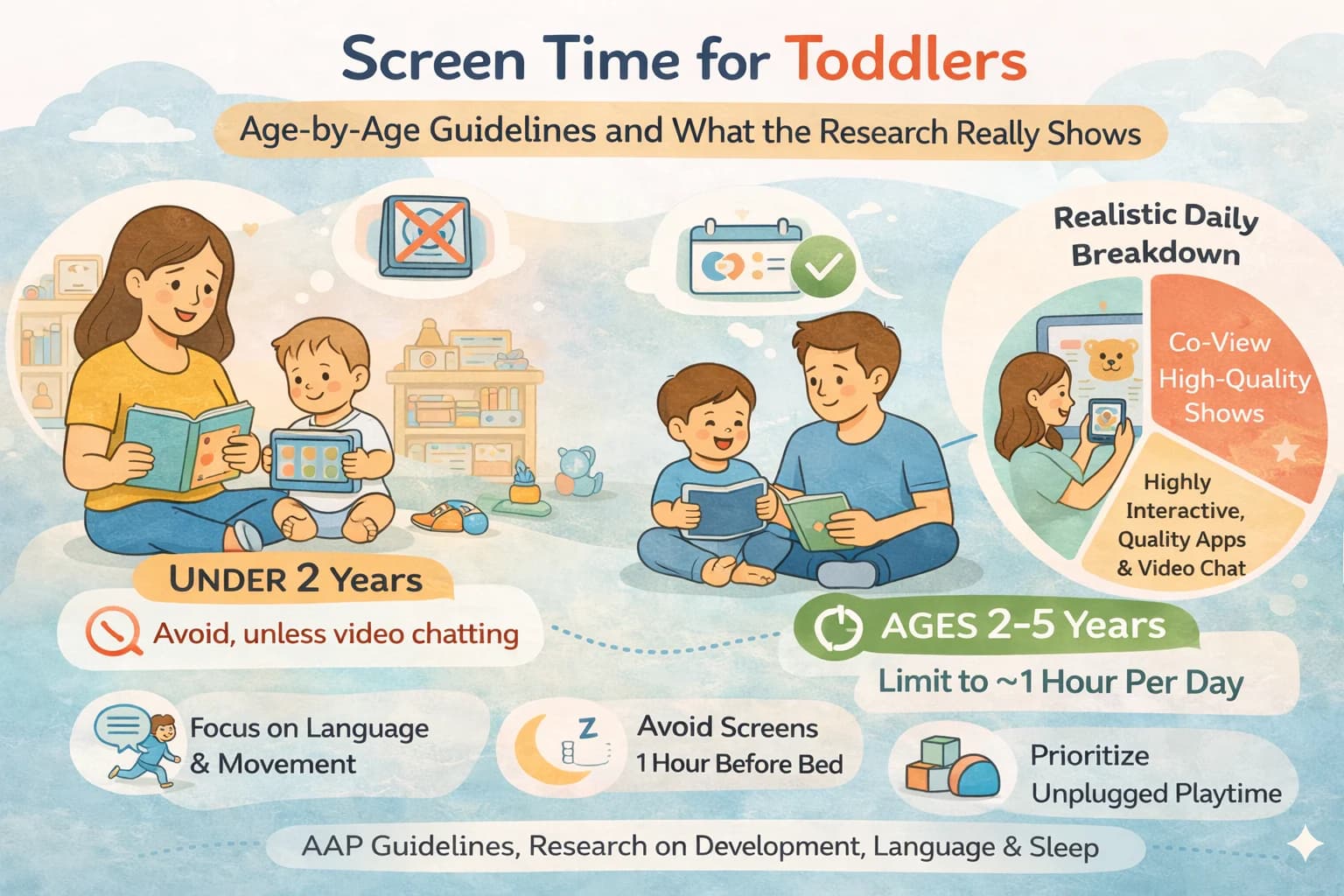
The AAP's guidance by age:
Under 18 months:
- Avoid all screen media except video chatting (FaceTime, Zoom with family)
- Video chatting is the exception because it involves real-time, responsive interaction with a familiar person — fundamentally different from passive media consumption
18–24 months:
- High-quality programming only, if parents choose to introduce screens
- Parents should watch with the child and help them understand what they are seeing
- Avoid solo, background, or passive screen use
2–5 years:
- Limit to 1 hour per day of high-quality programming
- Parents should co-view when possible and discuss content
- Avoid fast-paced content, content with a lot of distracting or irrelevant sounds, and any violent or inappropriate material
6 years and above:
- Consistent limits on time and ensure screens do not take the place of adequate sleep, physical activity, homework, and social interaction
- Designate screen-free times (meals, the hour before bed) and screen-free zones (bedrooms)
World Health Organization (WHO) — 2019 Guidelines
The WHO recommendations for physical activity, sedentary behaviour, and sleep align closely with AAP guidance:
- Under 1 year: No screen time
- 1 year: No screen time (sedentary screen time should not occur)
- 2–4 years: No more than 1 hour of sedentary screen time; less is better
The WHO frames their guidance explicitly around what screen time replaces — physical activity, sleep, and interactive play — rather than screens as inherently harmful.
What the Research Actually Shows
The research landscape on screen time and child development is more complex — and in some areas more reassuring — than popular discourse suggests. Here is what the evidence demonstrates:
Language Development
This is where the most robust research exists, and the findings are consistent:
Under 2 years: Infants and toddlers under 24 months learn language significantly more effectively from live human interaction than from video or screens — even interactive video. A well-replicated phenomenon called the "video deficit effect" shows that children under 2 learn words, solve problems, and imitate actions shown live by a person far more effectively than when the same content is delivered via screen.
The mechanism appears to be that infant learning is heavily dependent on contingent responsiveness — when an adult responds to the child's cues, adjusts their language, and follows the child's attention, language learning is optimised. Screens cannot do this in real time.
2–5 years: Significant variation based on content quality and co-viewing. Well-designed educational programming (Sesame Street has the most research behind it) does demonstrably improve vocabulary and school readiness when watched with an engaged caregiver who extends the learning through conversation.
Takeaway: For children under 2, screens are poor language teachers. From 2 onward, the quality of content and parental engagement dramatically affect outcome.
Attention and Cognitive Development
Fast-paced content — content with rapid scene changes, high sensory stimulation, and frequent cuts — appears to tax the developing attentional system in young children. A 2011 study (Lillard et al., Pediatrics) found that just 9 minutes of watching a popular fast-paced cartoon impaired executive function in 4-year-olds compared to drawing or watching an age-appropriate, slower-paced show.
However, the same body of research generally shows no significant impairment from slow-paced, educational programming in the 2+ age group.
The practical recommendation from this research: content pacing matters. Slow, dialogue-rich, character-driven programming (Bluey, Daniel Tiger) has a meaningfully different effect on young children than rapid-fire, highly stimulating content.
Sleep
This is where the evidence is clearest and most consistent:
- Blue light from screens in the hour before bedtime suppresses melatonin production, delaying sleep onset
- Content arousal — stimulating or exciting content — activates the sympathetic nervous system, further delaying sleep
- Background TV in the evening is associated with fragmented and shortened sleep in toddlers across multiple studies
A 2019 meta-analysis covering over 125,000 children found a consistent association between higher screen time and shorter sleep duration, later bedtimes, and poorer sleep quality.
The practical rule: Screens off at least 1 hour before bedtime. This is the single most evidence-supported specific guideline in this entire space.
Physical Activity
Screen time that displaces physical activity is a genuine concern. The WHO's framing here is instructive: the problem is not the screen itself, but the sedentary behaviour and the displacement of active play that accompanies it.
Active screen use — movement-based games, dance content followed by dancing, interactive apps that prompt physical movement — does not carry the same risk. The concern is specifically with prolonged, passive, sedentary screen consumption.
Emotional Regulation and Behaviour
The association between high screen time and behavioural problems in toddlers is real but requires careful interpretation. Most studies in this area are correlational — families under higher stress tend to use screens more as a coping mechanism, and those same stressors are independently associated with behavioural challenges in children.
What the research does suggest:
- Using screens as the primary tool to calm an upset child may interfere with the child developing internal emotion regulation strategies
- Social media and content depicting violence or conflict are associated with increased aggression even in young children
- High-quality, prosocial content (Daniel Tiger's Neighbourhood specifically has been studied) is associated with improved emotional recognition and empathy
Social Development
Video chatting with grandparents, cousins, or familiar family friends is consistently found to be beneficial — young children can and do learn language, recognise relationships, and develop social understanding through live video interaction. This is why the AAP specifically exempts video calling from their restrictions even for under-18-month infants.
Background TV (a TV on in the room that the child is not actively watching) is more concerning than it appears. Studies show it reduces the quality and quantity of parent-child verbal interaction — the most important driver of language and social development — even when the child appears not to be watching it.
The "What It Replaces" Framework
Rather than tracking screen time minutes rigidly, many developmental paediatricians now recommend evaluating screen use through the lens of what it is replacing:
If screen time is replacing: physical activity, outdoor play, face-to-face interaction, creative play, sleep, or mealtimes → address this actively.
If screen time is used: during transitions, as a controlled wind-down, for educational enrichment alongside engaged interaction, or for video calls with family → the concern is significantly lower.
This framework is more practical and more closely aligned with how the evidence actually works than a rigid minute-counting approach.
What Counts as "High-Quality" Content?
Not all screen time is equal. Characteristics of higher-quality content for toddlers:
- Slow pacing — scenes last long enough for young children to process
- Repetition — revisiting familiar concepts, characters, and phrases supports learning
- Dialogue-rich — characters talk to each other and to the audience clearly
- Prosocial themes — cooperation, kindness, emotional recognition, problem-solving
- Age-appropriate complexity — pitched at developmental level, not overwhelming
- Absence of advertising — particularly in the 2–5 age range
Examples of consistently well-reviewed programming for toddlers and young children:
- Bluey (Australia) — praised for realistic family dynamics, emotional intelligence, play themes
- Daniel Tiger's Neighbourhood — specifically designed for emotional literacy; well studied
- Sesame Street — the most extensively researched children's programme in history
- Bluey (note: available on ABC Kids and Disney+)
- Puffin Rock (nature-based, gentle narration, very young children)
- Tumble Leaf (Amazon) — imaginative play themes, slow-paced
Content to avoid for toddlers:
- Fast-paced, highly stimulating cartoons with rapid scene changes
- Content with conflict, violence, or frightening themes
- Videos designed primarily to be addictive (autoplay, infinite scroll on YouTube Kids without parental controls)
- Anything the parent cannot explain to the child or discuss afterward
Practical Strategies for Managing Screens in Real Life
Set Consistent Rules Before You Need Them
Boundaries established proactively are significantly easier to maintain than rules introduced reactively (after habits have formed). Decide your family's approach and communicate it consistently.
Co-View When Possible
The research on educational programming consistently shows that parental engagement dramatically amplifies benefits. Ask questions: "What did Bluey do there? Why do you think she was upset?" This transforms passive viewing into active learning.
Use Screen Time as a Bridge, Not a Babysitter
Use screens intentionally: to introduce a concept you then explore together, to provide a shared reference point for play, or to provide a genuine rest break. Avoid using screens as the default response to boredom, transition difficulty, or emotional upset whenever possible.
Create Predictable Screen-Free Times
- Mealtimes (eating together without screens supports language and family connection)
- The 1 hour before bedtime
- The first 30 minutes after waking
- Outdoor time
Manage Your Own Screen Use
Multiple studies show that parental smartphone use during play, feeding, and family time reduces the quality of parent-child interaction as significantly as toddler screen time does. Children also imitate what they observe. Modelling intentional technology use is a genuine parenting strategy, not just a cliché.
Use Parental Controls Thoughtfully
Set autoplay to off on any platform your toddler uses. Review content before your toddler watches it. On YouTube Kids, use the manual content selection feature rather than allowing the algorithm to decide. Consider app-based screen time management tools that allow you to set daily limits across devices.
When Screen Time May Be an Appropriate Tool
The research on screen time has sometimes been interpreted more rigidly than the authors intended. There are circumstances where screen use is not only acceptable but genuinely supportive:
- Video calling with geographically distant family — strongly positive
- Educational programming watched together with an engaged caregiver
- Managing a long journey, medical procedure, or highly stressful transition — occasional use in genuinely challenging circumstances
- Children with disabilities or additional needs — some children benefit significantly from specific apps designed for speech delay, sensory processing, or autism support
- Rest and recovery during illness — a sick toddler benefiting from quiet screen time is a reasonable accommodation
The goal is intentional, contextual, engaged use — not a rigid number of minutes.
Frequently Asked Questions (FAQ)
Q: My 18-month-old watches about an hour of TV a day. Have I already damaged their development? A: No. The research on screen time does not suggest that exposure causes permanent damage. It identifies associations and effects that are largely reversible. If your child is meeting language and developmental milestones, is active, sleeps well, and has rich play and interaction time, a moderate amount of screen use at 18 months is unlikely to be causing measurable harm. The more important question is: what is the screen time replacing?
Q: What is the difference between educational and non-educational screen time? A: Educational content is slow-paced, dialogue-rich, prosocial, and pitched appropriately for the child's developmental level. It is designed to teach something specific — vocabulary, emotional concepts, problem-solving — or to model positive social behaviour. Non-educational entertainment content is not inherently harmful for older toddlers but does not provide the same developmental return. The distinction matters most for children under 3, where passive entertainment has the least benefit.
Q: My toddler has a massive meltdown when I turn the TV off. What do I do? A: This is a very common and developmentally understandable response. Transitions are hard for toddlers, and screens are highly engaging. Strategies that help: give a 5-minute warning before turning off; use a visual timer so the child can see the time remaining; have a specific, engaging activity ready to transition to immediately after; ensure screen time ends at a consistent, predictable time rather than seemingly randomly. Over time, predictable transitions reduce the intensity of protests.
Q: Is YouTube Kids safe for toddlers? A: YouTube Kids filters content but is not perfectly curated — inappropriate content does occasionally appear. Safer approaches: use the smaller child (Preschool) setting with approved content only; turn off search so your child can only access what you have pre-selected; disable autoplay; preview content before showing it to your toddler. Some parents prefer fully curated platforms (Netflix Kids, ABC iview, BBC iPlayer Kids) where content is more reliably vetted.
Q: Does background TV affect toddlers even if they are not watching it? A: Yes, meaningfully. Background TV reduces the quantity and quality of parent-child verbal interaction — the primary driver of language development. Parents speak fewer words, use shorter sentences, and are less responsive to their toddler's cues when a TV is on in the room, even if they believe they are not watching it themselves. Turning the TV off during play and mealtimes has a measurable positive effect on interaction quality.
Q: At what age can children start to learn from educational apps? A: Most evidence-based educational apps are designed for children 2 years and above, and many work best from 2.5–3 years when symbolic thinking is more established. Below 2, the video deficit effect means most app-based learning is far less effective than the same interaction with a real person. From 2–3 years, simple, interactive, parent-involved app use with specific educational goals (letter recognition, numbers, vocabulary) can have modest benefits.
Q: My child uses a tablet at their nursery or childcare. Should I be concerned? A: Quality childcare providers use screens intentionally and sparingly — for specific educational content, to supplement activities, or for video calls with family members. If you have concerns, ask the provider directly about their screen time policy, what content is used, and how long children spend using tablets. A few minutes of intentional, supervised educational screen time in a childcare day is very different from hours of unsupervised passive viewing.
Q: Can screens help with my toddler's language delay? A: Standard passive screen use is not an effective intervention for language delay. Children with language delay need more face-to-face, responsive interaction — not more screen time. However, certain programmes specifically designed for children with language delays or autism (such as apps developed by speech-language pathologists) may have a supporting role when used alongside professional intervention. If your toddler has a language delay, a referral to a speech-language therapist is the appropriate first step.
References and Further Reading
-
American Academy of Pediatrics — Media and Young Minds (Pediatrics, 2016):
https://publications.aap.org/aapbooks/book/781/Pediatric-Collections-Digital-Media-Part-3-Use-of -
WHO — Guidelines on Physical Activity, Sedentary Behaviour and Sleep for Children Under 5 (2019):
https://www.who.int/publications/i/item/9789241550536 -
Lillard AS et al. — The Effect of Television on Children's Executive Function (Pediatrics, 2011):
https://pubmed.ncbi.nlm.nih.gov/21930548/ -
Hinkley T et al. — Early Childhood Screen Time and Parenting (JAMA Pediatrics, 2014):
https://pubmed.ncbi.nlm.nih.gov/25023834/ -
Madigan S et al. — Association Between Screen Time and Children's Performance on Cognitive Tests (JAMA Pediatrics, 2019):
https://pubmed.ncbi.nlm.nih.gov/30830516/
Medical Disclaimer
This article is for informational and educational purposes only. It does not constitute medical advice or replace guidance from your paediatrician. Screen time recommendations should be considered alongside your child's individual developmental needs, family circumstances, and the broader context of their daily life. If you have concerns about your toddler's development, screen use habits, or behaviour, consult your paediatrician or a qualified child development specialist.
About the Author
Abhilasha Mishra writes about early childhood development, parenting, and child health. Her work draws on developmental research and clinical guidance to help parents make informed, confident decisions in the real-world complexity of raising young children.