Newborn Umbilical Cord Care: When Does It Fall Off and How to Keep It Clean
Newborn umbilical cord care guide reviewed by an OB/GYN. Learn how to clean it, what's normal versus infected, when the stump falls off, and exactly when to call your doctor.
Try Related Tools
Use our source-informed calculators to get helpful insights.
Table of Contents
- What Is the Umbilical Cord Stump?
- What Does a Normal Umbilical Cord Stump Look Like?
- How to Care for the Umbilical Cord Stump: Current Guidelines
- When Does the Umbilical Cord Stump Fall Off?
- What Is Normal vs. What Requires Medical Attention
- Umbilical Granuloma: What It Is and What to Do
- Umbilical Hernia: What Parents Should Know
- Caring for the Navel After the Cord Falls Off
- Quick Reference Guide for Parents
- Frequently Asked Questions (FAQ)
- References and Further Reading
What Is the Umbilical Cord Stump?
During pregnancy, the umbilical cord connects your baby to the placenta, delivering oxygen and nutrients while carrying waste products away. At birth, after the cord is cut (by your doctor, midwife, or your partner), a small stump remains attached to your baby's belly button.
This stump contains the remnants of the cord structures — typically two arteries and one vein — and will dry up, shrink, and eventually fall off on its own as the vessels close and the tissue dies naturally.
The stump is clamped at birth with a plastic clip or ligature, which is typically removed by your midwife before you leave the hospital (usually within 24 hours, once the stump has dried sufficiently).
What Does a Normal Umbilical Cord Stump Look Like?
The appearance of the stump changes predictably over the days and weeks after birth. Knowing what is normal at each stage will save you significant anxiety.
At Birth
- Colour: Yellowish-green, or pale tan
- Texture: Soft, gelatinous, slightly rubbery
- Smell: Very mild, not unpleasant
Days 1–7
- The stump begins to dry and shrink
- Colour changes to yellow, then tan, then brown
- Texture becomes firmer and drier
- A slight smell during this stage is normal — it is decomposing tissue
Days 7–14
- The stump continues to darken to brown or black
- It becomes visibly shrivelled and hard
- The base may become slightly looser as it prepares to detach
- Small amounts of dried blood or clear-to-yellowish crusting at the very base can be normal
Day 10–21 (and sometimes up to 6 weeks)
- The stump falls off naturally
- The navel (belly button) may have a small, slightly raw-looking area for several days afterward
- This heals completely and requires no special treatment
"Parents are often alarmed when the stump turns black," says medical experts**. "This is completely expected — the tissue is undergoing normal dry gangrene (necrosis). It is exactly what should happen. A stump that remains pale or soft after two weeks is actually more of a concern than one that has turned black and shrivelled."
How to Care for the Umbilical Cord Stump: Current Guidelines
The guidance on cord care has changed significantly in the past two decades. Current recommendations from the World Health Organization (WHO), the American Academy of Pediatrics (AAP), and most major obstetric bodies now recommend a much simpler approach than older generations of parents were taught.
The Current Standard: Dry Cord Care
Dry cord care — meaning simply keeping the stump clean, dry, and exposed to air — is now the recommended approach for term babies in high-income settings.
What this means in practice:
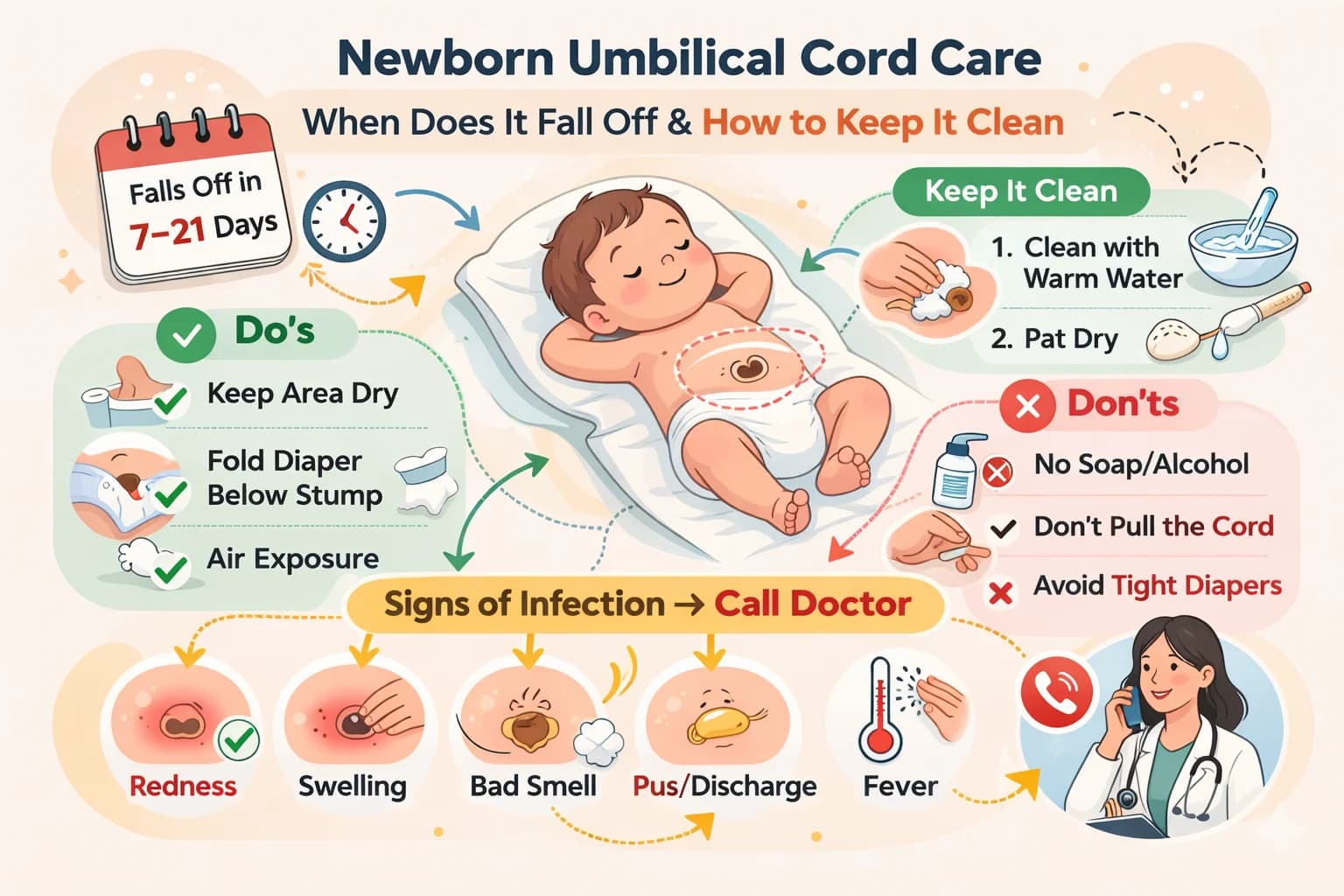
- Do not apply antiseptics, alcohol, or antibiotic creams to the stump routinely. Studies have shown that these can slow natural detachment and actually increase infection risk in some settings.
- Do not cover or bandage the stump — air circulation promotes faster drying and separation.
- Do not get it wet unnecessarily. While brief dampening during sponge bathing is acceptable, the stump should be dried gently and thoroughly afterward.
Sponge Bathing Until the Stump Falls Off
Until the cord stump has completely separated (and the navel has fully healed), give your newborn sponge baths rather than immersion baths. This means washing your baby with a warm, damp cloth while keeping the stump dry.
How to sponge bathe:
- Use warm (not hot) water and mild, fragrance-free baby wash if needed
- Support your baby on a flat, padded surface
- Work from the cleanest areas to dirtier ones
- Gently clean around (not over) the cord stump
- Pat the stump area dry with a clean cloth
Once the stump has separated and the navel looks fully healed (typically 1–2 weeks after cord separation), you can begin immersion bathing.
Nappy and Clothing Tips
- Fold the front of the nappy down below the cord stump to prevent friction, moisture, and faecal contamination. Many newborn nappy brands have a built-in cut-out for this purpose.
- Dress your newborn in loose clothing that does not rub against the stump.
- Avoid tight elastic waistbands over the stump area.
What NOT to Do
- ❌ Do not pull or tug at the stump — even if it looks almost ready to fall off
- ❌ Do not apply spirit, rubbing alcohol, iodine, or antiseptic powder routinely
- ❌ Do not cover with plasters or bandages
- ❌ Do not immerse in a bath until it has fully separated and healed
- ❌ Do not use belly binders or wrappings that cover and compress the stump
When Does the Umbilical Cord Stump Fall Off?
Most umbilical cord stumps fall off between 10 and 21 days after birth. This is the normal range.
Some stumps take up to 4–6 weeks to fall off, particularly in babies with certain genetic conditions affecting immune function. If the stump has not fallen off by 6 weeks, consult your paediatrician — this can occasionally indicate an underlying immune system issue.
Can you speed up the process? No. Dry cord care and air exposure are already the most effective approaches. Do not attempt to pull the stump off. If it is hanging by a thin thread and appears almost detached, it will separate on its own within hours to a day.
What Is Normal vs. What Requires Medical Attention
This is the most important section for new parents to know well.
Normal Findings — No Action Needed
| What You See | Why It Is Normal |
|---|---|
| Colour change from yellow → brown → black | Normal drying and necrosis of cord tissue |
| Slight smell during drying phase | Normal decomposition of dead tissue |
| Small amount of dried blood at the base | Minor bleeding from normal tissue separation |
| Clear or yellow crust at the base | Dried serous fluid — normal |
| Navel looks slightly raw/pink just after separation | Normal healing after separation |
| Stump sticks to clothing and seems "stuck" | Fine — it will release when ready |
| Tiny drop of blood when the stump falls off | Normal |
Warning Signs That Require Prompt Medical Attention
Contact your paediatrician or take your baby to be seen the same day if you notice:
- Redness spreading onto the surrounding skin — this is the key sign of omphalitis (cord infection), a serious condition. A small ring of pink immediately at the base can be normal, but redness spreading onto the abdominal skin is not.
- Swelling of the skin around the cord base
- Pus or cloudy discharge from the stump or surrounding skin (as opposed to the clear/yellow crust which is normal)
- Stump that is consistently wet and not drying despite appropriate care
- Fever in a newborn (temperature above 38°C / 100.4°F) with any cord abnormality
- Crying or apparent pain when the cord area is touched
- Foul, persistent smell — distinct from the normal mild drying smell
Go to the emergency department immediately if:
- Your baby has a fever AND signs of cord infection
- There is significant bleeding from the cord site (more than a few drops)
- Your baby appears unwell, lethargic, or is feeding poorly alongside any cord concern
"Omphalitis — infection of the umbilical stump spreading to surrounding tissue — is rare in healthy term babies with good cord care, but it can progress quickly and requires prompt antibiotic treatment," says medical experts**. "The single most important warning sign parents should know is redness spreading onto the abdominal skin around the cord. That is the clinical indicator that infection is moving beyond the stump itself."
Umbilical Granuloma: What It Is and What to Do
An umbilical granuloma is a small, pink, moist nodule of tissue that remains at the navel after the cord stump has fallen off. It develops when a small amount of tissue does not properly dry and separate.
What it looks like: A small, shiny, pink or reddish bump of soft tissue, sitting in or just above the belly button. It may be moist and produce a small amount of clear discharge.
Is it dangerous? No. It is not an infection and is not painful.
What happens: Your paediatrician will typically treat it with silver nitrate (a cauterising agent applied directly to the granuloma, which causes it to shrink and dry up over several visits). Salt application is another traditional method that is sometimes used at home but should be discussed with your provider first. Most granulomas resolve completely with 1–3 treatments.
Umbilical Hernia: What Parents Should Know
An umbilical hernia is a soft, painless bulge at the belly button that appears when the abdominal muscles have not fully closed around the umbilical opening at birth. It is particularly common in premature babies and those of African descent.
What it looks like: A soft swelling at the belly button that becomes more prominent when the baby cries or strains.
What to do: Most umbilical hernias close on their own by age 1–2, and nearly all close by age 4–5. They do not require treatment in the vast majority of cases. Never tape coins or objects over an umbilical hernia — this is a folk remedy with no efficacy and risks of skin irritation.
Consult a paediatrician if the hernia is large (over 1.5 cm), is not reducing in size by age 2, or becomes hard and non-reducible (a surgical emergency).
Caring for the Navel After the Cord Falls Off
Once the cord stump separates, the belly button area will look slightly raw and may have a small pink spot. This is normal.
Post-separation care:
- Keep the area clean and dry
- Sponge or bathe as normal — the navel can now be gently cleaned
- A small amount of dried blood or crust is normal immediately after separation
- Full healing typically occurs within 1–2 weeks
No special creams or products are needed. Plain, gentle washing is sufficient.
Quick Reference Guide for Parents
| Situation | What to Do |
|---|---|
| Stump is yellow-green at birth | Normal — leave alone |
| Stump turns brown/black | Normal — expected drying process |
| Mild smell while drying | Normal — continue dry cord care |
| Small amount of dried blood at base | Normal — clean gently, leave to dry |
| Stump hanging by a thin thread | Leave alone — will fall off on its own |
| Redness spreading onto abdominal skin | Call paediatrician today |
| Pus or cloudy discharge | Call paediatrician today |
| Stump still present at 6 weeks | Consult paediatrician |
| Pink nodule remaining after cord separation | Umbilical granuloma — see paediatrician |
Frequently Asked Questions (FAQ)
Q: Should I clean the umbilical cord stump with alcohol? A: Current guidance from the WHO and AAP recommends against routine alcohol cleaning for term babies in clean settings. Alcohol can slow natural separation and may disrupt beneficial bacteria. Simply keep the area dry and clean, and fold the nappy below it. Your healthcare provider will advise if your specific situation requires anything different.
Q: The cord stump smells — is that normal? A: A mild smell during the drying phase is normal. Dying tissue has an odour. However, a foul, persistent, or distinctly unpleasant smell — especially combined with redness, swelling, or discharge — is a sign of possible infection that warrants a same-day call to your paediatrician.
Q: My baby's cord stump has been there for 3 weeks. Should I be worried? A: Not necessarily. While most stumps separate by 21 days, some take up to 4–6 weeks. Continue dry cord care and sponge bathing. If there are no signs of infection and the stump appears to be drying normally, it is fine to wait. If it remains at 6 weeks or beyond, consult your paediatrician.
Q: Can I give my newborn a full bath before the cord falls off? A: No. Until the cord stump has fully separated and the navel has healed, give sponge baths only. Soaking the cord in water delays drying and increases infection risk.
Q: There was a small amount of blood when the cord fell off. Is that normal? A: Yes. A few drops of blood when the stump separates is normal. If there is more than a small spot of blood, apply gentle pressure with a clean cloth. If bleeding does not stop within a few minutes, seek medical attention.
Q: What is the correct way to fold the nappy to protect the cord? A: Fold the front of the nappy down and away from the cord stump so that it sits below the belly button. Many newborn-size nappies have a pre-cut notch for this purpose. This prevents the nappy from rubbing the stump, trapping moisture, or exposing it to faecal bacteria.
Q: My baby seems uncomfortable when I touch the cord area. Is that normal? A: The cord stump itself has no nerve endings and should not be painful. If your baby cries specifically when the cord area is touched, inspect carefully for signs of infection (redness spreading onto the skin, swelling, warmth, discharge) and consult your paediatrician.
Q: Is it safe to let the cord get a little wet during bath time? A: Brief dampening is acceptable, but the cord should be gently and thoroughly dried immediately afterward. Persistent moisture is the main preventable risk factor for cord infection. If the cord gets wet, pat (do not rub) it dry with a soft, clean cloth.
References and Further Reading
-
World Health Organization — Care of the Umbilical Cord:
https://www.who.int/tools/your-life-your-health/life-phase/newborns-and-children-under-5-years/caring-for-newborns -
American Academy of Pediatrics — Umbilical Cord Care:
https://www.healthychildren.org/English/ages-stages/baby/bathing-skin-care/Pages/Umbilical-Cord-Care.aspx -
Imdad A et al. — Umbilical Cord Antisepsis (Cochrane Database, 2013):
https://www.cochranelibrary.com/cdsr/doi/10.1002/14651858.CD008635.pub2
Medical Disclaimer
This article is for informational and educational purposes only and does not replace professional medical advice. Newborn health concerns — particularly suspected infections — require prompt in-person medical evaluation. Always consult your paediatrician, midwife, or healthcare provider with concerns about your newborn's health and wellbeing. Learn more about our medical review board.
About the Author
Abhilasha Mishra is a health and wellness writer specializing in women's health, pregnancy, and newborn care. She writes evidence-based guides to help new parents navigate the early weeks of parenthood with knowledge and confidence.