
Newborn Jaundice: What's Normal, What's Not, and When to Go to the Doctor
Newborn jaundice explained by an OB/GYN — what causes the yellow colour, which babies are at higher risk, what bilirubin levels require treatment, and the clear signs that mean go in today.
Try Related Tools
Use our source-informed calculators to get helpful insights.
Table of Contents
- What Is Newborn Jaundice?
- Types of Neonatal Jaundice
- Risk Factors for Significant Jaundice
- How Jaundice Is Assessed and Measured
- Treatment: Phototherapy and Exchange Transfusion
- Acute Bilirubin Encephalopathy and Kernicterus
- When to Call Your Doctor or Go to the Hospital Today
- The Role of Feeding in Managing Jaundice
- Frequently Asked Questions (FAQ)
- References and Further Reading
What Is Newborn Jaundice?
Jaundice (icterus) is the yellow discolouration of skin and the white of the eyes (sclerae) caused by an elevated level of bilirubin in the blood — a condition called hyperbilirubinemia.
Bilirubin is a yellow-orange pigment produced when red blood cells are broken down. It is processed by the liver, passed into bile, and excreted in stool (bilirubin gives stool its characteristic brown colour) and urine.
In newborns, two factors combine to cause bilirubin to accumulate:
1. Accelerated red blood cell breakdown: Newborns have a higher concentration of fetal hemoglobin, which is replaced rapidly by adult hemoglobin after birth. This breakdown process releases a large amount of bilirubin over a short period.
2. Immature liver processing: A newborn's liver takes several days to weeks to develop the full enzyme capacity (specifically UGT1A1, the enzyme that conjugates bilirubin for excretion) needed to process this surge efficiently. Until it does, unconjugated bilirubin accumulates in the blood and eventually deposits in tissues, producing the characteristic yellow colour.
Types of Neonatal Jaundice
Not all newborn jaundice is the same. Understanding the type is essential for assessing risk.
Physiological Jaundice (Normal Jaundice)
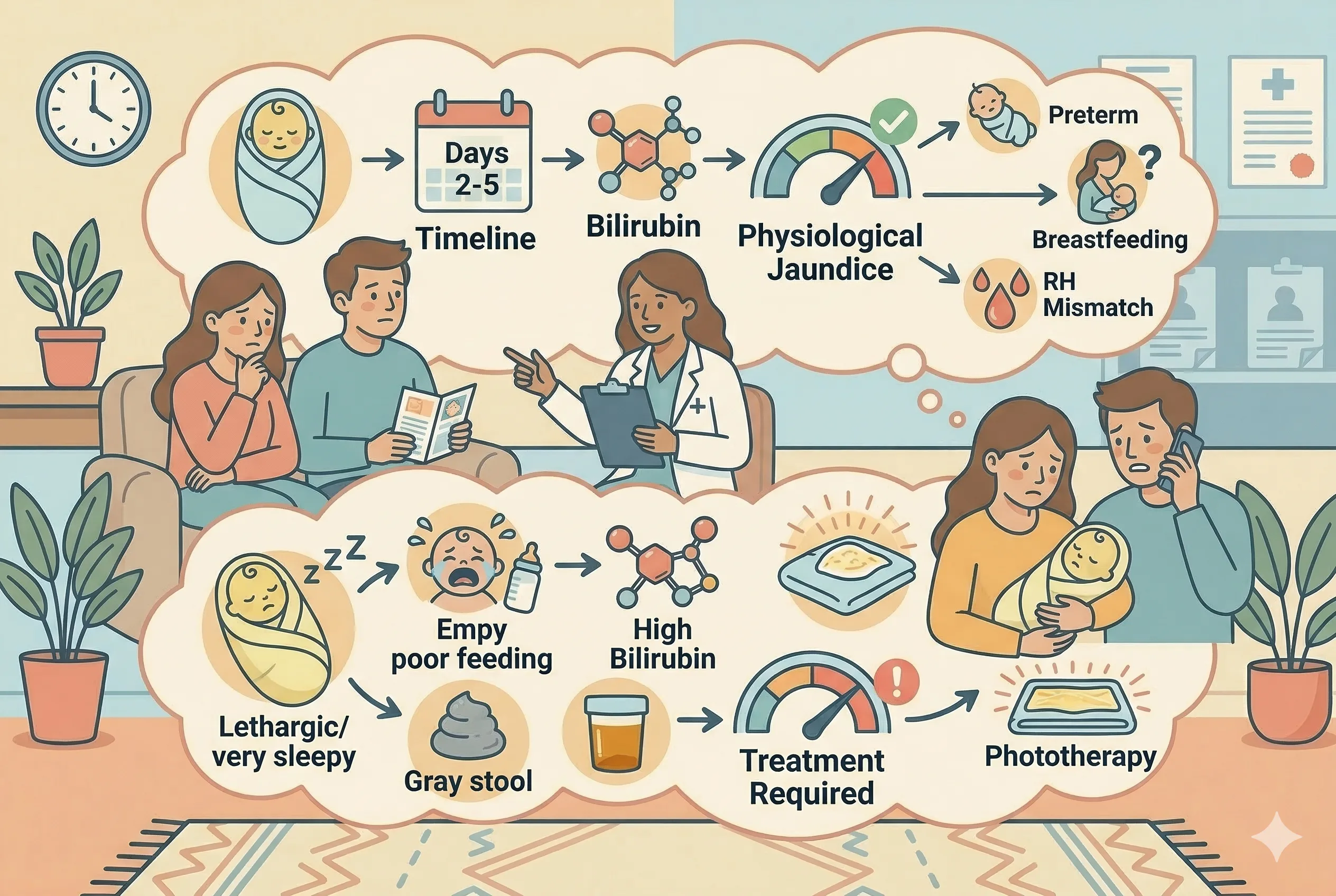
Physiological jaundice is the most common form — a normal, expected consequence of the newborn transition described above.
Characteristics:
- Appears after 24 hours of age (jaundice appearing in the first 24 hours is never physiological and requires immediate investigation)
- Peaks at days 3–5 in full-term babies
- Resolves spontaneously by 2 weeks in full-term babies (by 3 weeks in premature babies)
- Bilirubin levels remain below the treatment threshold
- Baby is otherwise well, feeding normally, and producing adequate wet and dirty nappies
Physiological jaundice does not require treatment beyond ensuring adequate feeding.
Breastfeeding Jaundice (Early, Days 2–5)
Not to be confused with breast milk jaundice (below). Breastfeeding jaundice in the early days is caused by insufficient milk transfer — a baby who is not feeding frequently or effectively enough to stimulate adequate stooling. Without sufficient stooling, bilirubin that has been excreted into the gut via bile is reabsorbed back into the bloodstream (enterohepatic recirculation).
This is the most preventable form of jaundice. It is addressed by:
- Increasing feeding frequency to at least 8–12 times per 24 hours
- Lactation support to improve latch and milk transfer
- Supplementation with expressed breastmilk or formula if clinically indicated
Breast Milk Jaundice (Late, Week 2 Onward)
A distinct phenomenon from early breastfeeding jaundice. Breast milk jaundice develops in the second week and can persist for 4–6 weeks or longer in some breastfed babies. It is caused by substances in mature breast milk that inhibit bilirubin conjugation in the liver.
Key features:
- Baby is otherwise thriving — gaining weight well, feeding enthusiastically, producing normal nappies
- Bilirubin levels are mildly elevated but generally below the treatment threshold
- Stopping breastfeeding is not necessary or recommended in most cases
- Confirm with your paediatrician that levels are not in a range requiring treatment
Pathological Jaundice (Requires Investigation)
Pathological jaundice is always present if jaundice appears within the first 24 hours, and may be present if it appears later with a rapid rise in bilirubin, persists beyond the expected resolution timeframe, or if bilirubin reaches the treatment threshold.
Causes include:
- Blood group incompatibility (ABO or Rh) — maternal antibodies cross the placenta and destroy fetal red blood cells at an accelerated rate
- G6PD deficiency — a genetic enzyme deficiency that increases red blood cell fragility; more common in boys from certain ethnic populations (African, Mediterranean, South and Southeast Asian)
- Infection (sepsis) — jaundice can be an early sign of neonatal infection
- Hypothyroidism
- Metabolic conditions — galactosaemia, Crigler-Najjar syndrome
- Cephalhaematoma — a large bruise on the baby's head from birth that breaks down, releasing a large bilirubin load
- Polycythaemia — abnormally high red blood cell count
Risk Factors for Significant Jaundice
Some babies are at higher risk of developing bilirubin levels that require treatment:
- Prematurity (born before 38 weeks) — immature liver, fewer intestinal bacteria for bilirubin conversion
- East Asian or South Asian ethnicity — higher prevalence of certain genetic variants affecting bilirubin processing
- G6PD deficiency — particularly relevant in boys; should be screened for in high-prevalence populations
- Sibling who had jaundice requiring treatment — strong predictor of recurrence
- Blood group incompatibility — mother O blood type with baby A or B (ABO incompatibility); Rh-negative mother with Rh-positive baby (Rh disease, less common with modern anti-D prophylaxis)
- Significant bruising at birth (large cephalhaematoma, extensive bruising from forceps or ventouse delivery)
- Exclusive breastfeeding in the first few days with slow milk establishment
- Pre-discharge bilirubin level in the high-intermediate or high-risk zone (based on the Bhutani nomogram)
How Jaundice Is Assessed and Measured
The Clinical Assessment: The Cephalocaudal Rule
Bilirubin deposits in the skin in a head-to-toe pattern as levels rise. A useful clinical rule:
- Face and eyes only → mild (bilirubin approximately 5–7 mg/dL or 85–120 µmol/L)
- Chest and upper abdomen → moderate (approximately 7–12 mg/dL or 120–200 µmol/L)
- Lower abdomen, thighs → significant (approximately 10–15 mg/dL or 170–255 µmol/L)
- Below the knees, hands and feet → severe (> 15 mg/dL or > 255 µmol/L)
This visual assessment is a guide, not a substitute for measurement. It is inaccurate in babies with darker skin. A jaundiced baby should always have an objective bilirubin measurement.
Objective Bilirubin Measurement
Transcutaneous bilirubinometry (TcB): A non-invasive device pressed against the skin that estimates bilirubin via light reflection. Used for initial screening. If levels are above a threshold, a blood test confirms.
Serum bilirubin (SBR): A blood test (heel prick or venous blood sample) measuring total bilirubin in the blood. This is the gold standard measurement. Results plotted on the Bhutani nomogram (or equivalent national chart) against the baby's age in hours to determine risk zone and treatment threshold.
Understanding Bilirubin Units
Bilirubin is measured in:
- mg/dL (milligrams per decilitre) — used in the US
- µmol/L (micromoles per litre) — used in the UK, Australia, and most of Europe
Conversion: 1 mg/dL = 17.1 µmol/L
Treatment: Phototherapy and Exchange Transfusion
Phototherapy (Light Therapy)
Phototherapy is the primary treatment for neonatal jaundice. It works by converting unconjugated bilirubin (which cannot be excreted without liver conjugation) into water-soluble isomers that can be excreted in urine and bile without liver processing.
How it works:
- Baby is placed under blue-spectrum lights (wavelength 460–490 nm), wearing only a nappy and eye protection
- Skin must be maximally exposed to maximise the photochemical conversion
- Conventional phototherapy reduces bilirubin by approximately 1–2 mg/dL (17–34 µmol/L) per 4–6 hours of treatment
- Intensive phototherapy (fibreoptic blanket in addition to overhead lights, or LED intensive units) works faster
During phototherapy:
- Feeding must continue frequently — feeds facilitate bilirubin excretion through stooling and maintain hydration
- Breastfeeding should continue unless bilirubin levels are in the range requiring temporary interruption (rare)
- Eye shields must remain in place whenever lights are on
- Temperature should be monitored — lamps generate heat
Exchange Transfusion
An exchange transfusion — replacing the baby's blood with donor blood through a umbilical catheter — is reserved for severely elevated bilirubin that has not responded to phototherapy or is rising so rapidly that acute bilirubin encephalopathy is imminent. It is performed in a neonatal intensive care unit and is now uncommon in well-resourced settings due to the effectiveness of early phototherapy.
Acute Bilirubin Encephalopathy and Kernicterus
This is why jaundice must be taken seriously when it escalates.
When serum bilirubin reaches very high levels, unconjugated bilirubin crosses the blood-brain barrier and deposits in specific regions of the brain — particularly the basal ganglia and brainstem — causing direct neurological damage.
Acute bilirubin encephalopathy is the early, potentially reversible form:
- Lethargy and hypotonia (poor muscle tone)
- High-pitched, abnormal cry
- Poor feeding and weak suck
- Arching of the back (retrocollis) or neck (opisthotonos) in severe cases
- Fever
Kernicterus is the chronic, irreversible neurological damage that results from untreated acute encephalopathy:
- Athetoid cerebral palsy
- Hearing loss (auditory neuropathy)
- Upward gaze palsy
- Dental enamel dysplasia
- Intellectual disability
Kernicterus is a preventable tragedy. The entire purpose of jaundice monitoring, bilirubin plotting, and prompt treatment initiation is to prevent it.
When to Call Your Doctor or Go to the Hospital Today
The following signs require same-day medical evaluation:
| Sign | Action |
|---|---|
| Jaundice appears in the first 24 hours of life | Emergency — go immediately |
| Yellow colour has spread to the baby's belly, thighs, or feet | Call your paediatrician today |
| Baby is difficult to wake for feeds | Go in today |
| Baby is feeding very poorly or not at all | Go in today |
| Baby has a high-pitched or abnormal cry | Emergency — go immediately |
| Baby arches their back unusually | Emergency — go immediately |
| Jaundice has not improved by 14 days in a full-term baby | Call your paediatrician |
| Jaundice appears to be worsening after initial improvement | Call your paediatrician today |
| Baby has dark orange or brown urine combined with pale stools | Go in today — this pattern suggests a liver problem |
The Role of Feeding in Managing Jaundice
Adequate feeding is the most important thing parents can do to help resolve physiological jaundice:
- Breastfeed or bottle-feed at least 8–12 times per 24 hours
- Meconium (first stools) contains bilirubin — frequent stooling eliminates this load; early feeding promotes early meconium passage
- As mature milk comes in and feeding becomes established, stooling increases and bilirubin is efficiently eliminated
- Do not restrict breastfeeding to treat jaundice unless specifically directed by your paediatrician with documented bilirubin levels requiring temporary interruption
Frequently Asked Questions (FAQ)
Q: How common is newborn jaundice? A: Jaundice is extremely common — it affects approximately 60% of full-term newborns and up to 80% of premature babies in the first week of life. The vast majority of cases are physiological, self-limiting, and require only monitoring and adequate feeding.
Q: When should jaundice appear and when should it resolve? A: Physiological jaundice appears after the first 24 hours of life, peaks on days 3–5, and resolves by 2 weeks in full-term babies (3 weeks in premature infants). Any jaundice appearing in the first 24 hours is pathological and requires immediate evaluation. Jaundice persisting beyond 3 weeks in a full-term baby requires investigation.
Q: Does jaundice mean I should stop breastfeeding? A: In almost all cases, no. Early breastfeeding jaundice is treated by breastfeeding more — not less. Late breast milk jaundice does not require cessation unless bilirubin levels are in a range your paediatrician considers dangerous. The benefits of breastfeeding far outweigh the risks of mild breast milk jaundice. Your paediatrician will advise if temporary formula supplementation is clinically indicated.
Q: What do the bilirubin numbers mean and how do I know if my baby's level is too high? A: Bilirubin levels are interpreted relative to the baby's age in hours, not just the absolute number. A level that is safe at 96 hours may be concerning at 24 hours. Your doctor or midwife will plot the level on a nomogram that gives a risk zone. Levels in the low-risk zone require monitoring only; high-intermediate and high-risk zones trigger phototherapy.
Q: Is sun exposure through a window an effective treatment for jaundice? A: No. Indirect sunlight through window glass is not an effective substitute for medical phototherapy. Window glass filters out the UV and short-wavelength blue light that converts bilirubin. Placing a jaundiced baby near a window for sunlight has minimal therapeutic benefit and risks sunburn. Medical phototherapy uses specific wavelengths at controlled intensities — it cannot be replicated at home.
Q: My baby had jaundice treated in hospital. Will they get jaundice again? A: Physiological jaundice is a one-time event of the newborn period and does not recur. However, having had significant jaundice is a risk factor for the same pattern in subsequent siblings — this should be flagged to the paediatrician in any future pregnancies so early monitoring can be arranged. G6PD deficiency and blood group incompatibility may recur in future babies depending on the specific diagnosis.
Q: Can jaundice cause brain damage? A: Severely elevated bilirubin that is not treated can cause acute bilirubin encephalopathy and, if untreated, kernicterus — permanent neurological damage causing cerebral palsy and hearing loss. This is why newborn jaundice monitoring is taken seriously. However, the risk of brain damage from physiological jaundice that is monitored and treated appropriately when needed is extremely low. The system exists precisely to prevent this outcome.
Q: My baby is 3 weeks old and still looks yellow. Is this normal? A: A full-term baby with jaundice that has not resolved by 14 days warrants a paediatrician review to distinguish prolonged physiological or breast milk jaundice (which is generally benign) from pathological causes. The most important thing to exclude is conjugated (direct) hyperbilirubinemia — indicated by dark urine and pale, chalky stools — which is always abnormal and requires urgent investigation. If your 3-week-old's stools are normal brown and urine normal yellow, prolonged breast milk jaundice is the most likely explanation, but a check with your paediatrician is still recommended.
References and Further Reading
-
NICE Guideline CG98 — Neonatal Jaundice:
https://www.nice.org.uk/guidance/cg98 -
American Academy of Pediatrics — Management of Hyperbilirubinemia in the Newborn:
https://www.healthychildren.org/English/ages-stages/baby/Pages/Jaundice.aspx -
NHS — Newborn Jaundice:
https://www.nhs.uk/conditions/jaundice-newborn -
WHO — Recommendations on Newborn Health:
https://www.who.int/maternal_child_adolescent/newborns/en -
CDC — Newborn Jaundice:
https://www.cdc.gov/ncbddd/jaundice/index.html
Medical Disclaimer
This article is for informational and educational purposes only. It does not constitute medical advice, diagnosis, or treatment. Neonatal jaundice can escalate rapidly and requires professional assessment and monitoring. If you are concerned about your newborn's jaundice — particularly if it appeared in the first 24 hours, is spreading rapidly, or is accompanied by any change in your baby's behaviour or feeding — seek medical assessment the same day. Do not rely solely on this article to assess your baby's condition.
About the Author
Abhilasha Mishra is a health and wellness writer specializing in newborn care, neonatal health, and early childhood medicine. She writes evidence-based guides to help new parents navigate the anxious early weeks with accurate information and confidence.