
LH Surge: What It Means & How to Track
LH surge explained: what it is, ovulation timing, how OPKs work, fertile window length, and tracking for pregnancy planning.
Try Related Tools
Use our source-informed calculators to get helpful insights.
Table of Contents
- What Is LH and Why Does It Surge?
- The Precise Timeline: LH Surge to Ovulation
- How OPKs Work: The Types and Their Differences
- How to Use OPKs Correctly: A Practical Guide
- The Peak Day vs. The Surge Day: A Critical Distinction
- Why You Might Not Get a Clear OPK Positive
- LH Surge in PCOS: The Special Challenge
- LH Surge Confirmed — Now What?
- Frequently Asked Questions (FAQ)
- References and Further Reading
What Is LH and Why Does It Surge?
Luteinising hormone (LH) is a gonadotropin — a hormone produced by the anterior pituitary gland that acts on the gonads (ovaries in women, testes in men). It is present in the blood and urine throughout the menstrual cycle at low baseline levels.
The Monthly Sequence Leading to the Surge
Each menstrual cycle, several follicles in the ovary begin developing under the influence of FSH (follicle-stimulating hormone). As these follicles grow, they produce oestrogen. As oestrogen rises to a critical threshold, it triggers what is called an oestrogen-induced positive feedback switch — rather than suppressing LH (as oestrogen normally does), very high oestrogen levels paradoxically signal the pituitary to release a massive surge of LH.
This LH surge:
- Causes the dominant follicle to undergo final maturation
- Triggers the resumption of meiosis in the egg (a process that had been paused since before birth)
- Stimulates the follicle wall to produce enzymes that will rupture it
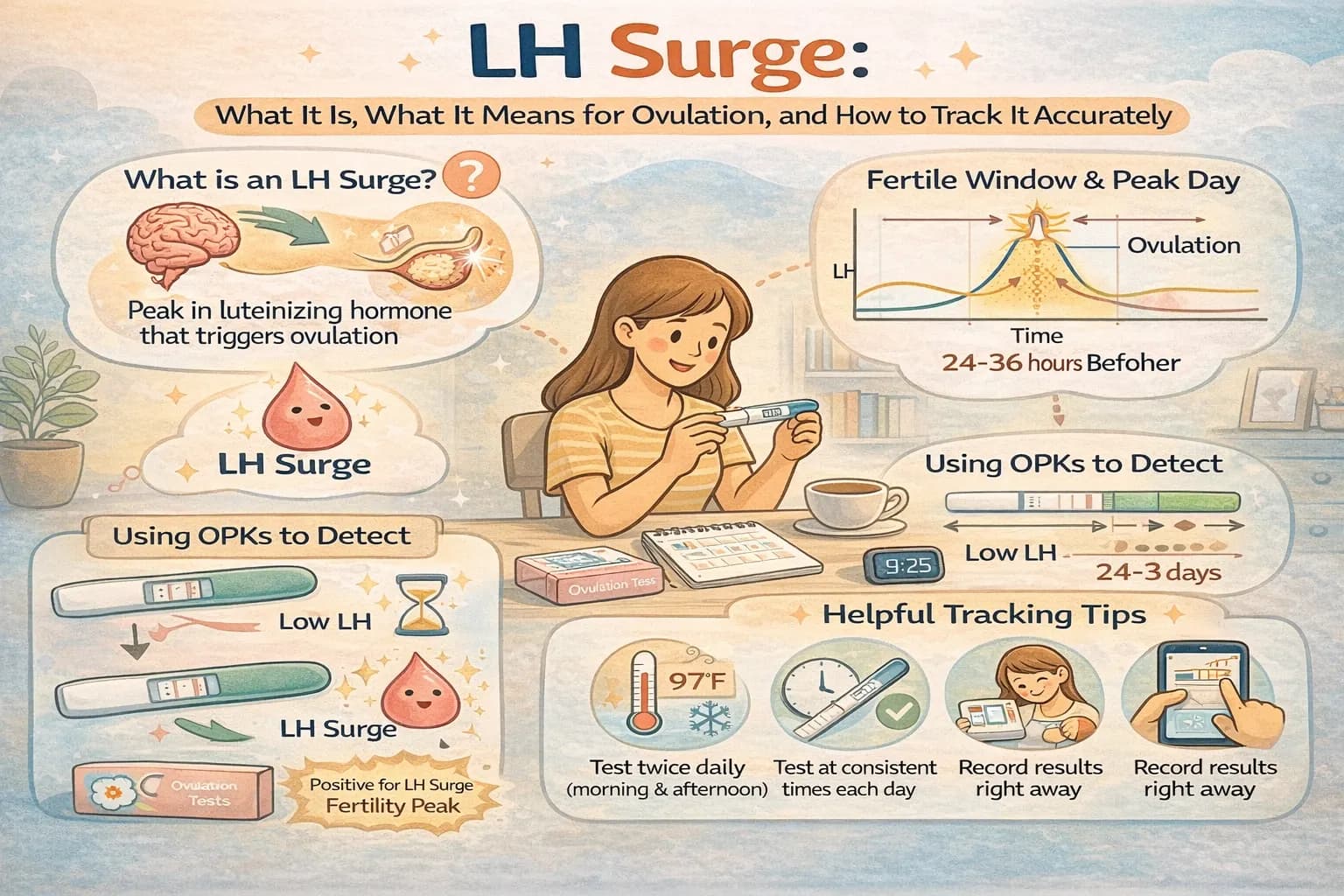
- Causes the follicle to release the egg — ovulation — typically 24–36 hours after the LH surge begins and approximately 8–20 hours after the LH peak
After ovulation, LH then transforms the ruptured follicle into the corpus luteum, which produces progesterone to prepare the uterine lining for implantation.
"The LH surge is not a single event — it has a rising phase, a peak, and a falling phase," explains medical experts**. "Understanding this helps women use OPKs correctly and understand what they are actually detecting at each point of the surge."
The Precise Timeline: LH Surge to Ovulation
This is the information that most fertility content gets wrong or oversimplifies:
| Time Point | What Is Happening |
|---|---|
| LH surge begins | LH starts rising above baseline — may be detectable on sensitive OPKs |
| LH peak (highest point) | Maximum LH concentration in blood and urine — approximately 28–40 hours before ovulation |
| Ovulation | Egg release — typically 24–36 hours after surge onset and 8–20 hours after the LH peak |
| Egg viability window | The egg is viable for fertilisation for approximately 12–24 hours after release |
| Sperm viability | Sperm can survive in fertile cervical mucus for 3–5 days |
Key implications:
- A positive OPK means ovulation will likely occur within the next 12–36 hours
- The day of the LH surge and the day after are the two highest-probability days for intercourse or insemination
- Because sperm survive for several days, intercourse in the 2 days before the LH surge is detected also has a high probability of resulting in fertilisation
- The egg itself is viable for only 12–24 hours — so timing after ovulation has already occurred is largely too late
How OPKs Work: The Types and Their Differences
Standard Threshold OPKs (Test Line vs Control Line)
The original and most widely used format. A positive result is indicated when the test line is as dark as or darker than the control line.
How they work: These tests detect LH by immunoassay — antibodies in the test strip bind LH in the urine sample. The darker the test line, the higher the LH concentration. The control line represents the manufacturer's threshold — approximately 25–40 mIU/mL for most standard tests (the level that, in studies of the average woman, corresponds to the LH surge).
Limitation: These tests tell you whether LH is above or below the threshold — they do not tell you how rapidly it is rising or where you are relative to your personal peak. For women with naturally higher baseline LH (including some women with PCOS), the test line may always appear positive. For women with a surge that does not rise much above baseline, the test may never appear clearly positive.
Digital OPKs (Smiley Face Results)
Digital OPKs use the same immunoassay technology but add a digital reader that converts the result into a clear positive (smiley face or peak indicator) or negative. Some advanced digital systems (Clearblue Advanced) also detect the rise in oestrogen that precedes the LH surge, providing additional "high fertility" days before the peak.
Advantage: Removes the subjectivity of line comparison. Limitation: Binary — you know positive or negative, but not where you are in the surge.
Quantitative LH Monitors (e.g., Mira Fertility Monitor)
These devices provide actual numerical LH values in mIU/mL, allowing you to track the rise, peak, and fall of your personal LH curve. They also detect oestrogen (E3G) and some track progesterone metabolites.
Advantage: Provides your personal baseline and personal peak — far more informative than threshold-based tests. Particularly valuable for women with PCOS, irregular cycles, or unusual LH patterns. Limitation: Significantly more expensive; requires consistent daily testing.
How to Use OPKs Correctly: A Practical Guide
When to Start Testing
Calculate based on cycle length:
| Cycle Length | Start Testing From Day |
|---|---|
| 24 days | Day 7 |
| 28 days | Day 10 |
| 30 days | Day 12 |
| 35 days | Day 17 |
| Irregular | Day 10 (or 17 days before expected period) |
For irregular cycles, starting on day 10 and testing daily (or twice daily near the expected surge) is a practical approach.
Time of Day for Testing
Mid-morning (10 am–2 pm) is the optimal time for most OPK brands. LH is released from the pituitary in the early morning and takes several hours to accumulate to detectable levels in urine. First-morning urine — counterintuitively — is often not the best for OPKs (it is the best for pregnancy tests, but different analytes behave differently).
Second-morning urine (first void after mid-morning) is often recommended.
Important: Limit fluid intake for 2 hours before testing to prevent over-dilution of the urine sample, which can mask a positive result.
Testing Frequency
- Once daily is adequate for tracking purposes in most cycles
- Twice daily (morning and afternoon) during the days when you expect the surge to improve the chance of catching it — some surges are short (less than 24 hours) and a once-daily test may miss the peak entirely
- If you have very short, irregular cycles, twice-daily testing from day 8 onward is advisable
Reading the Result Correctly
- Negative: Test line clearly lighter than control line
- Positive: Test line as dark as or darker than control line — plan intercourse today and tomorrow
- Approaching surge: Test line is getting progressively darker over successive days — this is a useful pattern even before a clear positive, indicating the surge is building
Photograph and compare tests daily — laying them in sequence allows you to see the gradual darkening pattern that confirms you are tracking the surge reliably.
The Peak Day vs. The Surge Day: A Critical Distinction
Many fertility resources treat "LH surge day" and "peak day" as the same thing. They are not.
- Surge day: The first day the OPK is positive — LH has crossed above the detection threshold
- Peak day: The day of highest LH concentration — usually 1 day after the surge day for many women, but variable
On a threshold OPK, you cannot tell the difference between the surge beginning and the peak — both appear "positive."
On a quantitative monitor, you can see:
- Day 1 of surge: 28 mIU/mL (first positive)
- Day 2: 58 mIU/mL (still positive, higher)
- Day 3: 14 mIU/mL (negative — this was the fall after peak)
This matters because ovulation is most reliably estimated as occurring 8–20 hours after the LH peak — so the day after the peak is often actually the day of ovulation or the day after, not the surge day itself.
For practical TTC timing: intercourse on the surge day and the day after covers the optimal window regardless of whether you can identify the exact peak.
Why You Might Not Get a Clear OPK Positive
This is one of the most common concerns in TTC communities, and it has multiple explanations:
You Missed the Surge
The LH surge can be as short as 8–12 hours in some women. Testing once daily can miss a surge entirely, particularly if it occurs and peaks between two testing times. Solution: test twice daily during your expected fertile window.
Your Baseline LH Is Naturally High
Approximately 6–8% of women have persistently elevated LH — making it difficult to distinguish the surge from baseline. This is common in PCOS, where LH may be chronically elevated, and in women approaching perimenopause, where FSH and LH both rise. A quantitative monitor that tracks your personal baseline is most useful in this situation.
Your Surge Is Low-Amplitude
Some women have a genuine LH surge that triggers ovulation but does not rise very far above their personal baseline — never crossing the standard threshold OPK detection level. This is a normal variant. Ultrasound monitoring (follicle tracking) is the definitive alternative.
You Are Not Ovulating (Anovulatory Cycle)
If you consistently get no positive OPK over multiple cycles, anovulation is possible. Conditions including PCOS, thyroid disorders, elevated prolactin, very low BMI, extreme exercise, and perimenopause all cause anovulatory cycles. Consult your doctor if you consistently see no LH surge after 2–3 complete cycles of proper testing.
Cycle Is Shorter or Longer Than Expected
If your cycle length is irregular, you may be starting testing too late and missing the surge, or starting too early and running out of test strips.
LH Surge in PCOS: The Special Challenge
Polycystic ovary syndrome (PCOS) is associated with chronically elevated LH and disrupted LH pulsatility. For women with PCOS:
- OPKs may appear persistently "positive" due to elevated baseline LH — making it impossible to identify the true surge
- Ovulation may occur but be irregular — sometimes multiple follicles begin developing but none reaches a dominant status and ovulates
- Cycles are often longer and more variable, making timing of testing harder
For women with PCOS trying to conceive, ultrasound follicle tracking (performed in a fertility clinic or gynaecology setting) is far more reliable than OPKs for confirming ovulation. The follicle is measured until it reaches 18–22 mm (dominant follicle size), and the post-ovulation collapse is confirmed on follow-up scan.
LH Surge Confirmed — Now What?
When you get a positive OPK:
- Have intercourse today and tomorrow — these are your highest-probability days
- Do not wait for the test to go negative before having intercourse — that means ovulation has already occurred or is occurring
- If you are doing intrauterine insemination (IUI), your clinic will typically schedule the procedure approximately 24–36 hours after the surge is confirmed
- Relax — the timing is set. Additional intercourse the day before the confirmed surge is also beneficial given sperm survival
Frequently Asked Questions (FAQ)
Q: How long after a positive OPK should I have intercourse? A: Have intercourse on the day of the positive OPK and the day after. Ovulation typically occurs 12–36 hours after the surge begins and 8–20 hours after the peak. Sperm need time to reach and capacitate in the fallopian tubes, so intercourse on the surge day positions sperm optimally for the egg's arrival. Do not wait for the test to go negative.
Q: Does a positive OPK confirm that I will ovulate? A: Not definitively. An LH surge is necessary for ovulation but does not guarantee it occurs. In some cycles — particularly in women with PCOS — LH surges without a follicle reaching full maturity or rupturing. This is called a luteinised unruptured follicle (LUF) syndrome. If you consistently have positive OPKs but are not conceiving, follicle tracking ultrasound can confirm whether ovulation is actually occurring.
Q: My OPK went from negative to faintly positive overnight. Is that my surge? A: Possibly. A test line that is noticeably darker than your baseline — even if not yet as dark as the control line — may indicate the beginning of the surge. Test again in 4–6 hours and again the following morning. If it continues to darken, you are in the surge. This is why photographing and comparing daily tests is valuable.
Q: Can the LH surge last multiple days? A: The classical LH surge lasts 24–48 hours. However, some women have an extended surge that keeps threshold OPKs positive for 3–5 days. In this case, the peak occurred on or near the first positive day, and ovulation likely occurred within 24–48 hours of that first positive — not at the end of the string of positives. A quantitative monitor would show you the actual rise and fall.
Q: I have PCOS and my OPKs are always positive. What should I do? A: Standard threshold OPKs are unreliable for women with PCOS due to chronically elevated LH. Options include: a quantitative LH monitor (which shows your personal baseline and identifies the true peak above it), ultrasound follicle tracking through your gynaecologist, or progesterone blood testing 7 days after the suspected ovulation date to confirm whether ovulation occurred. Discuss your situation with a fertility specialist.
Q: I got a positive OPK but my period came 9 days later. Is my luteal phase too short? A: A luteal phase shorter than 10 days is considered short and may affect implantation success — the corpus luteum may not sustain adequate progesterone long enough for an embryo to implant and signal its presence. If you are consistently getting positive OPKs followed by periods in 9 days or fewer, discuss luteal phase assessment and possible progesterone support with your gynaecologist.
Q: What is the difference between a standard OPK and a digital OPK? A: Both detect LH using the same antibody-based immunoassay technology. The difference is in how results are displayed: standard OPKs require you to compare line darkness (subjective and subject to user error), while digital OPKs use a reader to convert the result into a clear positive or negative display. Advanced digital systems (such as Clearblue Advanced) also detect the oestrogen rise before the LH surge, providing additional "high fertility" days before the peak positive.
Q: Can stress delay or prevent the LH surge? A: Yes. Significant physical or psychological stress can disrupt the hypothalamic-pituitary axis, delaying or suppressing the LH surge and causing a late or anovulatory cycle. This is why cycles may be irregular during illness, major life events, intense exercise programmes, or periods of restricted eating. The LH surge is one of the most stress-sensitive points in the reproductive cycle.
References and Further Reading
-
ASRM — Ovulation Detection:
https://www.reproductivefacts.org/news-and-publications/patient-fact-sheets-and-booklets -
NHS — Trying to get pregnant:
https://www.nhs.uk/pregnancy/trying-for-a-baby/trying-to-get-pregnant/ -
ACOG — Fertility Awareness-Based Methods:
https://www.acog.org/womens-health/faqs/fertility-awareness-based-methods-of-family-planning -
Direito A et al. — Relationships Between the LH Surge and Ovulation (Human Reproduction, 2013):
https://pubmed.ncbi.nlm.nih.gov/23503942/ -
World Health Organization — Natural Family Planning:
https://www.who.int/reproductivehealth/topics/family_planning/natural_methods/en
Medical Disclaimer
This article is for informational and educational purposes only. It does not constitute medical advice, diagnosis, or treatment. Ovulation timing and fertility are highly individual and influenced by many factors. If you have been trying to conceive for 12 months without success (or 6 months if you are over 35), or if you have irregular cycles, suspected anovulation, or a known reproductive health condition, consult a qualified gynaecologist or reproductive medicine specialist for individual assessment.
About the Author
Abhilasha Mishra is a health and wellness writer specializing in fertility, ovulation, and reproductive health. She writes to help women understand the biology of their own cycles with accuracy and clarity, empowering more informed and less anxious approaches to conception.