
Late Period but Negative Test: What Could Be Happening
A late period with a negative test is common and often not urgent. Learn why early tests miss pregnancy, when to retest, and when to use our test-timing calculator or speak with a clinician.
Quick Answer
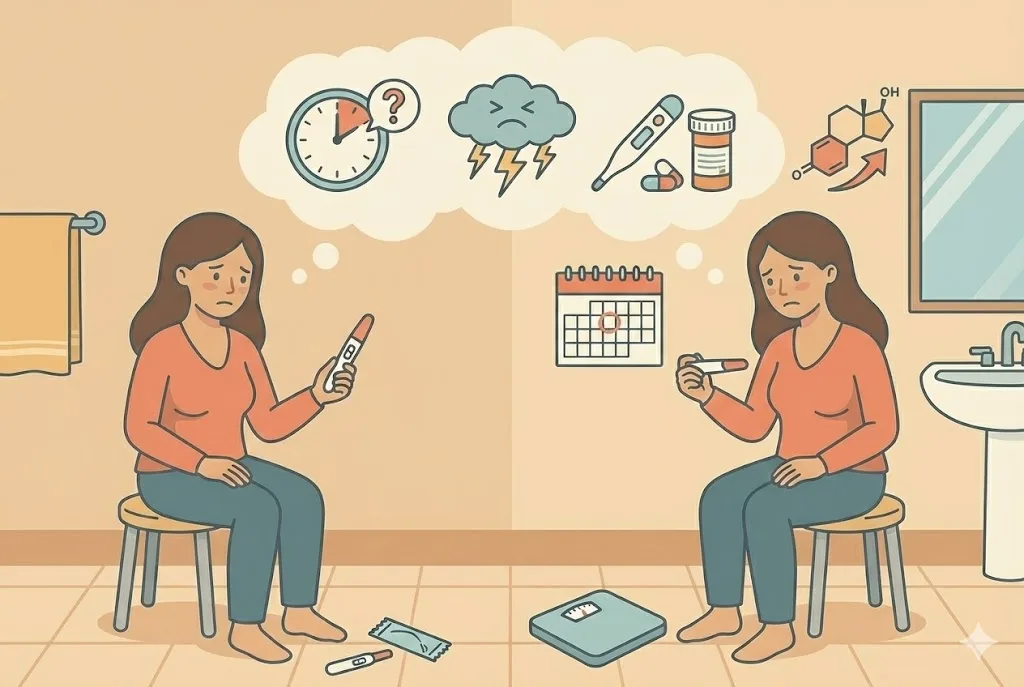
A negative pregnancy test with a late period often means you tested too early, ovulated later than expected, or have a non-pregnancy cause for the delay. Retesting a few days later or after a missed period is usually more informative than testing again immediately.
Try Related Tools
Use our source-informed calculators to get helpful insights.
Table of Contents
- First, Take a Breath
- Why Pregnancy Tests Can Be Negative Even If You Feel Pregnant
- Common Reasons for a Late Period With a Negative Test
- When Symptoms Feel Like Pregnancy but Tests Are Negative
- Chemical Pregnancy and Very Early Loss
- Irregular Cycles Are More Common Than You Think
- Emotional Impact: Why This Feels So Hard
- When to Test Again
- When to Call a Doctor
- What You Can Do Right Now
- Hope Without Pressure
- FAQs
- Trusted Medical References
First, Take a Breath
A late period does not automatically mean pregnancy. It also does not automatically mean something is wrong.
Many doctors explain that menstrual cycles are sensitive. Even small changes can delay ovulation or menstruation. When ovulation shifts, your period shifts too.
Your body is not broken. It is responding.
Why Pregnancy Tests Can Be Negative Even If You Feel Pregnant
Pregnancy tests detect the hormone hCG. That hormone appears after implantation, not after ovulation or conception.
If ovulation happened later than usual:
- Implantation may not have occurred yet
- hCG may still be too low to detect
- A test can appear negative even if pregnancy is possible
This is why timing matters more than symptoms.
The Conception Calculator can help estimate when fertilization might have occurred, but even these estimates vary.
Common Reasons for a Late Period With a Negative Test
1. Stress and Emotional Load
Stress affects the brain signals that control ovulation. Emotional strain, anxiety, grief, travel, or disrupted sleep can delay ovulation by days or weeks.
Many women are surprised by how powerful this effect can be.
2. Delayed Ovulation
Ovulation does not always happen on the same day each cycle. When ovulation happens late, the entire cycle extends.
Your period is not “late.” Ovulation was.
3. Hormonal Fluctuations
Changes in estrogen and progesterone can occur due to:
- Weight changes
- Illness
- Intense exercise
- Stopping or starting hormonal contraception
Hormones rarely shift quietly. Your cycle reflects these changes.
When Symptoms Feel Like Pregnancy but Tests Are Negative
Breast tenderness, nausea, fatigue, bloating, and mood swings occur before periods as well as during early pregnancy.
Progesterone causes many of the same sensations. This overlap can be confusing and emotionally draining.
Experts often explain that symptoms alone cannot confirm pregnancy.
Chemical Pregnancy and Very Early Loss
In some cases, fertilization occurs but implantation does not progress. This is known as a chemical pregnancy.
It can cause:
- A late period
- Very faint or negative tests
- Slightly heavier bleeding later
These early losses are common and usually unrelated to future fertility.
Irregular Cycles Are More Common Than You Think
Even women with “regular” cycles experience occasional variation.
The Cycle Length Variability tool can help you understand how much fluctuation is still considered normal.
Many doctors recommend observing patterns over several months instead of focusing on a single cycle.
Emotional Impact: Why This Feels So Hard
A late period with a negative test often triggers:
- Disappointment
- Anxiety
- Fear of infertility
- Confusion about your body
These feelings are valid. Hormonal shifts also amplify emotions, making everything feel heavier.
Be gentle with yourself during this time.
When to Test Again
Most healthcare providers recommend:
- Waiting 48 to 72 hours before retesting
- Testing with first-morning urine
- Avoiding repeated testing in the same day
If pregnancy occurred later than expected, hCG needs time to rise.
When to Call a Doctor
Seek medical guidance if:
- Your period is more than two weeks late
- Pain, fever, or unusual discharge occurs
- Cycles remain irregular for several months
- You are trying to conceive and feel stuck
Support is not an overreaction. It is care.
What You Can Do Right Now
- Reduce stress where possible
- Eat regularly and hydrate
- Sleep consistently
- Avoid obsessively tracking symptoms
- Give your body time
Your cycle will usually reset itself.
Hope Without Pressure
Many women conceive after cycles like this. Many others simply return to normal periods the following month.
This moment does not define your fertility.
FAQs
1. Can stress really delay a period this much?
Yes. Stress can delay ovulation significantly.
2. How late is too late?
A delay of up to two weeks can still fall within normal variation.
3. Should I test every day?
No. Frequent testing increases anxiety without improving accuracy.
4. Can illness cause a late period?
Yes. Even mild illness can disrupt ovulation timing.
5. Could my test be faulty?
Rarely, but expired or diluted tests can give false negatives.
6. Does a late period mean hormone imbalance?
Not necessarily. One late cycle alone does not indicate a disorder.
Trusted Medical References
-
American College of Obstetricians and Gynecologists
https://www.acog.org -
Mayo Clinic
https://www.mayoclinic.org -
National Institutes of Health
https://www.nih.gov
Medical Disclaimer
This content is for educational purposes only and does not replace personalized medical care. Always consult a healthcare professional for ongoing concerns.
About the Author
Abhilasha Mishra writes about early childhood development, women’s health, and parenting. Her work focuses on empathy, clarity, and practical guidance for mothers navigating the toddler years.