
Implantation Calculator Explained
A practical guide to what an implantation calculator does, how it estimates timing after ovulation, and why it helps with expectations during the two-week wait without confirming pregnancy.
Try Related Tools
Use our source-informed calculators to get helpful insights.
Implantation Calculator Explained
Table of Contents
- Quick Answer
- What Implantation Actually Is
- When Implantation Usually Happens
- How an Implantation Calculator Works
- Why Ovulation Timing Matters More Than People Realize
- What the Calculator Helps With
- What the Calculator Cannot Tell You
- Why It Is Still Useful During the Two-Week Wait
- Implantation Calculator vs Pregnancy Test
- Implantation Calculator vs Symptoms
- When the Estimate Becomes Less Reliable
- A Better Way to Use an Implantation Calculator
- FAQ
- References and Further Reading
Quick Answer
An implantation calculator does not detect implantation. It estimates the likely implantation window based on ovulation timing.
It is most useful for:
- understanding when implantation might happen after ovulation
- knowing why a very early pregnancy test may still be negative
- giving the two-week wait some structure
It is not useful for:
- confirming pregnancy
- proving that implantation happened
- diagnosing symptoms
If you want to estimate your likely timing, our Implantation Calculator can help. The important part is knowing that it gives a likely window, not a biological confirmation.
What Implantation Actually Is
Implantation happens when a fertilized egg, now developing as an embryo, reaches the uterus and begins attaching to the uterine lining.
That is a later step in the process, not the moment of conception.
The basic sequence is:
- ovulation
- fertilization, if sperm reaches the egg
- embryo travel through the fallopian tube
- arrival in the uterus
- implantation into the lining
This sequence is why a pregnancy test can still be negative even after fertilization has already happened. hCG becomes relevant only after implantation begins.
When Implantation Usually Happens
Implantation is often estimated to happen around 6 to 10 days past ovulation (DPO), with many cycles clustering somewhere in the middle of that range.
That does not mean every pregnancy implants on the same day.
What matters more is the idea of a window:
- too early after ovulation, implantation usually has not happened yet
- later in the luteal phase, it may have happened already
- exact timing depends on how the cycle unfolded
This is why implantation calculators show ranges instead of one guaranteed date.
How an Implantation Calculator Works
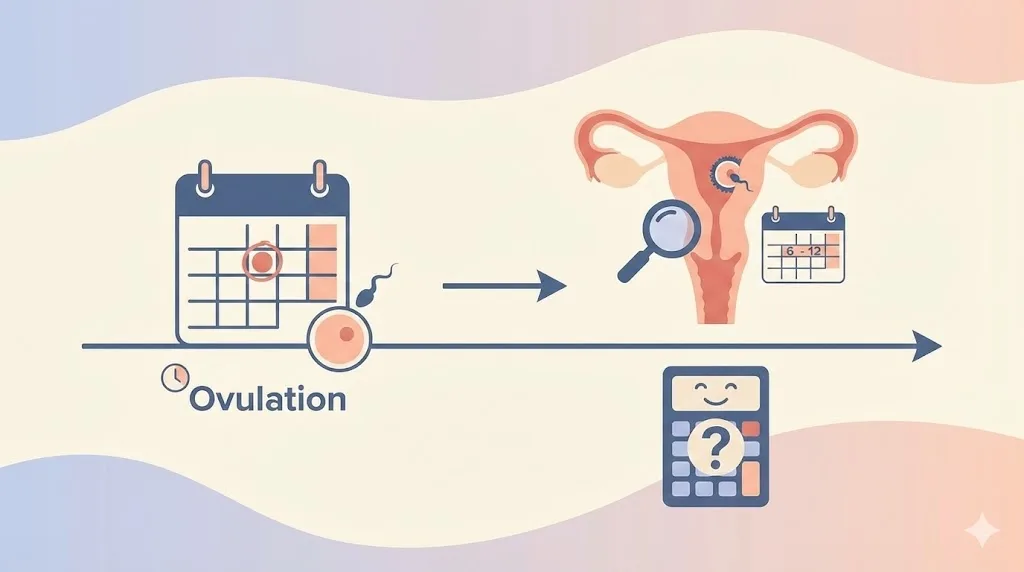
An implantation calculator starts with your estimate of when ovulation occurred. From there, it projects the likely post-ovulation implantation window.
That usually means the calculator relies on one or more of these inputs:
- ovulation date
- last menstrual period
- average cycle length
The core idea is simple:
- ovulation happens first
- implantation happens several days later
So the tool counts forward from ovulation to estimate when implantation could occur.
That is why the calculator is only as good as the ovulation timing it starts with. If ovulation timing is off, the implantation estimate shifts too.
Why Ovulation Timing Matters More Than People Realize
People sometimes expect an implantation calculator to solve uncertainty on its own, but it is downstream from ovulation.
If you are unsure when ovulation happened, then the implantation window becomes less precise immediately.
That is why many people use:
- an ovulation calculator first
- ovulation predictor kits
- cervical mucus tracking
- basal body temperature
to anchor the timeline before they use implantation estimates.
If you want the clearer difference between those tools, Implantation Calculator vs Ovulation Calculator breaks that out directly.
What the Calculator Helps With
Used well, an implantation calculator can reduce some unnecessary confusion.
It can help you:
- understand why 4 or 5 DPO is too early for implantation
- make more sense of the general DPO timeline
- avoid testing absurdly early
- see why the two-week wait feels long even when biology is unfolding normally
It is especially helpful for expectation-setting, not diagnosis.
What the Calculator Cannot Tell You
This is where expectations need to stay realistic.
An implantation calculator cannot tell you:
- that fertilization definitely occurred
- that implantation definitely happened
- that spotting means implantation
- that a symptom confirms pregnancy
- the exact day hCG will become detectable
It is a timing aid, not a measurement tool.
That distinction matters because people often use implantation calculators hoping for emotional certainty, when the tool can really only offer biological context.
Why It Is Still Useful During the Two-Week Wait
Even with its limits, the calculator can still be valuable because the two-week wait is emotionally noisy.
Without a timeline, people often:
- test too early
- overread normal luteal-phase symptoms
- assume no symptoms means no chance
- panic over a negative result that was never likely to be informative
An implantation calculator gives the wait some structure. It does not remove uncertainty, but it can stop you from expecting answers before biology makes them possible.
Implantation Calculator vs Pregnancy Test
These tools do different jobs.
The implantation calculator estimates:
- when implantation may be happening
- when early testing is probably still too soon
A pregnancy test answers:
- whether hCG is high enough to detect
That is why the calculator can guide when a test might start making sense, but it cannot replace the test itself.
If your real question is now about testing timing, When to Take a Pregnancy Test After Ovulation is the better next read.
Implantation Calculator vs Symptoms
This is another area where people can get tripped up.
A calculator helps with timing, but symptoms are still messy because progesterone can cause:
- cramps
- fatigue
- breast soreness
- bloating
- mood changes
in both pregnant and non-pregnant cycles.
So even if a symptom appears during the "right" implantation window, that does not mean the symptom proves implantation.
If that is the question you are wrestling with, Implantation Signs Week by Week: DPO Chart Explained goes deeper into what symptoms can and cannot tell you.
When the Estimate Becomes Less Reliable
An implantation calculator is less dependable when cycle timing itself is uncertain.
That includes:
- irregular cycles
- unclear ovulation timing
- recent cycle disruption
- PCOS
- thyroid-related cycle changes
- recent hormonal birth control use
In those situations, the tool can still be used as a rough guide, but it should not be treated as a precise personal forecast.
A Better Way to Use an Implantation Calculator
The most useful mindset is:
- use it to estimate the window
- do not mistake the window for proof
- let testing and the next few days answer more of the question
- avoid turning each symptom into a verdict
That keeps the tool helpful instead of emotionally punishing.
FAQ
Q: Can an implantation calculator confirm pregnancy?
A: No. It only estimates likely timing after ovulation. It cannot confirm fertilization, implantation, or pregnancy.
Q: When does implantation usually happen?
A: It is often estimated around 6 to 10 DPO, though exact timing varies.
Q: Is implantation always on the same DPO?
A: No. There is a range, which is why calculators provide windows rather than one exact guaranteed day.
Q: Why does my implantation calculator depend on ovulation date?
A: Because implantation is a later step that happens after ovulation. If ovulation timing is off, the implantation estimate shifts too.
Q: Should I test on my estimated implantation day?
A: Usually not. Implantation timing and detectable hCG are not the same thing, so testing on that day is often still too early.
Q: What if I feel nothing during the implantation window?
A: That is common. Many people have no noticeable symptoms at all.
References and Further Reading
- American College of Obstetricians and Gynecologists: Evaluating Infertility
- Mayo Clinic: Home pregnancy tests: Can you trust the results?
- PubMed: Time of implantation of the conceptus and loss of pregnancy
Medical Disclaimer
This article is for educational purposes only. It cannot confirm implantation, diagnose pregnancy, or explain unusual pain, bleeding, or repeated cycle concerns in your individual case. If you have severe pain, heavy bleeding, irregular cycles, or concerns about fertility or early pregnancy, speak with a qualified healthcare professional.
About the Author
Abhilasha Mishra is a health content writer focused on fertility, pregnancy, and practical patient education. Her work aims to make emotionally difficult health topics clearer without overstating what calculators and symptoms can prove.