
How to Use a Breast Pump: The Complete Beginner's Guide (Electric & Manual)
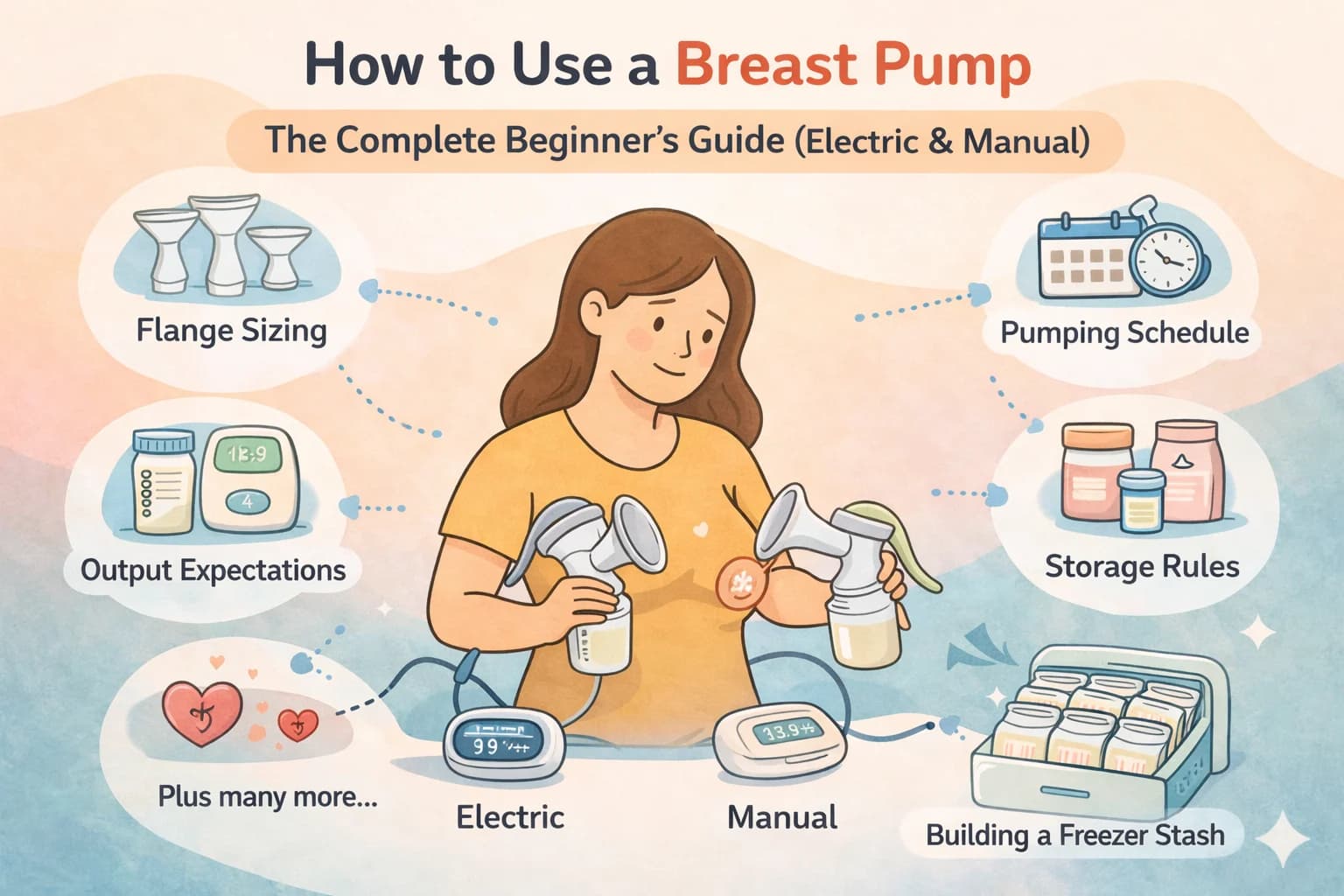
How to use a breast pump for the first time — an OB/GYN-reviewed guide covering flange sizing, pumping schedules, output expectations, storage rules, and building a freezer stash.
Try Related Tools
Use our source-informed calculators to get helpful insights.
Table of Contents
- Electric vs. Manual Pumps: Which Do You Need?
- Getting the Flange Size Right: The Most Critical Factor
- Setting Up Your Pump: Step by Step
- How to Pump: The Session Step by Step
- When to Pump: Schedules for Different Situations
- How Much Milk Should You Be Getting?
- Storing Expressed Breastmilk: The Safe Rules
- Troubleshooting: Common Pumping Problems
- Frequently Asked Questions (FAQ)
- References and Further Reading
Electric vs. Manual Pumps: Which Do You Need?
Electric Pumps
Double electric pumps (which express both breasts simultaneously) are the standard recommendation for mothers who:
- Plan to pump regularly to replace feedings (returning to work, extended separation)
- Are exclusively pumping
- Want to build a significant freezer stash
- Have premature or hospitalised babies who cannot breastfeed directly
- Are trying to establish or increase supply
Advantages: significantly faster (typically 15–20 minutes versus 30+ for sequential pumping), stimulate supply more effectively due to simultaneous stimulation, mimic a feeding infant more closely.
Single electric pumps are adequate for:
- Occasional pumping (one session per day or fewer)
- Relief pumping (engorgement, missed feeds)
- Travelling light when a double pump is impractical
Manual Pumps
Manual pumps (hand-operated squeeze pumps) are useful as:
- A backup to an electric pump
- For single, occasional sessions
- Travel situations where electricity is unavailable
- Expression of one breast while feeding from the other
They require significantly more effort and are not practical for regular pumping sessions. However, some mothers find that hand expression — no pump at all, just skilled manual compression — yields more milk than any pump, particularly in the early days.
Hospital-Grade Pumps
Hospital-grade pumps (like the Medela Symphony or Ameda Platinum) produce stronger, more physiologically optimal suction cycles and are typically available for hire. They are recommended when:
- Your baby is in the NICU
- You are establishing supply from birth without direct breastfeeding
- Persistent low supply has not responded to standard pump use
Getting the Flange Size Right: The Most Critical Factor
The flange (also called the breast shield) is the funnel-shaped cup that fits over your nipple and areola. Getting the correct size is the single most important factor in pump comfort, milk output, and nipple health.
An incorrectly sized flange is the most common reason mothers experience pain, poor milk removal, nipple damage, and low pumped output.
How Flanges Work
When the pump creates suction, your nipple is drawn into the tunnel of the flange. The tunnel must be wide enough to allow your nipple to move freely with each suction cycle, but not so wide that it draws in excessive areola.
Measuring for the Correct Flange Size
What you are measuring: the diameter of your nipple at its base, in millimetres — not including the areola.
How to measure:
- Use a soft measuring tape or a printable nipple ruler (available from most pump manufacturers)
- Measure across the widest part of your nipple at the base, in millimetres
- Add 2–3 mm to this measurement — this is your starting flange size
Example: If your nipple measures 17 mm across, your starting flange size is 19–20 mm.
Signs Your Flange Is the Wrong Size
| Sign | Likely Issue |
|---|---|
| Nipple rubbing against the tunnel walls | Flange too small |
| Pain, pinching, or white/red streaking on the nipple | Flange too small |
| Large amount of areola being pulled into the tunnel | Flange too large |
| Nipple appears swollen or discoloured after pumping | Flange too small |
| Low milk output despite correct technique | Often flange too large or too small |
| Nipple barely moves during suction cycles | Flange too small |
Important note: Your nipple size changes during pregnancy, over the course of breastfeeding, and even from morning to evening as milk pressure varies. Re-measure if you notice pain or declining output at any stage.
Most pump brands offer flanges in sizes from 19 mm to 36 mm. Silicone inserts are available to reduce standard flanges down to smaller sizes (13–17 mm) for mothers with smaller nipples.
Setting Up Your Pump: Step by Step
Sterilising and Assembling
Before first use and after each use:
- Wash all parts that contact milk (flanges, connectors, valves, membranes, bottles) in hot soapy water using a dedicated brush
- Rinse thoroughly
- Sterilise before first use by boiling for 5 minutes, or using a steam steriliser
- For ongoing use: sterilising once daily and thoroughly washing between sessions is generally sufficient for healthy, full-term babies
- Check membranes and valves for cracks, holes, or tears before each session — these are the most common cause of suction loss
Assembly tip: Membranes must be seated perfectly flat against the valve base. Even a small wrinkle can significantly reduce suction efficiency.
Pump Settings: Suction and Speed
Modern electric pumps typically have two controls:
- Speed (cycles per minute): How fast the suction and release cycle occurs
- Suction strength (vacuum level): How strong the pull is
The let-down phase (stimulation mode):
- Higher speed, lower suction
- Mimics the rapid, shallow suckling of an infant stimulating let-down
- Typically lasts 1–2 minutes until milk starts to flow
- Most pumps have a built-in let-down button or automatic mode switch
The expression phase (expression mode):
- Lower speed, higher suction
- Mimics the slower, deeper draw of a feeding infant removing milk
- This is where most of your milk volume is expressed
Key rule on suction: Use the highest suction level that remains comfortable — not the highest level the pump offers. Higher is not better if it causes pain. Pain activates the sympathetic nervous system, which suppresses oxytocin and actively inhibits let-down. A comfortable medium suction consistently outperforms painful high suction.
How to Pump: The Session Step by Step
Before You Begin
- Wash your hands thoroughly
- Assemble and check all pump parts
- Have water nearby — hydration directly affects milk production
- If possible, look at a photo or video of your baby, or have an item of clothing that smells of them — oxytocin is profoundly conditioned by sensory cues
- A warm flannel or gel pad placed on the breast for 2–3 minutes before pumping promotes let-down
The Pumping Session
- Position the flange centred over your nipple, with your nipple in the middle of the tunnel and no areola bunching
- Create a seal by pressing the flange gently against your breast — not pressing hard, just enough for a seal
- Start on stimulation mode (high speed, low suction) for 1–2 minutes
- Switch to expression mode when milk begins to flow — either manually or automatically
- Set suction to your comfortable maximum
- Pump for 10–15 minutes or until milk flow slows to drops
- If you have time: switch back to stimulation mode briefly to trigger a second let-down, then return to expression mode for a further 5 minutes. Two let-downs per session significantly increases session output.
- Hands-on pumping (breast compression): While pumping, use your free hand to apply gentle compressions to different areas of the breast — top, bottom, outer, and inner. This helps drain ducts that the flange alone cannot reach and consistently increases output by 15–30%.
Session Duration
A typical double-pumping session is 15–20 minutes. Pumping beyond 20–25 minutes rarely yields significant additional milk and increases the risk of nipple damage and over-stimulation.
When to Pump: Schedules for Different Situations
Pumping to Build a Freezer Stash While Breastfeeding
If your baby is feeding well at the breast and you want to accumulate stored milk for a return to work:
- Add one pumping session per day, ideally in the morning (1–2 hours after the first morning feed, when supply is typically at its peak)
- Morning sessions consistently yield more milk than evening sessions for most women
- Do not pump immediately before a feed — this depletes the breast for the baby. The 1–2 hour post-feed window balances supply preservation with accumulation
- Expect modest volumes initially (10-60 mL per session); this is normal and does not reflect overall supply
Pumping to Replace a Feed (Returning to Work)
Match the number of pump sessions to the number of feeds your baby takes while you are apart. If your baby takes three feeds in eight hours at work, aim for three pump sessions.
General schedule example (8-hour workday):
- Morning: feed baby directly before leaving
- Work Session 1: approximately 9–10 am
- Work Session 2: approximately 12–1 pm
- Work Session 3: approximately 3–4 pm
- Evening: resume direct breastfeeding
Exclusively Pumping
Exclusive pumping (EP) requires significantly more structure to maintain supply:
- 8–12 pump sessions per 24 hours for the first 3 months
- Sessions should be evenly distributed, ideally every 2–3 hours, including one session between midnight and 5 am (when prolactin levels are highest)
- After 3 months, many EP mothers can reduce to 6–8 sessions while maintaining supply
- Total pumping time per day: typically 120–160 minutes
- A hospital-grade pump hire is strongly recommended for EP
How Much Milk Should You Be Getting?
Realistic output expectations:
| Stage | Typical Range Per Session (Double Pump) |
|---|---|
| Day 1–3 (colostrum) | 2–20 mL total — this is normal and sufficient |
| Days 3–5 (transitional milk coming in) | 15–100 mL |
| Weeks 2–6 | 60–120 mL per session |
| Established supply (6+ weeks) | 60–180 mL per session |
Morning sessions typically yield 20–30% more than evening sessions due to naturally higher prolactin in the morning hours.
Critically important: What you pump is not a reliable indicator of your total milk supply. Babies are significantly more efficient at milk removal than pumps. Many mothers with excellent supply pump modest volumes. Do not make decisions about supplementing, weaning, or supply concerns based on pump output alone — baby's weight gain and wet/dirty nappies are the reliable measures of adequate supply.
Storing Expressed Breastmilk: The Safe Rules
Following correct storage rules is essential for preserving the nutritional and immunological properties of breastmilk and preventing bacterial growth.
Storage Duration Guidelines (Healthy, Full-Term Babies)
| Location | Temperature | Duration |
|---|---|---|
| Room temperature | Up to 25°C | Up to 4 hours |
| Insulated cooler with ice packs | ≤ 15°C | Up to 24 hours |
| Refrigerator | 4°C or below | Up to 4 days |
| Freezer (combined fridge-freezer) | -18°C | Up to 6 months |
| Deep freezer | -20°C | Up to 12 months |
Practical Storage Tips
- Use breastmilk storage bags or hard-sided plastic/glass containers specifically designed for milk storage (BPA-free)
- Store in small amounts (60–120 mL) to reduce waste — you can always thaw more, but you cannot refreeze thawed milk
- Label every bag with the date expressed and volume
- Lay bags flat in the freezer to stack efficiently and speed thawing
- Add fresh milk to already-cooled refrigerated milk — never add warm milk directly to cold milk or frozen milk
- Thaw frozen milk in the refrigerator overnight or by holding under warm running water — never microwave (microwaving creates hot spots and destroys antibodies)
- Thawed milk must be used within 24 hours and must not be refrozen
- Leftover milk from a feeding (that the baby has fed from) should be discarded within 1–2 hours — saliva introduced into the milk during feeding begins bacterial breakdown
Troubleshooting: Common Pumping Problems
Low Output
- Check flange size (most common cause)
- Increase pumping frequency rather than session length
- Add hands-on pumping and breast compression
- Ensure you are eating and drinking adequately — significant caloric restriction suppresses supply
- Review pump parts for cracks, wear, or poor valve seating
- Consider hiring a hospital-grade pump
- Check with a lactation consultant
Pain During Pumping
- Almost always a flange size issue — re-measure
- Check suction level — drop it down until comfortable
- Ensure flanges are centred correctly
- Inspect for blocked ducts or signs of mastitis (hard, red, painful area in breast with or without fever)
Milk Not Letting Down
- Allow longer in stimulation mode
- Reduce stress: closed room, phone away, calming content
- Use a photo or video of your baby
- Warm compress before pumping
- Try pumping at a consistent time each day — the let-down reflex responds to conditioned cues
Frequently Asked Questions (FAQ)
Q: When should I start pumping after birth? A: This depends on your situation. If your baby is breastfeeding well directly and your goal is simply to build a small freezer stash, starting around 2–3 weeks once breastfeeding is established is appropriate. If your baby cannot breastfeed directly (NICU, latch issues), start pumping within the first 1–6 hours after birth to establish supply — hand expression in the first 24 hours followed by pump use from day 1–2.
Q: How do I know if my flange size is correct? A: Your nipple should move freely in the tunnel with each suction cycle — in and out — without the tunnel walls touching the sides of your nipple, and without excessive areola being pulled in. Pumping should not hurt beyond mild initial discomfort in the very first seconds. If it hurts, your flange is likely too small. If you see large amounts of areola in the tunnel, it is likely too large.
Q: Why am I only getting 30 mL per session but my baby seems well fed? A: Pumped volume is not an accurate reflection of your milk supply. Babies are more efficient at extracting milk than any pump. Many mothers with excellent supply pump 30-60 mL per session, particularly with single pumps or in the evening hours. Baby weight gain, wet nappies (6+ per day), and content behaviour after feeds are the reliable indicators of adequate supply.
Q: Can I pump and breastfeed at the same time? A: Yes — many mothers pump one breast while the baby feeds from the other. This takes coordination but is highly efficient for building supply and accumulating stored milk simultaneously. The baby's suckling at one breast typically triggers let-down in both.
Q: How long does pumped breastmilk last in the fridge? A: Up to 4 days in a refrigerator at 4°C or below. Store at the back of the fridge (coolest part), not in the door. Label with the date expressed and use oldest milk first.
Q: My pump is making less suction than it used to. What do I check? A: First inspect the membranes (the small, thin flaps that cover the valves) — these are the most common failure point. If they are torn, cracked, stiff, or have holes, replace them. Also check that all connections are secure and that tubing (if used) has no cracks. If the motor is more than 12–18 months old with heavy daily use, the motor itself may have weakened.
Q: How do I wean from pumping without getting mastitis? A: Reduce session frequency gradually — remove one session every 3–5 days rather than stopping abruptly. Reduce session length progressively as well. If your breasts become very full and uncomfortable, pump just enough to relieve pressure (not to full emptying — this signals the body to maintain supply). Cold compresses and well-fitted (not tight) bras during weaning help reduce discomfort.
Q: How many bottles of pumped milk do I need to store before returning to work? A: A practical starting target is a 3–5 day supply — approximately 15–25 bags of 90–120 mL each. This buffer means a bad pumping day at work does not immediately cause a shortage. Accumulating more than 1–2 weeks' supply in the freezer before returning to work is generally unnecessary and may create anxiety around using older stock.
References and Further Reading
-
Academy of Breastfeeding Medicine — Clinical Protocol #8: Human Milk Storage for Home Use:
https://www.bfmed.org/protocols -
CDC — Proper Storage and Preparation of Breast Milk:
https://www.cdc.gov/breastfeeding/breast-milk-preparation-and-storage/handling-breastmilk.html -
WHO — Breastfeeding:
https://www.who.int/health-topics/breastfeeding -
UNICEF Baby Friendly Initiative — Assessment of breastmilk expression checklist:
https://www.unicef.org.uk/babyfriendly/baby-friendly-resources/implementing-standards-resources/assessment-of-breastmilk-expression-checklist/
Medical Disclaimer
This article is for informational and educational purposes only. It does not constitute medical advice or replace guidance from a qualified lactation consultant or healthcare provider. Every mother's breastfeeding journey is different. If you are experiencing persistent pain, low output concerns, signs of mastitis, or other difficulties, consult an International Board Certified Lactation Consultant (IBCLC) or your healthcare provider.
About the Author
Abhilasha Mishra is a health and wellness writer specializing in breastfeeding, infant feeding, and maternal nutrition. She writes practical, evidence-based guides to help new mothers navigate feeding decisions with confidence and clarity.