
How to Induce Labor Naturally at Home: What Works, What Doesn't
How to induce labor naturally — an OB/GYN-reviewed guide to walking, dates, membrane sweeping, and more. Understand what the evidence says and what is safe at term.
Try Related Tools
Use our source-informed calculators to get helpful insights.
Table of Contents
- Important: When Is It Safe to Try Natural Induction?
- Methods With Some Evidence of Efficacy
- Methods With Limited or Mixed Evidence
- Methods to Avoid
- What Actually Makes Labour Start?
- When to Speak to Your Doctor About Medical Induction
- How to Support Your Cervix Naturally (Without Forcing Anything)
- Frequently Asked Questions (FAQ)
- References and Further Reading
Important: When Is It Safe to Try Natural Induction?
Before attempting any method to encourage labour, you must understand when it is appropriate to do so.
Do not attempt natural induction methods before 39 weeks unless directed by your healthcare provider. Babies born before 39 weeks, even those just a week or two early, have a measurably higher risk of breathing problems, feeding difficulties, and other complications.
Natural methods are most appropriate when:
- You are at 39 weeks or beyond
- Your pregnancy is uncomplicated (no placenta previa, no breech presentation, no preeclampsia)
- Your baby is head down (vertex presentation)
- Your membranes are intact (your water has not broken)
- Your provider has not advised against any specific method
"I always advise patients to have this conversation with their doctor before trying anything," says medical experts**. "A baby that is not yet fully ready, or a cervix that is not ripe, will not respond to home methods — and some methods can be harmful if used incorrectly or at the wrong stage."
If you are post-dates (beyond 41 weeks), your provider may discuss medical induction with you. At 42 weeks, the risks of continuing the pregnancy typically outweigh the risks of intervention.
Methods With Some Evidence of Efficacy
1. Walking
Walking is the most consistently recommended natural method — and one of the safest. The upright posture helps the baby descend into the pelvis, and the gentle rocking motion of walking may encourage the baby's head to press against the cervix, stimulating prostaglandin release.
What the evidence says: Walking itself does not reliably induce labour, but it may help encourage early cervical changes in a cervix that is already beginning to ripen. It is low-risk and has additional benefits: it maintains cardiovascular fitness, reduces back pain, improves sleep, and supports overall wellbeing in late pregnancy.
How to do it safely: Walk at a comfortable pace. Stop if you feel contractions, dizziness, shortness of breath, or any pain. Do not walk to exhaustion — you will need your energy for labour.
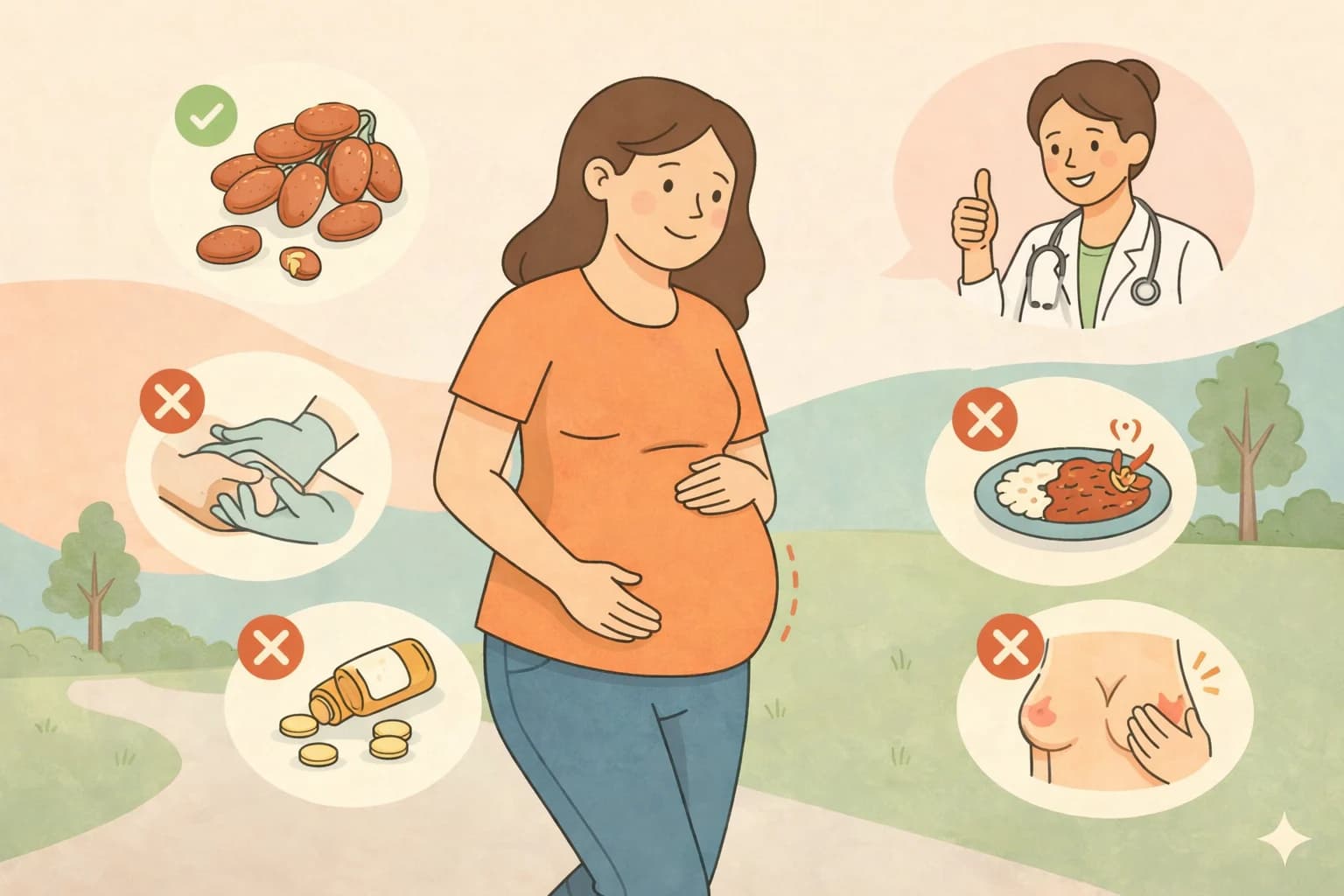
2. Eating Dates
Several small studies, including a notable 2011 study published in the Journal of Obstetrics and Gynaecology, found that women who consumed six dates per day in the final four weeks of pregnancy had significantly shorter first stages of labour, higher rates of intact membranes on admission, and were more likely to go into labour spontaneously.
What the evidence says: The evidence is preliminary but encouraging. Dates contain compounds similar to oxytocin that may act on uterine receptors. They are also nutritionally excellent — high in natural sugars for energy, potassium, magnesium, and fibre.
How to consume: Eat 6 Medjool dates (or equivalent) per day from 36 weeks onward. Discuss with your provider, particularly if you have gestational diabetes, as dates are high in natural sugars.
3. Nipple Stimulation
Nipple stimulation triggers the release of oxytocin — the same hormone that causes uterine contractions. Oxytocin is the basis of medical induction with Syntocinon (synthetic oxytocin).
What the evidence says: A Cochrane Review found that nipple stimulation was effective in increasing the rate of labour onset within 72 hours, particularly in women with a favourable cervix (a cervix that is already ripening). In women with an unfavourable cervix, its effectiveness was lower.
How to do it safely: Gently roll or massage one nipple at a time for 15 minutes, then switch sides. Do this for 1 hour per day. Stop if contractions become long (over 60 seconds) or very frequent (closer than every 3 minutes). This should not be done if you have had a previous caesarean section without medical guidance, as the powerful uterine stimulation carries a theoretical risk of uterine rupture.
Do not use a breast pump without medical guidance — mechanical pumping delivers a more intense, less controlled stimulation than manual techniques.
4. Membrane Sweeping (Stretch and Sweep)
While this is performed by a healthcare provider rather than at home, membrane sweeping (also called a stretch and sweep) is the most evidence-supported method of natural labour induction available.
What it involves: Your provider inserts a gloved finger through the cervix and sweeps it in a circular motion, separating the membranes from the lower segment of the uterus. This triggers prostaglandin release, which helps ripen and dilate the cervix.
What the evidence says: Multiple studies and NICE guidelines (UK) support membrane sweeping as an effective method of reducing post-term pregnancies. It is typically offered at 40–41 weeks.
What it feels like: Uncomfortable, sometimes quite painful, and may cause cramping and light bleeding for 24–48 hours afterward. Not all sweeps result in labour, but they increase the likelihood.
Ask your provider about a sweep at your 40-week appointment if you are considering it.
Methods With Limited or Mixed Evidence
5. Spicy Food
The idea that spicy food induces labour is one of the most popular cultural beliefs around the world. The theory is that spicy food irritates the bowels, which in turn stimulates the nearby uterus.
What the evidence says: No clinical evidence supports spicy food as a labour induction method. Spicy food may give you severe heartburn — a complaint that is already common in late pregnancy — and can cause gastrointestinal distress without any labour benefit.
Verdict: Harmless if you enjoy spicy food and tolerate it well, but do not eat it specifically expecting it to induce labour.
6. Acupressure and Acupuncture
Certain acupressure points (particularly Spleen 6, Bladder 60, and Bladder 67) are traditionally believed to stimulate uterine contractions when activated.
What the evidence says: Evidence from randomised controlled trials is mixed. A 2017 Cochrane Review found insufficient evidence that acupuncture or acupressure significantly increases spontaneous labour onset compared to no treatment.
Verdict: Low risk if performed by a trained practitioner familiar with pregnancy. May promote relaxation and wellbeing even if it does not reliably induce labour. Always inform the practitioner that you are pregnant.
7. Evening Primrose Oil
Evening primrose oil (EPO) is sometimes recommended (orally or vaginally) to ripen the cervix because it contains prostaglandin precursors.
What the evidence says: A 1999 study found that EPO did not shorten the overall length of labour and was associated with an increased rate of prolonged rupture of membranes and vacuum extraction in the studied group. More recent reviews have not consistently supported its use.
Verdict: Not supported by current evidence. Discuss with your provider before use. Do not use if you have any bleeding complications, placenta previa, or history of caesarean section.
8. Sexual Intercourse
Semen contains natural prostaglandins that may help ripen the cervix. Orgasm triggers oxytocin release. Both mechanisms are theoretically relevant.
What the evidence says: A 2006 study published in Obstetrics and Gynecology found no statistically significant difference in labour onset between women who had sex at term and those who did not. However, it remains low-risk (unless your membranes have ruptured or you have placenta previa) and has no harmful effects in uncomplicated term pregnancy.
Verdict: Safe in uncomplicated term pregnancy. Not proven to reliably induce labour, but carries no risk and may promote comfort and connection.
Methods to Avoid
Castor Oil
Castor oil is a powerful laxative that stimulates the bowels strongly enough to — in theory — trigger uterine contractions via adjacent muscle stimulation.
Why to avoid it: Castor oil consistently causes severe diarrhoea, vomiting, cramping, and dehydration. Arriving at the hospital dehydrated and exhausted is the opposite of how you want to begin labour. A 2009 review found insufficient evidence of benefit and noted the significant gastrointestinal side effects as a serious concern. Some case reports have associated castor oil use with meconium passage and fetal distress.
"Castor oil is one I specifically advise against," says medical experts**. "The gastrointestinal stress it causes can be severe, and any potential uterine effect is uncontrolled and unpredictable. It is not worth the misery."
Herbal Preparations and Supplements
Black cohosh, blue cohosh, and cohosh mixtures are sometimes recommended online as labour-inducing herbs. These are not safe and should not be used. Case reports exist of severe fetal complications, including fetal distress, stroke, and meconium aspiration associated with cohosh use in late pregnancy.
Raspberry leaf tea is often discussed as a uterine tonic. While it has a long traditional use in late pregnancy, the evidence is minimal and inconclusive. It is generally considered lower-risk than cohosh preparations but should still be discussed with your provider.
General rule: Herbal preparations are not subject to the same regulatory oversight as medications. "Natural" does not mean safe in pregnancy.
What Actually Makes Labour Start?
Understanding the genuine triggers of labour helps contextualise why "natural induction" has limited reliability.
Labour is initiated by a complex hormonal cascade involving:
- Fetal cortisol production — as the baby matures, its adrenal glands produce cortisol, which signals readiness for birth
- Prostaglandin release — from the fetal membranes, which triggers cervical ripening
- Oxytocin receptor upregulation — the uterus becomes increasingly sensitive to oxytocin near term
- Progesterone withdrawal — a relative decrease in progesterone's uterine-calming effect
This cascade begins from the baby's side, not the mother's. Most "natural induction" methods work (when they work) only because the cervix is already beginning to ripen and the baby is already ready. They nudge a process that has already started; they cannot reliably initiate a process that has not.
When to Speak to Your Doctor About Medical Induction
Medical induction with oxytocin (Syntocinon/Pitocin) or cervical ripening agents (misoprostol, dinoprostone) is the evidence-based approach when:
- You are 41–42 weeks and labour has not started
- You have gestational hypertension or preeclampsia
- Your baby has intrauterine growth restriction (IUGR)
- You have gestational diabetes (induction is often recommended at 39–40 weeks)
- Your membranes have ruptured but labour has not started
- There are concerns about reduced fetal movement or fetal wellbeing
Do not attempt to force labour at home beyond 41 weeks. The risks of post-term pregnancy (placental insufficiency, meconium aspiration, fetal distress) increase meaningfully after 41 weeks.
Check Your Contraction Pattern
If you are having contractions and want to know whether they are regular enough to go in, use our Contraction Timer to track frequency, duration, and strength in real time.
How to Support Your Cervix Naturally (Without Forcing Anything)
Rather than trying to "force" labour, the most effective approach in late pregnancy is to support your body's natural process:
- Stay active with daily walking
- Maintain good nutrition — dates, whole foods, adequate protein and iron
- Stay hydrated — dehydration can cause false contractions and fatigue
- Rest and sleep as much as possible
- Reduce stress — cortisol can inhibit oxytocin; relaxation supports its release
- Stay connected with your provider — attend all appointments and report any changes
- Consider a membrane sweep at 40 weeks if appropriate
Frequently Asked Questions (FAQ)
Q: Can walking really help induce labor? A: Walking helps the baby descend deeper into the pelvis and may encourage the cervix to ripen in a body that is already preparing for labour. It does not reliably start labour in a body that is not ready. It is safe, beneficial for overall wellbeing, and worth doing regularly in the final weeks.
Q: How many dates should I eat to help induce labor? A: Studies typically used six Medjool dates per day from 36 weeks onward. This is a reasonable, safe amount for most women. If you have gestational diabetes, discuss with your provider first, as dates are high in natural sugars.
Q: Is castor oil safe to induce labor at home? A: No. Castor oil causes severe diarrhoea and vomiting, which dehydrates you before labour even begins. It carries risks of fetal meconium passage and fetal distress. It is not recommended by any major obstetric authority.
Q: At what week should I start trying natural induction methods? A: At 39 weeks or beyond for uncomplicated pregnancies. Methods like date consumption can begin from 36 weeks. Nothing should be attempted before 39 weeks without specific medical direction.
Q: What is a membrane sweep and should I request one? A: A membrane sweep is a procedure performed by your midwife or doctor at 40 weeks (and again at 41 weeks if needed) to separate the membranes from the lower uterus and trigger prostaglandin release. It is the most evidence-supported non-medical induction method. It is worth discussing with your provider if you are approaching 40 weeks.
Q: Can sex help induce labor? A: Semen contains prostaglandins that may assist in cervical ripening, and orgasm releases oxytocin. Clinical evidence for reliable labour induction via intercourse is weak, but it is safe in uncomplicated term pregnancy with intact membranes and no placenta previa.
Q: My baby is overdue. When will I be induced medically? A: Most providers recommend medical induction at 41 to 42 weeks if labour has not begun spontaneously. At 42 weeks, the risk of continuing the pregnancy typically outweighs the risks of induction. Speak with your provider about their specific protocol and your individual situation.
Q: Can stress or anxiety delay labor? A: Chronic stress elevates cortisol, which can inhibit oxytocin. While you cannot consciously control hormonal responses, strategies that promote relaxation — warm baths, gentle movement, breathing exercises, partner support — may create a more favourable environment for labour to begin.
References and Further Reading
-
NICE Guidelines — Inducing Labour:
https://www.nice.org.uk/guidance/ng207 -
Cochrane Review — Nipple Stimulation for Cervical Ripening:
https://www.cochranelibrary.com/cdsr/doi/10.1002/14651858.CD003093/full -
Journal of Obstetrics and Gynaecology — Date Consumption Study:
https://pubmed.ncbi.nlm.nih.gov/21280989/ -
WHO — Recommendations for Induction of Labour:
https://www.who.int/publications/i/item/9789240052796
Medical Disclaimer
This article is for informational and educational purposes only and does not constitute medical advice, diagnosis, or treatment. Natural labour induction methods carry varying levels of evidence and should only be attempted after consultation with your obstetrician, midwife, or qualified healthcare provider. Never attempt to induce labour before 39 weeks of gestation without explicit medical direction.
About the Author
Abhilasha Mishra is a health and wellness writer specializing in women's health, pregnancy, and maternal care. She writes to bridge the gap between clinical evidence and everyday understanding, helping mothers make informed, confident decisions.