
How to Encourage Toddler Speech (Backed by Child Development Experts)
A warm, medically responsible guide to supporting toddler speech development with expert-backed strategies, simple daily practices, and reassurance for parents.
Try Related Tools
Use our source-informed calculators to get helpful insights.
Toddlers learn to speak in small, beautiful steps. For many mothers, hearing their child’s first clear word is one of the sweetest moments of early parenting. But the months leading up to that moment can bring questions. You may find yourself comparing your toddler to others at the park or wondering why your child says only a few words when others seem to talk constantly. If you are feeling anxious, please take a breath. Speech development varies widely, and most toddlers grow their vocabulary slowly at first, then suddenly surprise you.
Experts often explain that speech is not just about words. It grows from attention, understanding, emotional safety, and playful communication. When these pieces come together, language blooms. This guide blends medical understanding with simple, loving ways to encourage speech at home, all written with the goal of reassuring and supporting you.
If you want help tracking your child’s developmental progress, you can also read our 12–36 Month Toddler Milestones: A Complete Month-By-Month Guide which pairs perfectly with this article.
Table of Contents
- What Speech Development Really Looks Like
- Why Some Toddlers Speak Later Than Others
- Expert-Backed Ways to Encourage Toddler Speech
- When to Seek Professional Support
- How Speech Therapy Helps
- Creating a Speech-Friendly Home Environment
- Frequently Asked Questions (FAQ)
- Medical Disclaimer
- About the Author
What Speech Development Really Looks Like
Speech is not only about talking. Before toddlers speak, they learn to listen, imitate, understand emotion, and respond to tone. Many doctors recommend thinking of speech as a ladder. Your child climbs one step at a time.
The earliest signs of speech development include:
- pointing
- babbling
- bringing items to show you
- responding to their name
- following simple instructions
- looking where you point
These are all communication skills. Even if words are slow to appear, these behaviors show that the foundation is strong.
Some toddlers speak early. Others wait longer but catch up quickly. What matters most is steady progress and emotional engagement.
Why Some Toddlers Speak Later Than Others
Parents often blame themselves, but speech timing has many influences. None of them mean you are doing something wrong.
Common factors include:
- temperament
- personality
- exposure to language
- time spent around other children
- bilingual environments
- normal developmental variation
Research suggests that late talking on its own is not always a sign of a disorder. Some children are observers. They watch, listen, and think before they speak. Others prefer sound play and attempt words early.
The goal is not to rush speech. It is to support it gently.
Expert-Backed Ways to Encourage Toddler Speech
Below are simple practices backed by pediatric speech experts. You do not need special training to use them. Your daily interactions are the biggest influence on language growth.
1. Slow Down and Speak Clearly
Toddlers learn best from speech that is warm and easy to follow. Slow, gentle conversation helps them notice rhythm and meaning.
Try:
- short, simple sentences
- expressive but calm tone
- repeating important words
Example:
Instead of “Please bring mama the blue cup from the table,” try “Can you bring the cup? The blue cup. Yes, that one.”
2. Follow Your Child’s Lead
Experts often explain that children learn language faster when conversations follow their interests.
If your toddler points at a bird, talk about the bird. If they love cars, use car words. Their curiosity opens the door for speech.
3. Use Descriptive Language
Narrating your day helps your toddler attach words to actions.
Examples:
- “Mama is washing the cup.”
- “You are putting the blocks together.”
- “The water is warm.”
This simple style of speech builds vocabulary naturally.
4. Encourage Gestures
Gestures like pointing, waving, nodding, and shaking the head are important. They show that your child understands communication even before they use words.
Research suggests that toddlers who use more gestures tend to develop speech more smoothly.
5. Expand Their Words Gently
If your toddler says “ball,” you can respond with “big ball,” or “red ball,” or “ball rolling.”
This shows your child how to grow their language without pressure.
6. Read Every Day
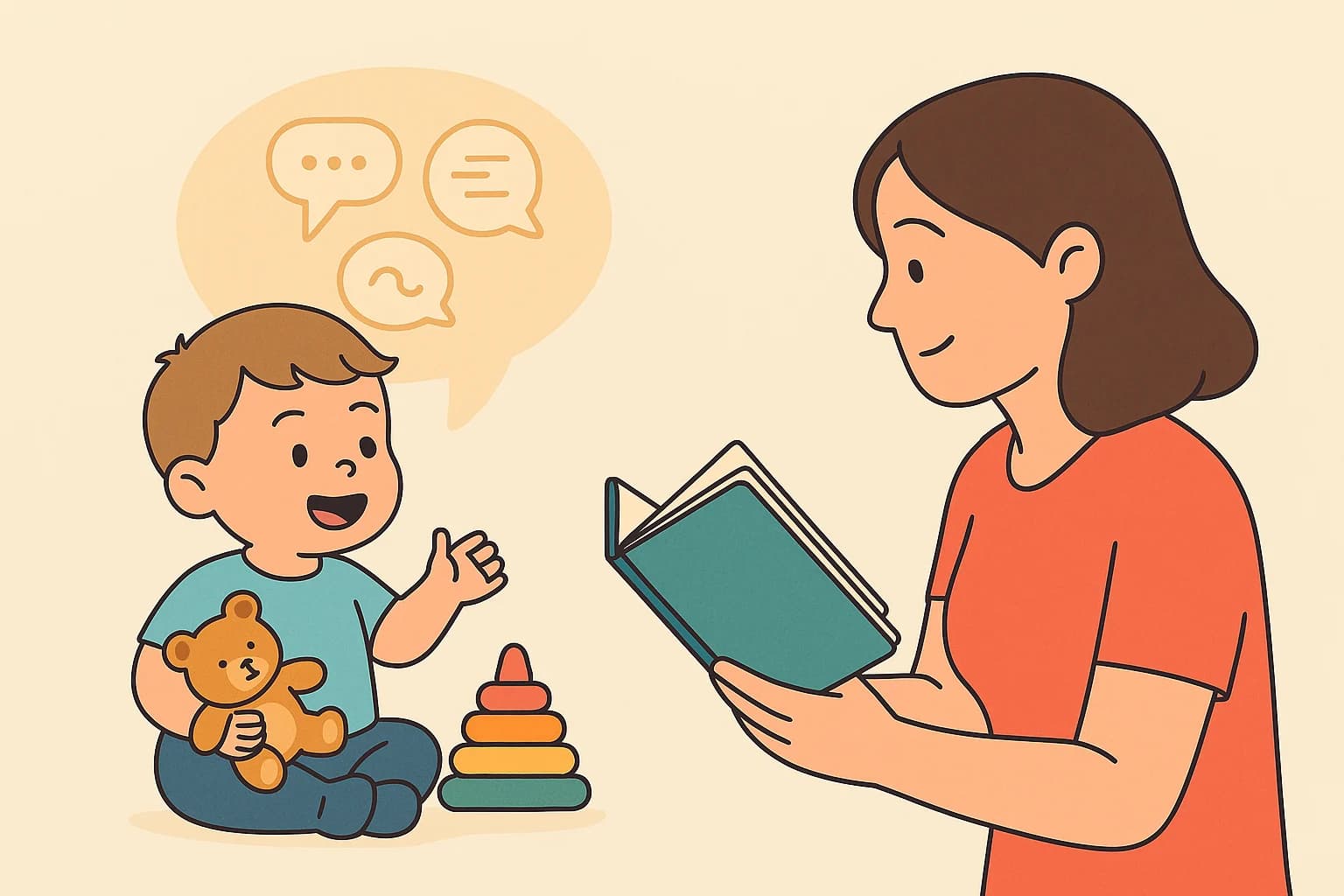
Reading is one of the most powerful tools for language development. Toddlers learn new sounds, rhythms, and ideas through stories.
Keep reading simple:
- soft, rhythmic books
- books with real-life pictures
- books that repeat phrases
Toddlers love repetition. The more familiar a story becomes, the more confident they feel trying new words.
7. Try Montessori and Educational Toys
Open-ended toys encourage imagination and language. Speech therapists often recommend toys that invite interaction instead of passive play.
Helpful examples:
- realistic animal figures
- wooden puzzles
- pretend food sets
- simple dolls
- stacking toys
You can also explore speech-supportive products on Amazon such as:
-
Speech Flashcards:
Toddler Vocabulary Flashcards -
Montessori Language Toys:
Montessori Language Toys for Toddlers
These tools are especially helpful when used during calm, connected play, where you name objects, describe actions, and wait for your toddler to respond in their own way.
8. Limit Screen Time
Toddlers learn speech through human interaction. Screens reduce opportunities for back-and-forth communication.
Many experts recommend co-watching if screens are used at all. Talking about what you are watching together is far more helpful than watching alone.
9. Offer Choices
Choices encourage toddlers to use their voice.
Example:
- “Do you want apple or banana?”
- “Blue cup or green cup?”
- “Do you want to sit or stand?”
Even pointing is progress. Over time, you can wait a moment and gently encourage a sound or word.
10. Celebrate Every Attempt
Speech grows best in an emotionally safe space. Praise effort, not accuracy.
Instead of correcting pronunciation, say “I love how you tried that word.” Your warmth strengthens your child’s confidence.
When to Seek Professional Support
Every toddler develops at their own pace. But experts often suggest reaching out for an evaluation if you notice:
- no babbling by 12 months
- no words by 16 to 18 months
- no word combinations by age 2
- very limited eye contact
- little interest in communication
- loss of previously used words
- frequent frustration due to communication difficulty
Early support is not a diagnosis. It simply gives your child the best foundation.
How Speech Therapy Helps
Speech therapists use playful techniques to build language. Sessions often include:
- imitation games
- gestures and sign support
- sound practice
- vocabulary building
- play-based routines
Therapy works best when combined with consistent practice at home. Parents are partners in progress.
Creating a Speech-Friendly Home Environment
Speech grows in homes where toddlers feel seen and heard. You can strengthen the environment with:
- patient conversation
- predictable routines
- shared meals
- active listening
- calm correction
- rich emotional connection
Your presence matters more than any technique. Even a few minutes of undistracted connection each day makes a difference.
Frequently Asked Questions (FAQ)
Q: My toddler understands everything but does not speak. Is that normal?
A: Many late talkers understand more than they say. Understanding is a strong sign of healthy language development. If you are unsure, talking with a pediatrician or speech therapist can reassure you.
Q: Should I correct words that are said wrong?
A: Model correct speech gently, but avoid harsh correction. Toddlers learn naturally through hearing accurate language again and again.
Q: Does bilingual exposure cause delays?
A: No. Bilingual toddlers may mix languages early on, but this is normal. Over time, they separate both languages and often gain long-term advantages.
Q: Are boys slower to talk than girls?
A: Some studies suggest slight differences on average, but there is a wide range within both boys and girls. Individual variation matters more than gender.
References and Further Reading
- American Academy of Pediatrics: HealthyChildren Language Development
- Centers for Disease Control and Prevention (CDC): Speech and Language Milestones
- National Institutes of Health (NIH): Language Development Research
Medical Disclaimer
This article provides general educational guidance on toddler speech development. It does not replace professional medical or therapeutic advice. Always speak to a pediatrician or speech-language pathologist if you have concerns about your child’s communication or behavior.
About the Author
Abhilasha Mishra writes about toddler development, speech support, and the emotional experience of early parenting. She believes that every mother deserves patient, evidence-based guidance delivered with kindness.