
How Much Milk Does a Baby Need? Age-by-Age Feeding Chart (0–36 Months)
A medically responsible, mother-centered guide explaining breastmilk and formula amounts from newborn to 3 years, with a clear feeding chart and gentle advice for real-life feeding challenges.
Try Related Tools
Use our source-informed calculators to get helpful insights.
Table of Contents
- Understanding How Much Milk a Baby Really Needs
- Age-by-Age Milk Intake Guide (0–36 Months)
- Age-by-Age Summary Table (0–36 Months)
- How to Know Your Baby Is Getting Enough
- When Babies Drink Too Much or Too Little
- Breastfeeding vs Formula Feeding Differences
- Real-Life Feeding Challenges Most Mothers Face
- FAQs
- 1. Is breastmilk enough until 6 months?
- 2. How fast should I increase bottle amounts?
- 3. What if my baby refuses cow’s milk after one year?
- 4. Is plant-based milk safe for toddlers?
- 5. How much milk should a two-year-old drink?
- 6. Should I wake a baby at night to feed?
- 7. Is spitting up normal?
- 8. Can toddlers drink too much milk?
- References and Further Reading
Understanding How Much Milk a Baby Really Needs
Milk intake depends on:
- Age
- Growth rate
- Feeding method (breast or formula)
- Sleep cycles
- Illness, teething, or developmental leaps
Pediatricians often remind parents that babies are born with an innate ability to regulate intake. Still, having a general range helps your confidence and routine.
You can also use our Baby Feeding Amount Calculator for a quick personalized estimation based on age and weight.
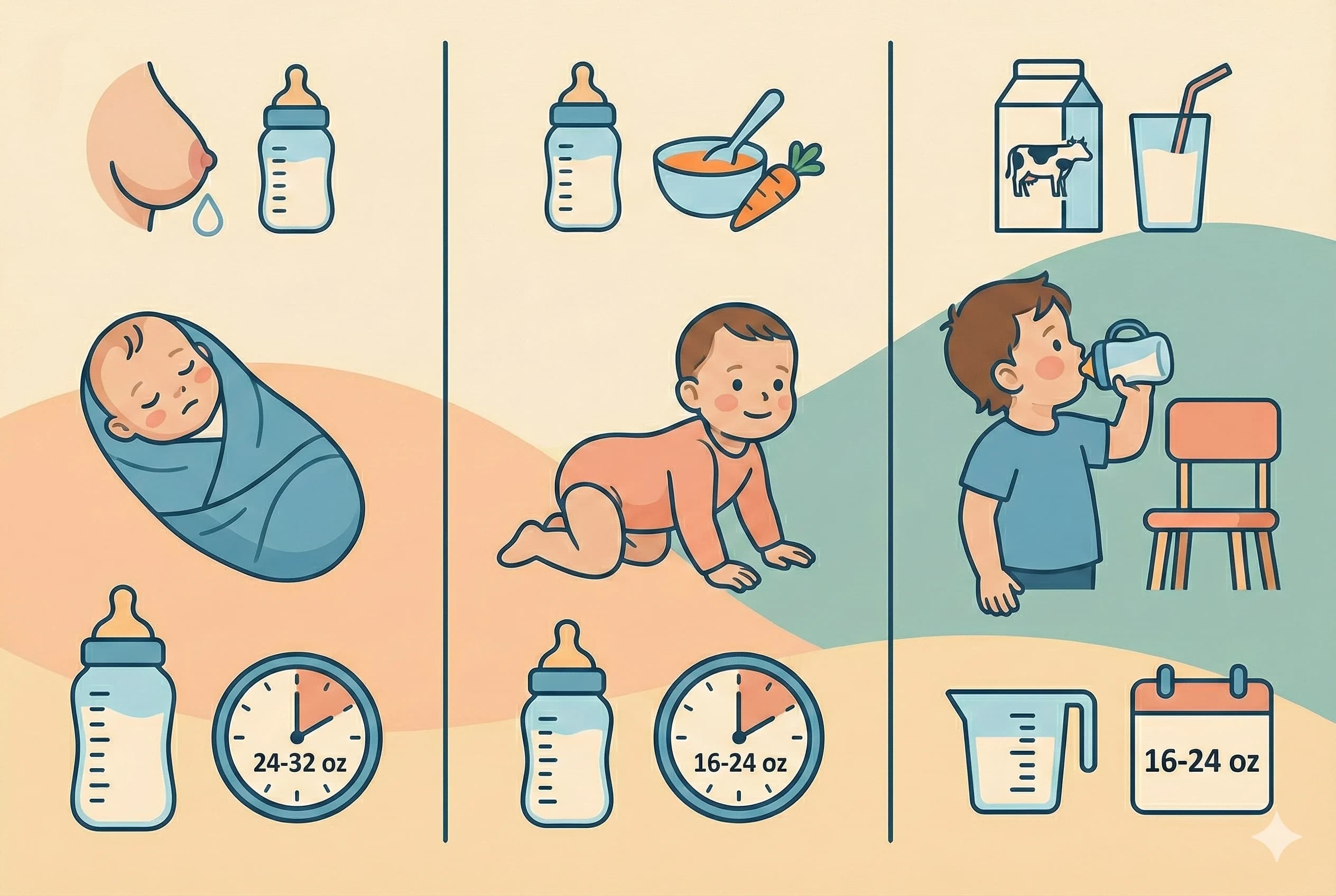
Age-by-Age Milk Intake Guide (0–36 Months)
0–3 Months: The Newborn Stage
Most babies feed 8 to 12 times a day. Growth is fast, and small stomach capacity means frequent feeds.
Breastfed babies:
- Usually 1.5 to 3 oz per feed
- Total daily intake averages 18–26 oz
Formula-fed babies:
- 2 to 4 oz every 2–3 hours
- Daily total often 20–28 oz
Signs baby needs more:
- Less than 6 wet diapers
- Persistent crying after feeds
- Poor weight gain
Feeding is rarely clockwork at this stage. Let your baby lead when possible.
4–6 Months: The Transition Period
Your baby becomes more alert, distracted, and socially interactive.
- 24–32 oz per day (breastmilk or formula)
- 4–6 oz per feed
- Still the sole source of nutrition until solids begin, usually near 6 months
If you are breastfeeding, you may notice cluster feeding during growth spurts. That is normal and helps your supply adjust.
6–9 Months: Solids Begin, Milk Still Primary
Solids become a sensory experience, not a replacement for milk.
- Most babies take 24–32 oz daily
- 4–7 oz per bottle or feed
- Milk remains the main calorie source
Toddlers exploring solids sometimes appear to drink less. Experts often explain that appetite naturally shifts during developmental bursts.
Consider exploring our Breastfeeding Guide for support during this phase.
9–12 Months: The Learning Eater
Your baby’s confidence with textures grows. Milk intake begins to dip slightly.
- 20–30 oz per day
- 3–5 bottles or breastfeeding sessions
Some babies self-wean daytime feeds as they enjoy more solids. This is typically safe as long as growth stays steady.
If you feel your supply fluctuating, our Breastfeeding Journey tool can help track patterns.
12–24 Months: Toddler Milk Needs
After the first birthday, toddlers often become curious, busy, and unpredictable eaters.
Typical total milk amount:
- 16–24 oz/day (breastmilk, whole cow’s milk, or formula)
More than 24 oz daily may:
- Reduce solid food appetite
- Increase constipation risk
- Lead to iron-deficiency anemia
You can also refer to our Breast Care & Pain Relief Guide if you are extending breastfeeding beyond one year.
24–36 Months: Preschooler Transition
Your toddler may switch from bottles to cups and rely more on meals and snacks.
Total milk:
- 12–20 oz/day
- Cow’s milk or continued breastfeeding is common
- Aim for balanced solids: proteins, fruits, vegetables, healthy fats
If changing from breastmilk or formula to cow’s milk, our Formula Transition Guide can help with a smoother adjustment.
Age-by-Age Summary Table (0–36 Months)
| Age | Typical Daily Milk Intake | Notes |
|---|---|---|
| 0–3 months | 18–26 oz | Frequent feeds, rapid growth |
| 4–6 months | 24–32 oz | Milk remains sole nutrition |
| 6–9 months | 24–32 oz | Solids begin, milk still primary |
| 9–12 months | 20–30 oz | Appetite shifts with development |
| 12–24 months | 16–24 oz | Avoid excess to prevent low iron |
| 24–36 months | 12–20 oz | Encourage balanced solids |
How to Know Your Baby Is Getting Enough
Pediatricians often recommend focusing less on exact ounces and more on:
1. Growth tracking
A steady curve on the growth chart reassures that intake is adequate. You can check trends with our Baby Feeding Amount Calculator anytime.
2. Diaper output
- 6 or more wet diapers for infants
- Regular stools depending on age and diet
3. Mood and alertness
Babies who feed enough usually appear:
- Content
- Smiling
- Relaxed between feeds
4. Breast changes (for breastfeeding mothers)
- Softening of the breast after feeds
- Noticeable swallowing
- Good latch
When Babies Drink Too Much or Too Little
Too little may show as:
- Dry lips
- Hard stools
- Lack of weight gain
- Low energy
Too much milk may show as:
- Frequent spit-up
- Gassiness
- Poor appetite for solids
- Waking more often at night
If any of these signs persist, many doctors recommend checking your baby’s weight at a clinic or with your pediatrician.
Breastfeeding vs Formula Feeding Differences
Both feeding methods require love, patience, and responsive care.
Breastfed babies often:
- Drink smaller amounts more frequently
- Adjust intake naturally during development
- Comfort feed during teething or illness
Formula-fed babies often:
- Take larger, predictable bottles
- Stay full for longer stretches
- Have slightly firmer stools
Both patterns are completely normal.
Real-Life Feeding Challenges Most Mothers Face
1. Distracted feeding
Babies over 6 months get curious. Feeding in a calm, low-stimulus environment helps.
2. Night feeds returning suddenly
Often related to teething, developmental leaps, or illness.
3. Refusing the bottle
Try:
- Slower nipple flow
- Warmer milk
- Offering after waking, not before sleep
4. Decrease in supply
Research suggests:
- Skin-to-skin
- More frequent nursing
- Pumping after feeds
can help stimulate supply.
5. Growth spurts
Common at:
- 3 weeks
- 6 weeks
- 3 months
- 6 months
During these times, babies may drink more for a few days.
FAQs
1. Is breastmilk enough until 6 months?
Yes. Experts often explain that breastmilk alone provides all essential nutrients until around 6 months.
2. How fast should I increase bottle amounts?
Increase by small amounts if your baby finishes feeds quickly and still shows hunger cues.
3. What if my baby refuses cow’s milk after one year?
You can try:
- Gradual mixing
- Warm milk
- Offering in a cup
Many toddlers adjust with time.
4. Is plant-based milk safe for toddlers?
Only fortified soy milk is usually considered a suitable alternative if medically needed. Others lack key nutrients.
5. How much milk should a two-year-old drink?
Most toddlers thrive on 12–20 oz daily alongside balanced meals.
6. Should I wake a baby at night to feed?
For newborns, yes if recommended by your doctor. Older babies usually do not need waking unless there is a medical concern.
7. Is spitting up normal?
Yes, unless accompanied by poor weight gain or discomfort. Reflux is common and often improves by 6–9 months.
8. Can toddlers drink too much milk?
Yes. Excess milk after one year may reduce solid food intake and iron absorption.
References and Further Reading
-
American Academy of Pediatrics:
https://www.healthychildren.org -
CDC Infant Nutrition Guidelines:
https://www.cdc.gov/nutrition/infantandtoddlernutrition -
La Leche League International:
https://www.llli.org
Medical Disclaimer
This article is for informational and mental wellness purposes only. It is not a substitute for a professional medical diagnosis or treatment plan from a physician, psychiatrist, or therapist. If you are experiencing thoughts of self-harm or harming your baby, please call 911 (or your local emergency number) or go to the nearest emergency room.
About the Author
Abhilasha Mishra is a health and wellness writer specializing in women's health, fertility, and pregnancy. With a passion for empowering individuals through evidence-based information, she writes to make complex health topics accessible and actionable.