
Fetal Heart Rate Normal Range by Week
A practical guide to fetal heart rate normal range by week, including why the heartbeat rises early, why it slows later, and when a reading should be discussed with your clinician.
Try Related Tools
Use our source-informed calculators to get helpful insights.
Fetal Heart Rate Normal Range by Week
Table of Contents
- Quick Answer
- Why the Fetal Heart Rate Changes Across Pregnancy
- Fetal Heart Rate Normal Range by Week
- What Is Normal in Early Pregnancy
- Around 6 weeks
- Around 7 to 8 weeks
- Around 9 to 10 weeks
- What Is Normal in the Second Trimester
- What Is Normal in the Third Trimester
- Why One Reading Can Be Misleading
- Doppler, Ultrasound, and Formal Monitoring Are Not the Same Thing
- Ultrasound
- Handheld Doppler
- Formal monitoring in later pregnancy or labor
- When a Fetal Heart Rate May Need Follow-Up
- What Parents Often Worry About Most
- "Is 170 bpm too high?"
- "Is 120 bpm too low?"
- "Can the heartbeat tell me the baby's sex?"
- What Matters More Than Chasing One Number
- FAQ
- References and Further Reading
Quick Answer
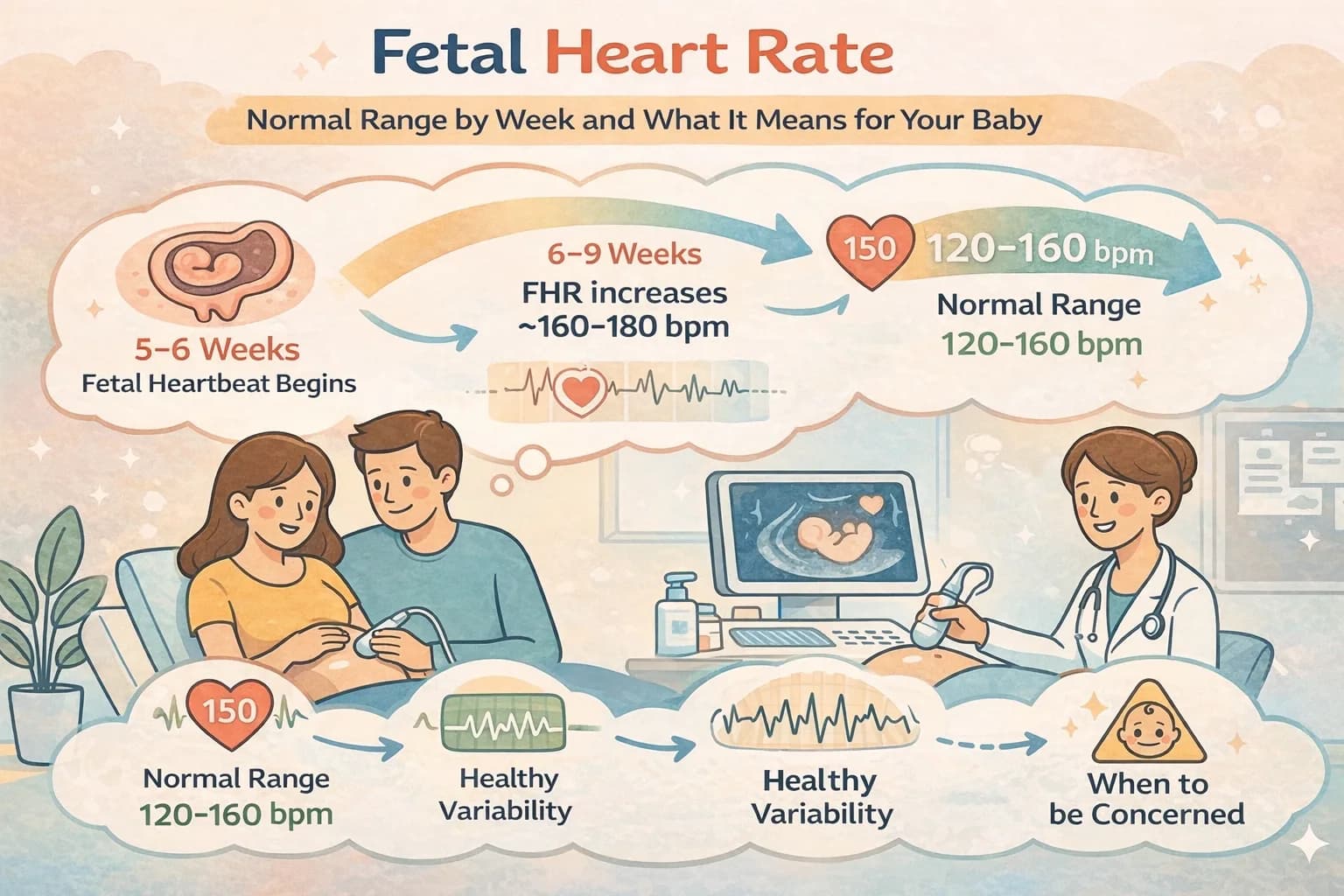
Fetal heart rate changes with gestational age.
- around 6 weeks, the heartbeat is usually slower because it has only recently become detectable
- by 8 to 10 weeks, it often reaches its fastest range
- in the second and third trimesters, it usually settles into a lower and steadier pattern
For many pregnancies, the commonly quoted later-pregnancy normal range is 110 to 160 beats per minute (bpm). Earlier than that, the expected number depends much more on the exact gestational week.
If you want to compare your reading with gestational age, our Fetal Heart Rate Calculator can help you interpret the number in context.
Why the Fetal Heart Rate Changes Across Pregnancy
The fetal heart does not behave like an adult heart. Early in pregnancy, the heart and nervous system are still developing, so the rate rises quickly as the conduction system matures. Later, the parasympathetic nervous system begins balancing the faster signals, and the average rate trends lower.
That is why:
- a number that is normal at 9 weeks may look too high at 34 weeks
- a number that is acceptable in late pregnancy may be too slow in a much earlier scan
- week matters as much as the bpm itself
This is also why one isolated heartbeat number should never be interpreted without knowing the dating of the pregnancy.
Fetal Heart Rate Normal Range by Week
These are practical reference ranges, not a diagnosis on their own.
| Gestational age | Typical fetal heart rate range |
|---|---|
| 6 weeks | about 100 to 115 bpm |
| 7 weeks | about 120 to 150 bpm |
| 8 weeks | about 145 to 170 bpm |
| 9 to 10 weeks | about 160 to 180 bpm |
| 11 to 13 weeks | about 150 to 170 bpm |
| 14 to 20 weeks | about 140 to 160 bpm |
| 21 to 30 weeks | about 130 to 160 bpm |
| 31 weeks to term | about 110 to 160 bpm |
The important pattern is easier to remember than the table:
- early pregnancy starts lower
- the rate peaks around 9 to 10 weeks
- then it gradually slows into the familiar later-pregnancy range
What Is Normal in Early Pregnancy
Early pregnancy heartbeat questions usually come from viability scans, where a clinician may be checking whether a heartbeat is present and whether it seems appropriate for the gestational age.
Around 6 weeks
At this stage, the heartbeat has only recently become visible. A lower number here does not mean the same thing it would later in pregnancy. Dating also matters a lot. If ovulation happened later than expected, a scan that looks like 6 weeks may actually be earlier than assumed.
Around 7 to 8 weeks
The heart rate usually climbs quickly during this period. This is why parents can be alarmed by a number in the 150s or 160s even though that may be completely expected for the week.
Around 9 to 10 weeks
This is often the peak. A fetal heart rate in the high 160s or even 170s can be normal here. A number that would sound fast later in pregnancy may be ordinary at this stage.
What Is Normal in the Second Trimester
By the second trimester, the heartbeat usually becomes less dramatic and more stable. Many readings fall somewhere in the 140 to 160 bpm range, though movement, timing, and technique still affect what you hear.
This is also when many parents start hearing the heartbeat more regularly at appointments with a Doppler.
A single number in the second trimester is usually interpreted alongside:
- fetal movement for that stage
- ultrasound growth
- anatomy scan findings
- maternal symptoms and overall pregnancy context
If you are also trying to make sense of growth scans, our guide to Understanding Fetal Growth Percentiles and Charts explains how those measurements are interpreted alongside other reassuring signs.
What Is Normal in the Third Trimester
In the third trimester, the widely used baseline range is often 110 to 160 bpm.
At this point, clinicians care not only about the number itself but also about the overall pattern:
- whether the baby is moving normally
- whether the rate rises with movement
- whether there are concerns about growth, fluid, or maternal blood pressure
- whether the tracing is reassuring if formal monitoring is done
A heartbeat of 120 bpm can be normal in late pregnancy. So can 150 bpm. The number alone is not the whole story.
Why One Reading Can Be Misleading
Parents often receive one number and try to decide immediately whether it is good or bad. But fetal heart rate can shift because of:
- gestational age
- whether the baby is active or resting
- recent movement
- scan timing
- maternal fever or illness
- the method used to record the heartbeat
That means one isolated number is most useful when it is read in context, not in isolation.
For example:
- a higher reading after movement can be expected
- a slightly lower resting reading can still be reassuring
- a number outside the expected range may prompt repeat checking rather than instant conclusions
Doppler, Ultrasound, and Formal Monitoring Are Not the Same Thing
Parents often hear the heartbeat in different ways across pregnancy.
Ultrasound
In early pregnancy, ultrasound is often the best way to confirm the heartbeat and match it to gestational age.
Handheld Doppler
Later in pregnancy, a handheld Doppler can quickly identify the fetal heart rate at a routine appointment. It gives a number, but it does not tell the whole clinical story.
Formal monitoring in later pregnancy or labor
If clinicians are concerned about fetal wellbeing, they may use more structured monitoring to look at the pattern over time rather than one bpm value. That is different from hearing a brief heartbeat at a standard office visit.
When a Fetal Heart Rate May Need Follow-Up
You should not try to diagnose yourself from the table alone, but some situations do warrant clinical follow-up.
Contact your clinician if:
- you were told the heart rate is outside the expected range for your gestational age
- a follow-up scan was recommended
- you have fever, illness, bleeding, or concerning symptoms
- fetal movement feels reduced later in pregnancy
- you have a high-risk pregnancy and were told to report changes promptly
In later pregnancy, reduced movement is often more important than a number you read online. If the baby's movement pattern changes noticeably, contact your maternity team even if the last recorded heartbeat sounded normal.
What Parents Often Worry About Most
"Is 170 bpm too high?"
It depends on the week. Around 9 to 10 weeks, that may be normal. In late pregnancy, a sustained rate that high would usually need clinical assessment.
"Is 120 bpm too low?"
In the third trimester, 120 bpm can still be normal. In much earlier pregnancy, interpretation depends on the exact week and whether the dating is certain.
"Can the heartbeat tell me the baby's sex?"
No. The idea that a faster heartbeat means a girl and a slower one means a boy is a myth. Heart rate varies with development, movement, and physiology, not fetal sex.
What Matters More Than Chasing One Number
The most helpful questions to ask after a heartbeat reading are:
- Is this normal for this gestational age?
- Do you want a repeat scan or repeat Doppler?
- Is anything else about the pregnancy concerning?
- Should I watch for changes in movement or symptoms?
Those questions are more useful than trying to declare a number "good" or "bad" without context.
If you are also trying to understand how pregnancy milestones line up with heart rate changes, our guide to Fetal Development Week by Week can help connect the number to the stage of pregnancy.
FAQ
Q: What is a normal fetal heart rate at 6 weeks?
A: Around 6 weeks, a fetal heart rate may be roughly 100 to 115 bpm. Dating accuracy matters a lot at this stage, so clinicians often interpret the number together with scan findings and repeat timing if needed.
Q: What is a normal fetal heart rate at 8 weeks?
A: At 8 weeks, many normal readings fall around 145 to 170 bpm. This is part of the normal early-pregnancy rise.
Q: What is a normal fetal heart rate at 10 weeks?
A: Around 10 weeks, fetal heart rate is often near its peak and may be in the 160 to 180 bpm range.
Q: What is the normal fetal heart rate later in pregnancy?
A: In the second and third trimesters, many clinicians use roughly 110 to 160 bpm as the common later-pregnancy range, though interpretation still depends on context.
Q: Is 158 bpm normal for a baby in the womb?
A: It often can be, depending on gestational age. Around early-to-mid pregnancy, 158 bpm may be completely normal. Context is essential.
Q: When should I worry about fetal heart rate?
A: Worry less about internet cutoffs and more about whether your own clinician has flagged the reading, whether movement has changed, and whether there are other symptoms such as bleeding, fever, pain, or high blood pressure concerns.
References and Further Reading
- ACOG: Special Tests for Monitoring Fetal Well-Being
- NHS: Your antenatal appointments
- PubMed: Reference ranges for fetal heart rate from 10 to 20 weeks of gestation
Medical Disclaimer
This article is for educational purposes only. It cannot interpret your scan, Doppler result, or fetal monitoring in the context of your exact gestational age, symptoms, pregnancy risks, or movement pattern. If you are worried about the baby's heartbeat, fetal movement, bleeding, fever, or any change in wellbeing, contact your healthcare professional promptly.
About the Author
Abhilasha Mishra is a health content writer focused on fertility, pregnancy, and practical patient education. Her work aims to make clinical information clearer for parents without replacing personalized medical advice.