
Early Signs of Labor Approaching: What Your Body Is Telling You
Early signs of labor approaching explained by an OB/GYN. From lightening to bloody show, know which signals mean your baby is coming soon — and when to call your doctor.
Try Related Tools
Use our source-informed calculators to get helpful insights.
Table of Contents
- What Happens in the Weeks Before Labor?
- Early Signs of Labor Approaching (Days to Weeks Before)
- Signs That Labor Is Imminent (Hours to Days Away)
- Other Pre-Labor Signs to Know
- When to Go to the Hospital: A Clear Guide
- When to Call Your Provider Before Going In
- Frequently Asked Questions (FAQ)
- References and Further Reading
What Happens in the Weeks Before Labor?
Labor does not arrive without warning. In the final two to four weeks of pregnancy, your body undergoes a remarkable sequence of preparatory changes collectively called prelabour or the latent phase. Cervical ripening, hormonal shifts, and the baby repositioning itself are all part of this orchestrated preparation.
As medical experts** explains: "Many women worry they will miss the signs or be caught off guard. In reality, the body prepares quite visibly. Understanding what each sign means removes fear and helps mothers respond appropriately — neither rushing to the hospital too early nor waiting dangerously long."
Early Signs of Labor Approaching (Days to Weeks Before)
These signs indicate that labor is on its way, but not necessarily imminent. They may appear days or even two to three weeks before active labor begins.
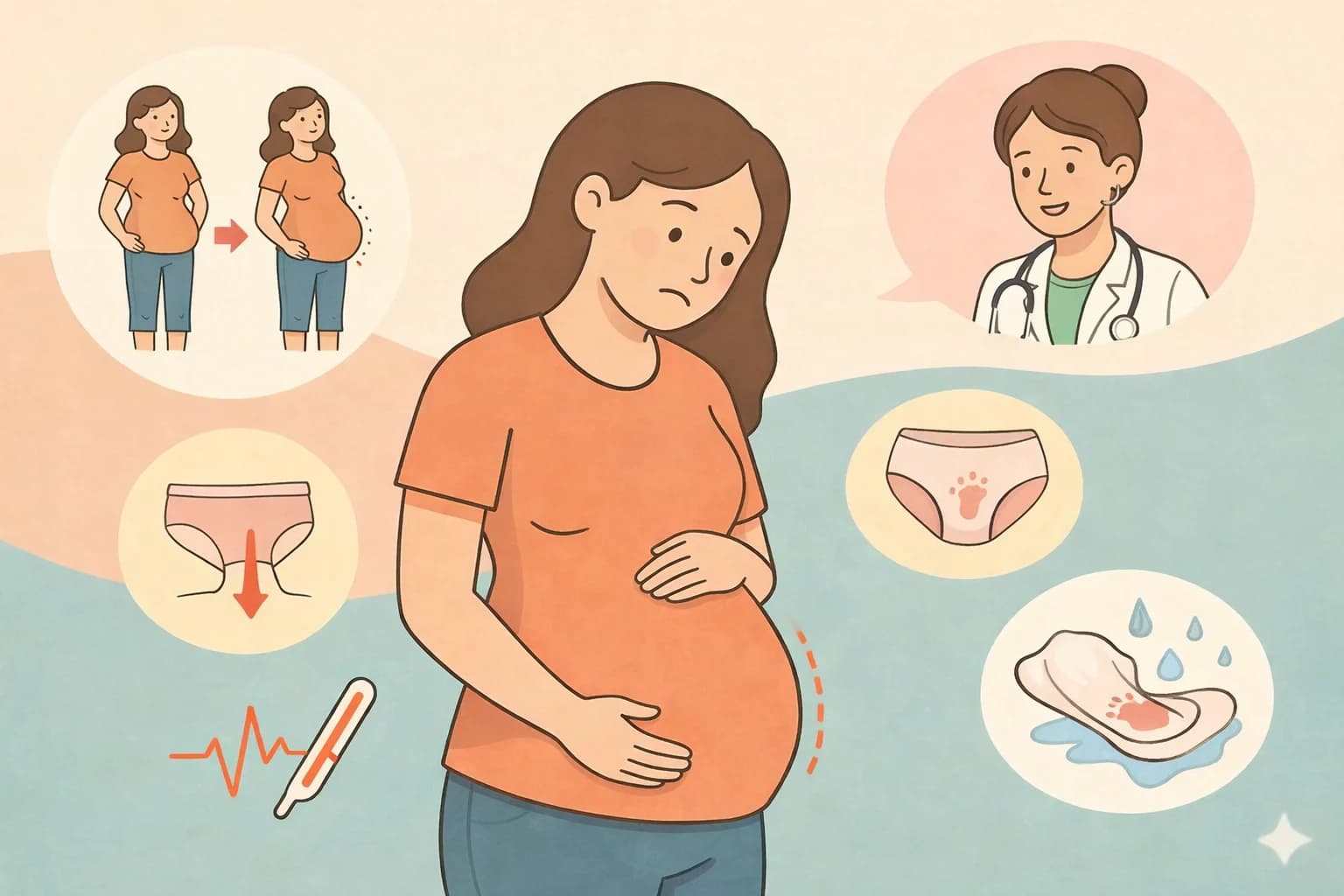
1. Lightening (The Baby "Drops")
Lightening occurs when your baby descends deeper into the pelvis in preparation for birth. You may notice your belly appears lower and more forward than before.
What you will feel:
- Easier breathing as the baby moves away from your diaphragm
- Increased pelvic pressure and discomfort
- More frequent urination as the baby presses on your bladder
- A waddling gait becomes more pronounced
When it happens: For first-time mothers, lightening can occur two to four weeks before labor. For women who have given birth before, it often does not happen until labor actually begins.
2. Cervical Changes (Effacement and Dilation)
Your cervix must thin (efface) and open (dilate) before the baby can pass through. Your doctor or midwife will check for these changes in your final prenatal visits.
- Effacement is measured in percentages. A cervix that is 50% effaced is halfway thinned.
- Dilation is measured in centimeters. Active labor begins at 6 cm.
You may not feel these changes at all, which is why prenatal checks are important. However, some women experience mild cramping or increased pelvic pressure during cervical changes.
3. Braxton Hicks Contractions Become More Frequent
Braxton Hicks — the practice contractions your uterus has been performing since mid-pregnancy — may become more frequent and slightly more noticeable as your due date approaches.
The key difference from real labor contractions:
- Braxton Hicks are irregular (no pattern)
- They do not intensify or become closer together over time
- They usually stop if you change position, walk, or drink water
- They are typically felt in the front of the abdomen only
4. Increased Vaginal Discharge
You may notice an increase in clear, pink, or slightly blood-tinged vaginal discharge. This happens as the cervix begins to soften and thin. This is normal.
When to be concerned: Contact your provider immediately if you experience heavy, bright red bleeding. Light spotting or pink-tinged discharge after a cervical exam or intercourse is generally normal at this stage.
Signs That Labor Is Imminent (Hours to Days Away)
These signs suggest labor will begin very soon — typically within 24 to 48 hours.
5. Losing the Mucus Plug
The mucus plug is a thick, gelatinous collection of cervical mucus that has sealed the uterus throughout pregnancy, protecting it from bacteria. As your cervix ripens and begins to dilate, this plug dislodges.
What it looks like:
- A glob of thick, jelly-like discharge
- Clear, pinkish, or streaked with brown or old blood
- It may come out all at once or gradually over several days
What it means: Losing the mucus plug signals that your cervix is changing and labor is approaching, but it does not pinpoint exactly when. Labor may follow within hours, or it may be another one to two weeks away.
6. Bloody Show
Bloody show is different from the mucus plug, though they can occur together. It refers specifically to a discharge tinged with fresh or old blood, caused by the rupture of small cervical blood vessels as the cervix dilates.
What it looks like: Pinkish, brownish, or lightly blood-streaked mucus. It is distinct from heavy bleeding.
"Bloody show is a strong indicator that cervical dilation is progressing," says medical experts**. "When a patient calls to report bloody show alongside mild, regular cramps, I take that very seriously as a sign that labor is likely within 24 to 48 hours."
7. Your Water Breaks (Rupture of Membranes)
When the amniotic sac ruptures, amniotic fluid leaks out. This is commonly described as your water breaking.
What it may feel like:
- A sudden gush of warm fluid (as movies depict)
- A slow, steady trickle that you cannot stop
- An unexpected wet sensation in your underwear
What to do immediately: Call your provider and head to the hospital or birthing center. Even if you have no contractions, ruptured membranes carry an infection risk. Most providers recommend delivery within 24 hours of rupture.
Note: Leaking urine is common in late pregnancy and can be confused with amniotic fluid. Amniotic fluid is typically odorless or has a slightly sweet smell. Urine has a distinct ammonia scent.
8. True Labor Contractions Begin
True labor contractions are the most definitive sign that labor has begun. Unlike Braxton Hicks, true contractions:
- Occur at regular intervals
- Gradually become stronger, longer, and closer together
- Are not relieved by changing position or drinking water
- Are often felt in the lower back and wrap around to the abdomen
- Progress systematically — this is the key feature
The 5-1-1 Rule: Most providers recommend heading to the hospital when contractions are 5 minutes apart, lasting 1 minute each, for at least 1 hour. (For second or subsequent pregnancies, the guidance may be 10-1-1 due to faster labor progression.)
Track Your Contractions in Real Time
When you feel contractions beginning, use our Contraction Timer to track frequency, duration, and intensity — so you know exactly when to head in.
Other Pre-Labor Signs to Know
9. Nesting Instinct
A sudden, powerful urge to clean, organize, and prepare your home is reported by many women in the days just before labor. This instinctive behavior, driven by a surge in nesting hormones, is considered a soft biological indicator.
It is not dangerous, but do not exhaust yourself. You will need your energy.
10. Loose Bowel Movements or Diarrhea
In the 24 to 48 hours before labor, the body naturally releases prostaglandins (hormone-like substances) that help soften the cervix. These same prostaglandins can stimulate the bowels, causing loose stools or diarrhea. Your body is effectively "clearing out" before birth.
11. Back Pain and Pelvic Pressure
Persistent low back pain, different from the general pregnancy backache you may have experienced for months, can signal labor. Pelvic pressure — a heavy, bearing-down sensation — accompanies cervical dilation.
Back labor: Some women experience labor contractions primarily as intense lower back pain. This often occurs when the baby is in the occiput posterior (OP) position, facing forward instead of toward the mother's spine.
12. A Sudden Burst of Energy (or Extreme Fatigue)
The day before labor begins, some women experience an unexpected wave of energy — the urge to clean, cook, and prepare intensifies dramatically. Others feel the opposite: a heavy, bone-deep exhaustion that signals the body is conserving energy for the work ahead. Both are reported as pre-labor phenomena.
When to Go to the Hospital: A Clear Guide
Not every sign requires an immediate trip to the hospital. Here is a practical framework:
| Situation | Action |
|---|---|
| Contractions 5-1-1 (5 min apart, 1 min long, 1 hour) | Head to hospital |
| Water breaks — any amount of fluid | Call provider immediately; go in |
| Heavy bright red bleeding | Emergency — go immediately |
| Baby's movements have decreased significantly | Call provider; go in to be assessed |
| Severe headache, vision changes, swelling in face/hands | Emergency — could indicate preeclampsia |
| Contractions irregular, mucus plug lost, no other symptoms | Call provider, monitor at home |
When to Call Your Provider Before Going In
Call (do not just text) your OB/GYN or midwife if:
- You are not sure whether your water has broken
- You have lost your mucus plug with bloody show
- Contractions have started but are not yet 5-1-1
- You have any question about your baby's movement patterns
Frequently Asked Questions (FAQ)
Q: How do I know if I am in real labor or just Braxton Hicks? A: Real labor contractions become progressively stronger, longer, and more frequent over time. They do not stop with rest, position changes, or hydration. Braxton Hicks are irregular, do not intensify over time, and usually resolve with activity changes.
Q: Can I lose my mucus plug weeks before labor? A: Yes. Losing the mucus plug is a sign that cervical changes are underway, but it can happen anywhere from one to three weeks before active labor begins. The mucus plug also partially regenerates, so losing it does not always mean birth is imminent.
Q: What does it mean if my water breaks but I have no contractions? A: This is called premature rupture of membranes (PROM) and requires immediate medical attention. Call your provider and head to the hospital. Labor will usually need to be induced within 24 hours to reduce infection risk.
Q: Is bloody show normal and when should I worry about bleeding? A: Light, pinkish, or brownish-streaked mucus (bloody show) is normal. Heavy, bright red bleeding like a period is not normal and requires immediate emergency evaluation.
Q: I am 37 weeks and have had several signs of labor. Should I go in? A: At 37 weeks you are considered early term. Contact your healthcare provider and describe your symptoms. Unless your water has broken or contractions are regular and intensifying, most providers will advise monitoring at home and coming in when the 5-1-1 rule is met.
Q: What is back labor and how is it different? A: Back labor occurs when the baby is in an occiput posterior position (facing your abdomen instead of your spine). Contractions are felt primarily as intense, persistent low back pain rather than abdominal cramping. It is more intense but manageable with positioning techniques.
Q: Can I eat when I think I am in early labor? A: Eating a light meal in early labor is generally acceptable if your hospital or provider permits it. Avoid heavy meals. Once active labor is established, most hospitals restrict oral intake in case an emergency cesarean is needed.
Q: How long does the latent phase of labor last? A: The latent phase (early labor, 0-6 cm dilation) varies widely. For first-time mothers it can last anywhere from 6 to 20 hours, and sometimes longer. For subsequent births, it is typically shorter.
References and Further Reading
-
American College of Obstetricians and Gynecologists (ACOG) — Labor and Delivery:
https://www.acog.org/womens-health/faqs/how-to-tell-when-labor-begins -
NHS — Signs That Labour Has Begun:
https://www.nhs.uk/pregnancy/labour-and-birth/signs-of-labour/signs-that-labour-has-begun/ -
Mayo Clinic — Signs of Labor:
https://www.mayoclinic.org/healthy-lifestyle/labor-and-delivery/in-depth/signs-of-labor/art-20046184 -
World Health Organization — Intrapartum Care for a positive childbirth experience:
https://www.who.int/publications/i/item/9789241550215
Medical Disclaimer
This article is for informational purposes only and does not replace professional medical advice, diagnosis, or treatment. Every pregnancy is unique. Always consult your obstetrician, midwife, or qualified healthcare provider about symptoms, concerns, or questions related to your individual pregnancy and labor.
About the Author
Abhilasha Mishra is a health and wellness writer specializing in women's health, pregnancy, and maternal care. Her work is grounded in evidence-based medicine and written to empower expecting mothers with the knowledge and confidence they need at every stage of their journey.